Q&A: How Challenger Lifts is investing in U.S. manufacturing
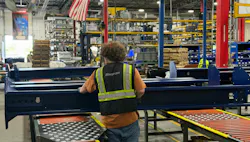
During a recent tour of Challenger Lifts' manufacturing facility in Louisville, Kentucky, PTEN spoke with Challenger Lifts National Sales Manager Trevor Coleman about how the facility and company have evolved.
Coleman has been with Challenger Lifts for 26 years, including 13 years under Snap-on, which acquired the company in 2013. He discussed the investment that has taken place since the acquisition, including increased automation, employee training, expanded manufacturing capabilities, and the company's efforts to produce more of its products in-house.
Q: When was the current Challenger Lifts facility built, and where was the company located previously?
A: "This factory was built around 2017. Previously, we started on Main Street and Cable Street. There were two different locations in Louisville over time. They started out on Main Street in the '70s, moved to Cable Street in the '80s, and then moved out here."
Q: Snap-on acquired Challenger Lifts in 2013, so the move to this facility came after the acquisition. How much has changed since then?
A: "It's a state-of-the-art facility now, and those investments help us deliver the quality, consistency, and support our customers expect."
Q: We saw quite a bit of automation during the tour. When did Challenger begin bringing more of that technology into the manufacturing process?
A: "It started just prior to the COVID era. We began automating more of the heavier and repetitive activities while continuing to invest in the skilled people who build our products.
We didn't abandon our skilled labor force for automation. We use our associates to handle the skilled work, and the automation handles the tedious labor. We still want to keep that human skill set because it’s an important part of delivering the quality our customers expect.”
Q: How has adding automation affected the workforce here?
A: "We've upskilled the current associates we have and hired even more skilled labor.
"We took people who were already here and weren't familiar with the technology and trained them. We wanted to develop the people we already had and help them build new skills. We sent them for training so they could use the newer technology. We elevated the people we had first instead of just looking for people from the outside who already had those skills.
Now, those people are training the newer associates."
Q: About how many people currently work at the Louisville facility?
A: "Around 170 here in Louisville."
Q: And that's actually more people than before the facility added much of its automation?
A: "Almost double."
Q: How many different lifts are manufactured here?
A: "There are at least 15 series of lifts, but if you went by individual models, it would be in the hundreds because there are different versions of all those series.
Everything lift we build can come in different colors and different configurations. There might be 15 series of lifts we build here, but that could mean 500 or 600 models or more."
Q: We also heard during the tour about the push to manufacture more components in the U.S. Why is that important to Challenger and Snap-on?
A: "I think Snap-on has always been a 'build where you sell' company. I think everybody's goal today is to build more here.
We want to build as much as we possibly can and have the most control over our own destiny.
We've always had to buy certain things from other places, and now we have the ability to build things that we used to buy. This has been one of our goals and we have been very successful of bringing more in house.
As you could see during the tour, we're making space, and that space is going to be for more manufacturing. We're going to continue building as much here as we can and continue expanding our manufacturing capabilities."
Q: How large is the manufacturing operation?
A: "This facility is about 140,000 sq. ft., and the additional warehousing is another 200,000 sq. ft.
We work to inventory what we need, build lifts every day and keep lead times as short a possible for our customers."
Q: You've been with Challenger for 26 years and have seen the company both before and after the Snap-on acquisition. What do you think people in the industry may not understand about Challenger today?
A: "I think one of the things people in the industry have a misconception about is that Challenger is still a small, privately held company in Louisville, because we were. But we've grown up, and Snap-on is the direct reason why we did.
The investment Snap-on has made in this facility has been transformational for us, and that’s coming from somebody who’s been here for almost all of it. Snap-on's investment has allowed us to grow our people, capabilities, and manufacturing footprint in ways we couldn't have before.
What people may not realize is just how much manufacturing happens here in Louisville. We're not importing a bunch of components from other places and putting them together here. We buy the raw material, we cut it, we bend it, we weld it, we paint it, we pack it, and we ship it.
What we have today is not what some people may envision based on Challenger of the past. It's a totally different place. We're doing it with technology, we're doing it with people, and we're doing it with the care. Building product customers want that are the best products in the market.
And when it gets to the end user, there's a support staff here to support it after the sale."
Q: Can you talk more about that support and what a shop gets after purchasing a Challenger lift?
A: "When you buy a Challenger lift, it comes with a manufacturer's warranty. We hope we never have to use it, but they're pieces of machinery. People use them, and things are going to happen.
That support comes from right here in Louisville, and we have different levels of support we offer customer. We have our standard product support offered through our service department, which takes care of parts orders, warranties, and technical staff, who help people diagnose things.
We take it another step with what we call managed care. If you're a multi-store group, we can manage your lift inspections, service, dispatching, and invoicing. We handle many customers that own hundreds or even thousands of locations.
We can take care of our customers throughout the ownership of our product, and I think that's one thing we do better than anybody."
About the Author
 Nadine Atiya
Nadine Atiya
Editor-in-Chief
Nadine Atiya is the editor-in-chief of Professional Tool & Equipment News (PTEN) and Professional Distributor magazines. She has been covering the automotive aftermarket since 2021, after graduating from Kent State University with a bachelor's degree in journalism and marketing.
Don't miss Atiya's next article. Sign up for PTEN or Professional Distributor's weekly newsletter.