Tool Review: OTC Motorcycle Lift
Content brought to you by PTEN. To subscribe, click here.
Q: How did the tool/equipment function as far as saving you time?
A: Outstandingly. The foot pedal raises and lowers the lift quickly and responsively, with none of the lag you get from a hand pump. The safety latch retainer is intuitive to engage and release, which cuts real time off every lowering cycle.
Q: How has using this tool impacted your shop's profitability?
A: In a shop setting, this lift would be essential for flat-rate motorcycle work where bay turnaround time is crucial. Every minute saved getting a bike up, serviced, and back down means more bikes through the bay per day. Anything that speeds up turnaround time is pure profit.
Q: What kind of setup was involved before using the product?
A: Very little. It took about 15 minutes to unpack and assemble, start to finish. The instructions were easy to follow, and the assembly itself is intuitive enough that you could put it together without them. Full assembly takes only three cotter pins and five bolts.
Q: How easy was it to use?
A: Incredibly easy. One pedal raises the lift, one pedal lowers it. The safety lock clips into place automatically during lowering, so you can focus on the bike instead of the lift. The included straps keep the bike secure and going nowhere while you work.
Q: How was its packaging? Did it come with any accessories?
A: The only included accessory was the safety straps. Packaging was secure and efficient, using heavy cardboard instead of foam inserts.
Q: Was there a manual included? If so, did you use the manual, and was the manual easy to understand?
A: Yes. I referred to it a few times during setup, and it was clear and easy to understand, covering everything needed for assembly, operation, and safety.
Q: What features did you like?
A: The foot control keeps both hands free to stabilize the bike when needed. The safety latch retainer is a convenient touch. The rubber pads on the lifting points protect the paint on whatever you're lifting.
Q: Is there any way you could think to improve or add to this tool?
A: The safety latch only makes contact on the left side. Even under the full weight of the bike, only one side of the latch engages. The latch mechanism doesn't appear to be bent, so the issue seems related to the spring on that side. I'd separate the two safety latches from each other and add another retainer on the frame.
Q: What types of jobs/repairs did you use this tool for?
A: Oil service on two bikes: one sport bike and one cruiser.
Q: How does this tool compare to other tools you've used like it?
A: Most similar lifts I've used or seen rely on a hand pump and a twist-knob release. Foot controls, combined with a removable handle for adjusting height, make this lift far more efficient to work with and keep you working obstruction-free compared to similar lifts.
Q: Is there anything you had questions or concerns about in regard to the tool?
A: Just the safety latches. I asked around, and it sounds like this isn't isolated to this particular unit.
Q: On a scale of 1 to 10, how would you rate this tool overall? Why?
A: Nine, if the safety latches get addressed. Even as is, it's still a very useful lift and works great for quick jobs.
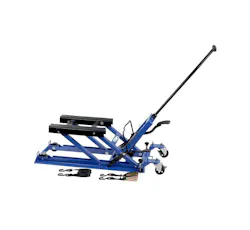
The OTC Motorcycle Lift, No. 1545A, is designed to raise and support motorcycles weighing up to 1,500 lbs. Its dual 17-inch rubber-coated skids accommodate large cruisers, while a 3-1/2-inch minimum height provides low-clearance access and a maximum lift height of 16-3/4 inches. A foot-pedal pump raises the lift, while the automatic safety lever locks it into position during lifting. The removable handle provides access around the motorcycle for service. Two fixed and two rotating locking casters allow the stand to be repositioned and secured. Spring-loaded leveling screws help stabilize motorcycles on uneven surfaces. Four tie-down points and two included ratcheting straps secure motorcycles during service. The lift is covered by OTC's limited lifetime warranty.
About the Author
 Noah Nelson
Noah Nelson
Technical Editor | Motor Age
Noah Nelson is the Technical Editor for Motor Age Magazine. As an ASE Master Certified Automotive Technician (A1–A9) with 25 years of hands-on industry experience, Noah specializes in advanced electrical systems, vehicle communication networks, and physics-based diagnostic workflows. He is currently documenting his pursuit of the prestigious ASE/AutoCare Association World Class Technician registry.