What I wish I had known when I started working on diagnostics
Key Highlights
- Use an unbiased, evidence-led process instead of treating trouble codes as instructions to replace parts.
- Verify circuit power, ground, wiring, and control before condemning a component.
- Record scan-tool data during road tests and review it afterward to diagnose problems safely and in context.
- Learn to use a lab scope to see electrical signals that a meter may not clearly explain.
- Consider what information a vehicle computer has—and why it might make a particular decision.
First, a bit of background about myself and why I think I may have a useful perspective on the diagnostic process.
I started in automotive service at the tender age of 13, having known since I was about 10 that I wanted to be an auto mechanic, as the profession was called in 1968. This was in spite of considerable discouragement from my elders, including my father, who wanted me to become some kind of scientist, like himself.
I spent the first four years of my career taking things apart, which is what you do when you work for an auto dismantler, otherwise commonly known as a junkyard. I got a good taste of the need for diagnostics there. Customers who bought parts based on guesses about what was wrong with their vehicles had a distinct tendency to want to return them when their guesses turned out to be incorrect, and the parts failed to solve their problems. The “All Sales Final” sign was supposed to solve that problem, but naturally, customers would claim that the replacement part was defective. Sound familiar?
I finally received some good instruction in high school auto shop, followed by two years in a community college automotive program. I began to realize that, despite four years at a dismantler and one year as an apprentice at a Chrysler dealership, I knew virtually nothing.
My electrical class at community college was a good start. I began to understand some of the fundamentals of electricity and how to read wiring diagrams. That was in 1977, and all my experience up to that point had involved no-start problems with points-and-condenser ignition systems. I was terrified that electronic ignition was going to leave me behind. I realized pretty quickly that I didn't understand points-and-condenser ignition as well as I thought I did, either.
In 1980, as I began to see electronic carburetors added to the mix and electronic ignition and fuel injection appearing on Asian cars, I realized I needed additional training. Those opportunities were scarce in those days, and I found myself driving 95 miles after work toward Los Angeles to get whatever training I could.
It was absolutely worth the sacrifice. My advice to young technicians is simple: Don't pass up training opportunities, particularly if you're still single and don't have family responsibilities. The time will come when it will be much more difficult to justify sacrificing family time for training.
Fast-forward to 1988, when an instructor at the local community college asked me to develop a training program in computerized engine control. He specialized in suspension and brakes and knew I had plunged headfirst into learning the electronics side of the business.
When I began teaching, I once again faced the realization that I still knew almost nothing. One of my very bright students tested a thermistor circuit, in this case a coolant temperature sensor, and called me over to the vehicle to show me that it didn't work the way I had said it did.
At the time, I was taking a Ford training course, so I asked the instructor to explain the circuit in a way that would help me teach it clearly to my students. It didn't take long to realize that he didn't understand it, either. That wasn't much help, but the experience made me realize that I needed to dig seriously into the fundamentals of Ohm's law and truly understand the voltage-divider circuit.
After all, it's just two wires, and one of them is connected to ground through the module. How hard could it be?
If you're reading this and thinking, “Well, I still find it hard,” let me tell you that you need to figure it out and understand it thoroughly. Once you do, you'll already have a great deal of the fundamentals of electrical behavior under your belt.
Recently, I participated as a judge in a SkillsUSA competition. The participants were enthusiastic young aspiring technicians, both male and female, and my station covered basic electrical skills. Students were asked to wire a set of “headlamps” on a ConsuLab practice board and make them switchable through a relay.
I had ten spare fuses and used every one of them during the day. I even had to ask permission to stop a student when I saw that they were about to create a direct short and blow yet another fuse.
That was when I realized how much was missing from some high school programs when it came to teaching the fundamentals of circuits and the principles of voltage, current, and resistance.
Looking back, I wonder how well I could have performed those tasks fresh out of high school auto shop. I knew how to rebuild an engine and had a pretty good understanding of what I was doing and why. Today, however, that skill set is becoming less common as much of that work has moved into factory-type settings.
But I don't think I had a solid understanding of basic electricity, and I wish I had learned it much earlier.
Now, with more than 50 years of troubleshooting behind me and 38 years of teaching automotive technology, I think I have a few things worth sharing with the current generation of up-and-coming technicians.
Don't use parts to diagnose problems
First, let's return to the lesson I learned from that “All Sales Final” sign during my years at the dismantler. In a certain sense, I think our industry would be better off if every parts supplier adopted the policy commonly found in dealership parts departments: “No returns on electrical parts.”
How many of you have opened a box from a parts store and found that either (A) the part had obviously already been installed or (B) the part was used?
Because of the competitive nature of automotive parts sales, suppliers have generally accepted returns with relatively few questions asked. I'd suggest that the entire industry suffers as a result when technicians use parts as diagnostic tools.
Based on my experience, I'd like to offer some advice to beginning technicians, illustrated with a few practical examples.
Let's start with a simple, common trouble code: P0135, whose SAE definition is “O2 Sensor Heater Circuit Malfunction (Bank 1 Sensor 1).” First, we’ll consider what the code means and the thought process I wish I had developed much earlier in my career. Fortunately, teaching helped me develop it.
What possibilities, besides the sensor itself, could cause this code?
Before answering that question, I'd like to borrow a quote from automotivetechinfo.com:
“Approaching automotive diagnostics from an agnostic viewpoint allows a technician to gather evidence without bias toward a specific answer.”
I asked ChatGPT to define ‘agnostic’ as used in that sentence. Here's the definition it gave me:
“Agnostic: In automotive diagnostics, an approach that does not presume a particular cause or diagnosis before the evidence has been gathered and evaluated. It allows the technician to follow the evidence wherever it leads, rather than favoring a preconceived answer.”
Many incorrectly replaced parts could have been avoided if that concept had been firmly implanted in my mind early in my career. I'd like to implant it in yours right now.
Let's apply the concept to our P0135 code. You may already know that, in many cases, the code results from a failed oxygen sensor. So why not just read the code and recommend replacing the sensor?
Because every time you do that and the repair succeeds, you reinforce the habit of favoring a preconceived answer. It's fast and easy, but remember that the guy at the parts store with a code reader can do the same thing, and he charges nothing for it.
If I understand that P0135 could also be caused by a lack of power to the heater circuit, a blown fuse, a wire damaged by a rodent or some other cause, a faulty ground or ground connection, or even a failed driver in the PCM, I can begin to develop an agnostic approach.
How long does it take to verify power and ground at the heater circuit before condemning the sensor? With the proper back-probing or piercing equipment, perhaps ten minutes.
After eliminating the other possibilities, I can confidently tell the service writer, “I have a P0135 code. I've verified the heater circuit's power supply and ground-side control, and the circuit checks out except for the sensor itself. The sensor is the likely failure.”
Or perhaps I'll say, “I've verified that there's no power reaching the heater circuit. On this model, the power supply comes from the PCM. I need additional diagnostic time to access the PCM and determine whether its driver has failed.” The exact test procedure will depend on the vehicle's wiring diagram and circuit design, but the principle remains the same: Test before you replace.
If you develop this habit, a couple of things will happen. First, your service management personnel will quickly realize that you're not a “diagnostic-dice” technician or a “most common fixes” technician. You won't simply roll the dice, look up the most common repair, and replace the part without confirming that it's faulty.
Capture data instead of watching the scan tool
Another habit I developed only about 15 years ago, and one I wish I'd learned much earlier, is driving the problem vehicle and recording scan-tool data.
I used to drive the vehicle while trying to watch the data at the same time. That was far more dangerous than using a cell phone while driving. I had several close calls, but fortunately, no collisions.
Here's what I learned to do instead:
First, consider the trouble code or customer complaint using the agnostic approach. Ask yourself: What inputs or outputs might the computer be monitoring that would help me understand the problem?
Once I answer that question, I have a better idea of which PIDs to select for recording during the road test.
I then drive the vehicle under conditions most likely to reproduce the complaint, if one exists, and record the data. Back at the shop, I upload the recording to a program such as ScanShare or Snap-on ShopStream Connect.
Without the distractions of driving, I can study the data in context. That context includes engine temperature, vehicle load, vehicle speed, throttle position, and whatever other parameters are relevant to the problem.
I've solved many difficult problems using this approach. It's safer and far more effective than trying to watch the scan tool while driving, or even trying to interpret the data while someone else drives.
Learn to use a lab scope
One tool that helped me understand electricity better is the lab scope. In my experience helping technicians diagnose problems in their own shops, I've found that many are intimidated by the tool because of its learning curve.
As a visual learner who recognizes that working with numbers isn't my strongest skill, I find the waveforms displayed by a scope much more useful than a meter for many diagnostic tasks.
Here I'll pat myself on the back rather than say this is something I wish I'd known when I started. When I began my career, there were only analog scopes, which were more complex and harder to use. I bought my first digital scope in 1992 for $3,000.
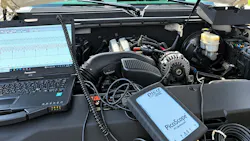
Today, there's a good chance you already have access to one but haven't used it because you're intimidated by the learning curve. Some tools, like Snap-on’s scanners, have Guided Component Diagnostics built in to help you overcome the learning curve. If you don’t have one, you’ll find that a non-automotive Pico model 2204a two-channel PC-based scope is available for less than $200, or a handheld, color, single-channel AESwave uScope can be had for very little money as well.
Here's a question to consider: If you were measuring the signal wire of a 5V, Hall-effect crankshaft position sensor with a 5V pull-up and a 50 percent duty cycle during engine cranking, what would your voltmeter read?
If you don't know the answer, wouldn't it make more sense to look at the signal with a scope, where you can actually see what's happening?
With an agnostic approach, you can't simply replace the sensor and hope the problem goes away. Resist that temptation. In the long run, you'll be glad you learned to read a scope. It will teach you something every time you use it.
Put yourself in the “shoes” of the computer
I'll give one more example of the agnostic approach. Alternatively, we could call it ‘differential diagnosis.’
Here's a real example from a 2021 Ford F-550. The A/C compressor wouldn't engage, and I had confirmed there was no power to the compressor clutch. I checked all the modules for codes and found none relevant to the problem. Using my scan tool's bidirectional controls, I was able to command the clutch to engage.
Now what?
This is where I try to put myself in the computer's shoes, so to speak. What reason might the module or modules responsible for engaging the compressor have for refusing to do so?
Since there were no relevant trouble codes, I had to consider that whatever information the modules were missing might not be something they recognized as a fault. If the information appeared plausible to the module, it might not set a code at all.
What about ambient temperature? What about evaporator temperature? Perhaps the sensor's data wasn't displayed by my scan tool, or the sensor reported to a different module than the one I expected.
Taking a few minutes to think through the possibilities led me to an ambient temperature sensor that had originally been located in the passenger-side mirror. The mirror had been replaced with a cheaper aftermarket unit that didn't include the sensor.
There were no trouble codes because the missing sensor wasn't necessarily something the system would identify as a fault. And from the computer's perspective, if it believed the outside temperature was minus 40 degrees, why would it allow the A/C compressor to engage?
This is a good example of why we need to understand not only what a system is doing, but also why the computer might be making the decision it is making. Rather than simply looking for a failed part, try to put yourself in the computer's shoes. What does it know? What does it believe? And, based on that information, what would you expect it to do?
Your strongest diagnostic tool is your ability to think
Your ability to think is your strongest diagnostic tool. If you're willing to develop your thinking skills from the beginning, your on-the-job education will continue throughout your career.
By all means, get every bit of training you can. Some of my training in differential diagnosis came from a microbiology course I took in college while working toward my degree in vocational education. What I learned about diagnosis in that course helped shape my thought processes and made me a better diagnostic technician.
Don't settle for the “have code, replace part” mentality. In the short term, it might earn you more money, particularly if you're paid flat-rate. In the long run, however, it will paralyze your progress and prevent you from developing the diagnostic skills that distinguish a good technician from a parts replacer.
About the Author
 Phil Fournier
Phil Fournier has been the owner/technician at Phil’s Auto Clinic for 32 years and a working auto technician for 45 years. Fournier received his ASE Master Certification in 1982 and his AAM from the Automotive Management Institute in 1994. Currently, he works as a consultant doing diagnosis, reprogramming, and virtual instruction. Fournier currently holds 17 ASE certifications including ASE Master Auto and Master truck plus L1, L2, and L3.