A case of penny-wise & dollar-foolish
There are times we all encounter that one vehicle that simply drives us nuts. Failure to gain a sense of direction can force us out of our comfort zone as well as our normal diagnostic approach. But sometimes it's necessary to travel the uncharted path.
We were familiar with the customer's vehicle being a simple cargo van, so we knew this wasn't a complex vehicle to deal with. So, this should be a quick in-and-out diagnosis, or so we thought. In the end, we put 60 miles on the customer's vehicle, fixed the problem, and scheduled his next vehicle for a service appointment (FIG1).
When the customer first called us on this vehicle, we viewed it as a chance to gain a new customer. We get many referrals on electrical and drivability concerns because of our reputation. We take pride in fixing these vehicles and always look at them as potential long-term customers.
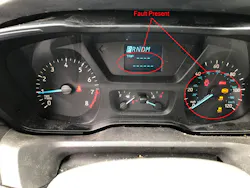
In this case, it was the business owner (not the driver) who brought the vehicle in. He only knew that the warning indicators would come on every time the vehicle was driven. Specifically, the red brake warning lamp, ABS lamp, traction control light and traction control off lamps lit up when driving. No other specific information was given at the time. We did place a call to the driver, but he had little information to aid in duplicating the problem, just that every time he drove it, the lights would come on.
Flushing the fault to the surface
I am a big believer in making sure you can duplicate the customer's concern. If you can't, you have nothing to test for. If I can't duplicate the problem, I will ask for the customer to give me as much information as possible for the conditions in which the problem occurs. I will ask them to go for a test drive with me to try to duplicate the problem. We have all had that customer who doesn't believe us when we tell them the vehicle isn't acting up. The solution is simple; take them for a ride! There are two possible outcomes:
1) The customer will duplicate the problem for you
2) The customer will see the vehicle isn’t acting up and realize you are not trying to ignore their problem
If the problem is not duplicated send the customer out till the problem becomes more frequent or until they know the conditions to duplicate the problem. On this Transit, it happened every time it was driven, although sometimes it would take longer than others.
My technician, Jason Oltmann (one of the best diagnostic technicians I have worked with), was tasked with this vehicle. I had every bit of confidence he would knock this one right out of the park. He was leaving for vacation in two days, and I never thought that would be a factor on this one. But in the end, both of us worked together to get this one fixed.
He was given this vehicle to look at and began with a test drive, as usual. It did take a longer test drive than normal to finally duplicate the problem. He initially only noticed that the indicator lights would come on and stay on. He then began gathering the codes, checking TSBs, and Identifix. The trouble codes indicated no clear direction. He went back out on several test drives to try and find what the specific trigger was for the problem to happen. As the test drives continued, he found he could duplicate the concern only on left-hand turns.
Code Scan: Relatively simple vehicle, only has 8 modules.
There are only a total of 6 codes in the vehicle:
ABS Module U0100:00-08 Lost comm with the ECM
U0100:87-48 Lost comm with the ECM
U0100:00-08 Lost comm with the TCM
U0100:87.08 Lost comm with the TCM
U0126:00-08 Lost comm with the steering angle sensor
BCM U0001:00-08 High Speed CAN comm bus
Code Descriptions:
ABS U0100:00 Lost communication with ECM/PCM ‘A’
Sets when the ABS module does not receive any messages from the PCM
ABS U0100:87 Lost communication with ECM/PCM ‘A’: Missing message
Sets when the ABS module any of the following messages are missing, accelerator
pedal position, brake on-off switch, cruise control status, or engine RPM
ABS U0126:00 Lost communication with the steering angle sensor module
Sets when the ABS module does not receive any messages from the SASM
BCM U0001:00 High-Speed CAN Communication Bus
An HS-CAN fault was present at a point in time. The fault is not currently present
since the module is communicating with the diagnostic scan tool.
Possible Causes:
ABS U100:00-08 (Applies for both the ECM & TCM)
Possible causes: Network communication concern
Stop lamp switch
PCM
ABS Module
ABS U0126:00 Possible causes: Network communication concern
Stop lamp switch
PCM
ABS Module
BCM U0001:00 Possible causes: Network communication concern
The problem always lasted just a split second. But once the lights came on, the ignition had to be cycled to turn the lights out. As we gathered more information, we were finally able to make the problem last longer than just a split second. We would lose the tachometer, speedometer, odometer, and trip odometer when this would happen. Yet we had no codes for the instrument cluster. He also found that the vehicle would continue to run and would not lose power to the engine. We were making progress, back to the drawing board to look at the symptoms, trouble codes, and wiring diagrams.
Developing a gameplan
Jason was diligently working on this vehicle to gather as much information as possible. He and I would then bounce theories off each other to formulate a test plan. I will not begin just testing a vehicle at random. If you are testing a vehicle without having a clear idea of what is wrong with the vehicle, you are wasting your time. When you test a vehicle, you are testing to confirm the problem you suspect. We knew from the trouble codes that we should be looking at the network, PCM, and ABS module, but what about the instrument cluster? The lights on the instrument cluster could be explained by the ABS module. The speedometer could be explained also by the ABS module. But, what about the tachometer, trip indicator, and odometer? Also, why only left-hand turns?
Jason placed the van on his lift, and we began to do a simple wiggle test of the engine bay wire harnesses. The symptom was not present. All the harnesses were routed properly and in their proper retaining clips, and a visual inspection also not indicate any type of damage to the harness. Again, where do we begin to test when we can’t duplicate the problem consistently or for more than a few seconds?
Let's look at the network from a logical standpoint. The ABS module was the one reporting lost communication codes with the other modules, but the other modules were not reporting lost communication codes with the ABS module. The body control module was reporting high-speed CAN message codes. Looking at the network topology, we could see that the only modules on this vehicle on the High-Speed CAN bus were the BCM, PCM, ABS, Parking Assist module, and the Restraint control module. Why were there no communication codes from the other modules? Again, no direction. We checked the wiring diagrams for common grounds and power supplies, and none were found. We checked the easily accessible grounds, and they were all good. We simply could not gain any direction.
By this point, Jason and I were both getting frustrated. Both of us are very good diagnostic technicians, and our pride was being seriously challenged. We had spent the afternoon in a parking lot driving in circles for 6 miles. We had the scanner with us scanning modules, looking at live data, but again, we couldn't get the problem to happen consistently, or for more than 20 or 30 seconds to gather enough data for a theory as to the problem.
At this point, with one last test drive with the scanner, both of our stomachs were in our throats from driving in circles. Jason began to get the problem to occur more frequently, and I was able to find out that the ABS module and BCM would go offline when the problem occurred. Some direction, but still not enough.
With the countdown to vacation, I knew Jason wanted to finish this job and have a fix for peace of mind. The push was on! I also knew in the back of my mind we should have been on the problematic system within an hour of starting to work on this vehicle to begin pinpoint testing. We weren't even close.
Jason began the day knowing we had a problem with the ABS module going offline when the problem occurred. He started testing the ABS fuses for loss of power (when he could duplicate the problem); no problems were found. I even went as far as to place an amp clamp at the ABS module fuses. Nothing at all was found. I was getting very frustrated with myself by this point. I had begun doing what you shouldn’t do, test without direction.
As the day continued, we took the van for a ride. And after 10 minutes, we got it to act up. Back to the bay we went. We had been very careful to take note of what was and wasn’t working and also the specific lights that were on. Jason and I were both stumped; we still did not know if it was a power, ground, module, or network communication issue we should be chasing.
I had Jason pull the ABS module’s electrical connector for a visual inspection, and no visual problems were found. When the connector was apart, Jason had tightened the terminals (just out of habit) and we continued on with another test drive. FINALLY, some direction! The problem could no longer be duplicated on left-hand turns, no matter what we did. Time for a different approach, we headed to a local parking lot that had a few crater-sized potholes, and we began hitting them. We knew we had changed something, but the problem was still there.
Third time is the charm
It was now 4:45 Friday afternoon and we decided we needed to come at this problem from a repeatable (but different) angle. We took what I deemed a time-consuming approach and started pulling fuses until we duplicated the problem. We pulled fuse #2, and we got the lights to come on after four seconds. But when we hit the bumps, the problem was immediate. Pulled Fuse #13… GOTCHA! We pulled the fuse and the exact symptoms happened immediately!
Fuse #13 is listed as powering the ABS module valves (HUH?) How would the power to the ABS control valves affect the network, the odometer, the tachometer? We called it a day (defeated, frustrated, and mentally exhausted). It was time for Jason to leave for vacation.
Monday 9 a.m., I grab one of my other technicians, Austin Gehman, to go pull the ABS module connector and check the terminal tightness with the proper terminals. WE GOT IT! The terminal was loose enough to lose connection from time to time. The terminal was tightened and another test drive in the parking lot of craters and FIXED!
How and Why!
Why did the warning indicator lights come on?
The ABS module was losing power on fuse #13. Examining the fuses for the ABS module:
Fuse # 22: 40 Amp Hot at all times Goes to the brake vacuum pump
Fuse # 17: 40 Amp Hot at all times Goes to the ABS Pump Motor
Fuse # 13: 25 Amp Hot at all times Goes to the ABS module
Fuse # 2: 4 Amp Switched Goes to the Traction control switch & VPWR for the ABS module
We can rule out Fuse #22 (that is the vac pump only), fuse #17 (for the ABS pump motor)
Fuse #2 (the power to wake up the module), and finally, fuse #13 is for the ABS valves and computer.
4 Amps is most likely not enough to power the computer by itself.
Why did the tachometer, speedometer, odometer, and trip stop?
The ABS module relays the information from the PCM to the BCM. The BCM then sends the information to the instrument cluster on a low-speed CAN network. I believe the mileage is logged in the PCM (therefore the loss of the odometer). I believe the trip odometer missing was simply a by-product of the odometer information missing from the network message.
Why did it only happen on left-hand turns?
The best we can figure was a combination of body flex and movement of the harness.
Why did the amp clamp not work to pick up the loss of power to the ABS module?
I had the amp clamp set on a higher scale and did not see anything. But also remember, the ABS module did not reinitialize either after regaining power. We still had a switched power supply to stay active.
We had debated doing a voltage drop test across the circuit, but because the terminal was loose in the ABS module connector, we would have never seen a change. Our test point voltages wouldn’t have changed.
Conclusion:
Looking back throughout events, the very thing that I didn't want to do was exactly what we needed to get the vehicle properly diagnosed. I was concerned that removing the fuses might mask the problem and also be very time-consuming. However, that simple step would have saved hours of driving. Yes, I was being penny-wise and dollar foolish. We had a very intermittent issue that we were able to force-duplicate. No, it didn’t give us a specific fix, but it gave us the direction we needed to start our pinpoint tests and come to a conclusion within 30 minutes after that.