Dissection and Leveraging of the Wiring Diagram
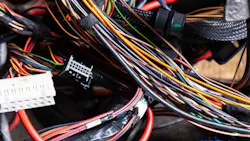
As my career shifted from a path of “just getting by” to one with a sense of direction, I’ve become proactive about not only referencing wiring diagrams sooner in my game plan but also using a lot more of what each one has to offer.
The 30,000-Foot View
Regarding the design of the automotive subsystems on today's vehicles, assuming how something is designed to function isn't wise. It's far more prudent to assume that every subsystem differs in design from the one you last addressed.
In my experience, the old adage “There is more than one way to skin a cat” truly applies when it comes to system topology and circuit design. Referring to a wiring diagram to see how a circuit or system is configured is like learning all the players on a sports team and the job each of those players has. For instance, consider the functionality of a basic horn circuit. Realizing this difference in topology before troubleshooting begins will play a crucial role in an efficient diagnosis. Let's compare what I would call a classic (or common) design to one from even as far back as 20 years ago (Figure 1).
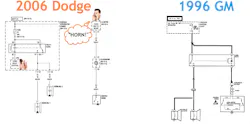
The topology of the horn circuit from the 1996 GM vehicle is simple in design, and something many of us older (I mean, experienced) technicians are very familiar with. Most vehicles of this era possessed horn circuits of this design.
Depressing either of the two horn buttons on the steering wheel simply provided a ground path for the horn relay coil. With the buttons depressed, the horn relay coil became a magnet, and the contacts closed, allowing current to flow from the fuse box and through both horns (which were provided with a case ground where they fastened to the vehicle).
However, the story is very different from the 2006 Dodge. Unlike the GM, the Dodge's horn button didn't control the relay. It simply created a ground path for a horn-request signal that was output by the cluster. What can't be seen here is that the cluster (along with many other ECUs) resides on a bus network.
The grounding of the horn request signal initiated a horn request message on the bus from the cluster and was shared with the Integrated Power Module (or IPM, where the horn relay lives). Another ECU that resides within the IPM is in direct control of the horn relay. After that, the horn circuit behaves just like the GM circuit discussed above. As you can see, assuming “business as usual” could certainly lead to a long, expensive, and unprofitable day.
It's in the Job Description
Combining what was just learned about system topology with the system's description and operation will allow for a play-by-play breakdown of the system's functionality. Having this data will allow you to determine a game plan for how to approach a system fault. For instance, reading about the system description and operation for the Dodge's horn circuit educated me to the fact that ECUs communicated on a bus network. With this powerful knowledge, my first step in analysis would be to leverage a scan tool (Figure 2).
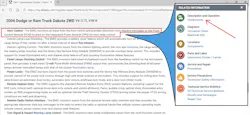
With a capable scan tool in hand, I could use it to determine where a fault may lie if the horn-request message hadn't made it to its destination:
- Did the cluster see the horn-request signal being manipulated?
- Did the IPM receive the command from the cluster?
- Did the IPM attempt to energize the horn relay?
These three simple (but important) questions could be asked right from the driver's seat. In fact, you wouldn't even have to open the hood, and you would already have determined where not to waste any time testing.
Again, all of that could be derived simply by looking at the wiring diagram and the system's description and operation. Taking it a step further, though—by way of bi-directional control—the horn relay could be manipulated. What does this do for us? Well, let's break that down a step further.
If the horn failed to operate using the horn pad but successfully sounded when commanding the relay to operate with the scan tool, you would've proven several things: The horn functions, so adequate voltage supply, ground supply, and horn integrity can be taken right off the table.
The IPM (ECU under the hood/intelligent fuse box) is alive and well. It's capable of receiving/processing message requests and executing the output (driving the horn relay). Ultimately, the fault had been isolated to an input issue, simply by process of elimination and leveraging a little logic from what was learned above. As can be seen, this isn't difficult—it just takes some discipline.
Talking the Talk
As mentioned several times above, this horn system leverages the CAN bus to carry the horn request and command between ECUs. But how would we learn which ECUs are in place within this configuration and the media in which these messages are carried? That's where the information bus details come into play. These diagrams contain only the information pertinent to how ECUs share information. All of the particular circuits regarding component functionality and power/ground distribution have been intentionally eliminated from the diagrams to allow a technician to focus on the communications networks only (Figure 3).
For instance, the diagrams will show:
- In-line connectors
- Harness-to-harness connectivity
- Splices and star connectors
- Gateways
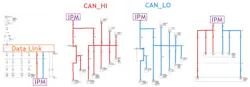
Each network (Hi-speed CAN, Med-speed CAN, LIN, Ethernet, K-line, MOST, etc.) Having access to this information will help you strategize (on paper, at your toolbox) before approaching the vehicle. This is important because many of these networks can be found throughout the entire vehicle, including under the carpet, within door panels, inside tailgates, above the headliner, behind the dashboard, under the vehicle, and inside the engine compartment.
The labor cost alone of simply eliminating suspect components from the network (arbitrarily) could be thousands of dollars and take weeks of work. Bypassing ECUs with jumper wires and 120-ohm resistors is a much better way to eliminate potentially faulted sections of media or even faulted ECUs—strategically. And none of this would be possible without implementing the information bus diagrams.
Best Course of Action
So, it's now time to move forward with confidence. You've leveraged the previous wiring diagram features and characteristics to give you a logical sense of direction, and now you have a decision to make on where to conduct the testing. When faced with that question, my answer is always the same: I’ll conduct testing at the easiest component to access. And the section of service information containing “component location” is the next stop for me.
For the sake of discussion regarding our Dodge horn system, say, for instance, that the scan tool indicated no loss of communication; yet the horn failed to sound, and the cluster did not report a request for horn operation. Logic should dictate that the input circuit is somehow compromised. We have a choice to make:
- Remove the steering wheel to test for presence of horn request signal voltage
- Remove cluster to test for presence of horn request signal voltage
- Locate another access point requiring no disassembly
By visiting the component location section of service information and combining it with the wiring diagram details for the horn input circuit, we can devise a plan to test without disassembly. More specifically, we can determine if the signal is present from the cluster (where it originates) and if so, can the signal be manipulated (pulled low) when the horn pad is depressed. The answers to these questions determine the next logical course of action, and the best part is that no time was wasted—just invested (Figure 4)
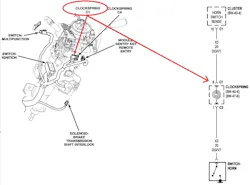
If the signal is present at connector C1-Terminal No. 6, it should get pulled low with the horn depressed. If not, test at connector C3-Terminal No. 1 during the same conditions. If the signal still fails to pull low, an open circuit is present between C3-1 and the horn switch. But “not-so-fast”—take a moment to create your own path to ground. Become the horn switch and short the horn request signal to ground. Not only will this confirm you are on the right path (fault located closer to the steering wheel), but when the horn sounds, you've also confirmed the functionality of the entire horn system (nothing more embarrassing than discovering multiple faults in the same system after a repair or correction has taken place).
Pinpoint Location
As you progress toward a pinpointed diagnosis, many times you will find yourself at a relatively large ECU connector, an in-line connector, or one that interfaces a fuse box. In many of those situations, the connector can have as many as 120 terminals. It's easy for your eyes to deceive you, but at the same time, it's of the utmost importance to identify the correct circuit before testing. This is the difference between a correct or botched diagnosis, and it's absolutely your responsibility as a diagnostician. The connector view will offer information like:
- Connector body color
- Number of terminals
- Connector layout
- Terminal position
- Color of the wires in each terminal
- Circuit function
While using this information from the wiring diagram, I will identify several wires (by way of color) adjacent to the terminal I'm interested in. This acts as a bit of an insurance policy (or a checks-and-balances system) to help ensure I'm seeking the correct wire terminal (Figure 5).
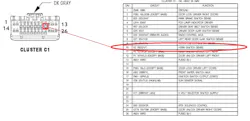
For instance, the horn sense switch circuit we've been chasing is a dark-green/violet wire and should be located between both a violet/tan wire and a tan/orange wire.
Furthermore, I will find this wire located on the top row of the connector (in reference to the connector position assurance tab), on the end with the three smaller terminals (not the end with the two smaller terminals). I just described four factors of identification to ensure a mistake isn't made. This is how to remain accurate and efficient at the same time.
Flow Charts: More Than Just Toilet Paper
There's been an ongoing joke circulating the diagnostic world that flow charts are only good for toilet paper. Where that joke stemmed from is that relying on flowcharts to solve symptoms doesn't always end well. However, from my perspective, they do have value to offer.
Flow charts tend to contain some goodies that I leverage when available. Helpful information can be found in them to better understand the system you're addressing and why it may not be behaving as expected. Some of these include:
- Resistance specifications
- Voltage level thresholds
- Expected reactions
- Default strategies
- Expected values at test points
- Testing conditions/running conditions
- Function criteria
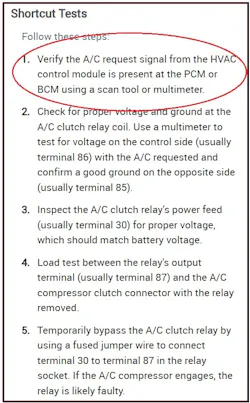
Information like that above helps recreate scenarios where expected values can be tested for. For instance, there would be no use in testing for an A/C compressor function with the ignition key in the “off” position if part of the function criteria states the key must be in “Run.”
I also leverage flow charts to quiz myself on my knowledge of system functionality. Many times, my understanding of how a circuit or system functions is a misconception. The information found in flow charts can help set the record straight.
To sum it all up, not any single one of these information sources is better than the other. It takes an understanding of what each one can do for you in the situation you are encountering at the time.
Take the time to research all the data that is valuable to you and implement it. In only a short period of time, you'll find your path to diagnostic success has been shortened as well!
About the Author
 Brandon Steckler
Brandon Steckler
Technical Editor | Motor Age
Brandon began his career in Northampton County Community College in Bethlehem, Pennsylvania, where he was a student of GM’s Automotive Service Educational program. In 2001, he graduated top of his class and earned the GM Leadership award for his efforts. He later began working as a technician at a Saturn dealership in Reading, Pennsylvania, where he quickly attained Master Technician status. He later transitioned to working with Hondas, where he aggressively worked to attain another Master Technician status.
Always having a passion for a full understanding of system/component functionality, he rapidly earned a reputation for deciphering strange failures at an efficient pace and became known as an information specialist among the staff and peers at the dealership. In search of new challenges, he transitioned away from the dealership and to the independent world, where he specialized in diagnostics and driveability.
Today, he is an instructor with both Carquest Technical Institute and Worldpac Training Institute. Along with beta testing for Automotive Test Solutions, he develops curriculum/submits case studies for educational purposes. Through Steckler Automotive Technical Services, LLC., Brandon also provides telephone and live technical support, as well as private training, for technicians all across the world.
Brandon holds ASE certifications A1-A9 as well as C1 (Service Consultant). He is certified as an Advanced Level Specialist in L1 (Advanced Engine Performance), L2 (Advanced Diesel Engine Performance), L3 (Hybrid/EV Specialist), L4 (ADAS) and xEV-Level 2 (Technician electrical safety).
He contributes weekly to Facebook automotive chat groups, has authored several books and classes, and truly enjoys traveling across the globe to help other technicians attain a level of understanding that will serve them well throughout their careers.