Key Highlights
- Choose between a cab chassis and a step van, then compare engine options and nearby warranty service.
- Match truck length to your route, maneuverability, and inventory needs.
- Plan the interior layout, displays, shelving, and storage around your sales priorities.
- Select ceiling, carpet, trim, and exterior details that suit your preferences and brand.
- Make sure your business can support the investment and use the new truck to renew customer interest.
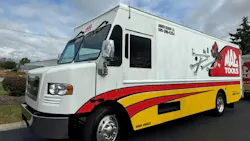
You’ve made the decision to purchase a new tool truck, but you’re unsure of your next steps. While it may seem like a complicated process, it is actually quite simple if approached in the right manner. By breaking down each step of the process into one small decision at a time, you can easily figure out what your next (or first) mobile tool store should entail.
Step 1 — Truck type
The first thing to decide upon is what type of truck meets your needs and/or desires. There are only two types to choose from. A cab chassis with a box or a step van. The next thing would be to determine if a gasoline- or diesel-powered vehicle is the right choice for you. If a cab chassis is your choice of truck, then currently your only option for gasoline-powered would be the Ford F-Series. If diesel is your preference, then the field is wide open with a variety of manufacturers to choose from.
Say a step van is your choice; well, Freightliner has you covered with both gas and diesel options in a variety of combos. Ford is also a player if gas meets your needs. One important thing to consider also is who is available to service your new truck if a warranty issue arises. You might have a Freightliner store on the route, but Kenworth is 100 miles away. If that’s the case, you’re probably going to lean towards the Freightliner.
Step 2 — Truck size
After deciding on the chassis, next up is how big (length) you want your mobile store to be. Tool trucks come in a variety of sizes from 16’ long all the way up to a monster 30-footer. What’s going to be best for you? Typically, the decision is made due to several different factors.
- How large is your route in terms of rural or city?
- How easily can you move around inside the route?
- How large is your inventory?
The answers to those questions may assist in determining whether an 18’ step van or a 28’ cab chassis is for you.
Step 3 — Truck layout
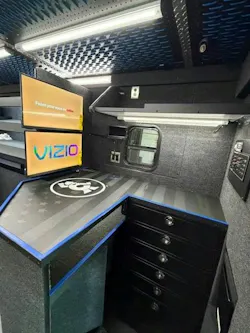
Now what about the interior layout and options? All builders provide many different choices when it comes to designing the interior. Most builders offer a standard built-out package based on chassis, style, and length of the truck. Usually, it includes shelving, lights, heat, air conditioning, and a liftgate, to name a few of the most common things. Aside from those basics, builders typically have a few routine questions that, when answered, help guide this process.
- Where would you like your work area (counter/desk) located? (Roadside or curbside are the two choices.)
- How many toolbox areas would you like, and what size?
From there, it becomes fairly easy to start moving the design forward. With a cab chassis, you have no wheel wells to contend with, as opposed to a step van where the wheel wells can inhibit some layout designs.
What types of sales do you want to focus on? If it’s cordless tools, for example, you may want to consider an enhanced cordless tool display that may feature a wide variety of choices. If diagnostics sales are a segment that you are wishing to grow, an eye-level display that allows the scanners to be touched or demonstrated might be the way to go. Keep in mind some of the design choices may ultimately limit your base shelving configuration and shelving lengths. Be careful to leave yourself enough shelving for all of those basic need items that are sold week in and week out.
Step 4 — Truck storage
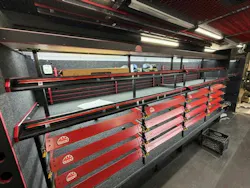
Another key area of consideration is cabinetry. How many storage drawers do you need? When assessing this area of design, most tool distributors have a good idea of what they may want as far as drawer space goes, and typically, configuration can be whatever you desire. More recently, finish choices have broadened. Traditionally, oak-trimmed cabinetry, whether natural or stained, was the choice. New materials have entered the arena in this area with HPDE plastic. Its popularity is based on overall durability and variety of color choices. More than 90 percent of our custom builds are trimmed in HPDE plastic.
Step 5 — The ceiling
What about the ceiling? The ceiling was at one time considered valuable real estate, and distributors were careful not to add too many components to take away from that space. Recently, we are seeing more of a trend away from concerns about ceiling space. It seems the advent of different packaging may have had an impact on how the ceiling is displayed. This could also be because next-day shipping no longer requires a distributor to inventory multiples of certain tools. Regardless of those situations, there are usually three choices to be made when it comes to the ceiling — panel color, lacing color, and lacing pattern. There are no right or wrong answers when it comes to the decision.
Step 6 — Carpet and trim
Designing a truck becomes very personal when it comes to carpet and trim color choices. Over the years, carpet color choices have become somewhat limited to gray and black tones, with the deciding factor being the brightness of the truck and the ability to maintain cleanliness. Shelving trim colors have followed suit with the cabinet trim choices, with the HPDE becoming the “leader in the clubhouse.”
Step 7 — Truck exterior
What about the exterior, you say? Well, there are many things to consider in this area as it’s the first thing your customer sees when you pull up, so first impressions are important. Many popular add-ons are exhaust stacks, custom wheels, and additional marker lights. Some distributors really like the bling.
Of course, the graphics for your truck will vary depending on whether you’re a franchise distributor or an independent.
Investing in yourself
All in all, making the choice to buy a new truck is usually a good one as long as the business can support the purchase. It says to your customers that you have made an investment in your business, and you are there to stay. Most distributors report a significant uptick in buying as the “new shiny” lures the customers back to the truck. Happy shopping!
About the Author
 Tim Herr
Tim Herr has been involved in the tool truck industry for 37 years. Beginning with refurbishing used units in the late 1980’s, that experience and knowledge led to manufacturing new units in 2004. Herr leads a team of more than 35 employees who handle all facets of manufacturing mobile tool stores for Cornwell, Mac Tools, Matco Tools, and Snap-on franchisees. Herr has been married for 31 years to his wife, Charlotte, and they have one son, Jacob, who works in the business with him.
Related
 Buying new vs used