While L.A. docks operate 24/7, industry leaders tend to logistical basics
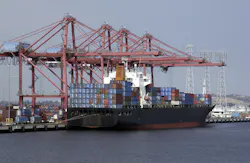
A handful of automotive aftermarket leaders are sighing relief, if not cautious optimism, over the decision to operate the Port of Los Angeles around the clock. The 24/7 activity at the nation's busiest maritime docks, announced by President Biden on October 14, aims to expedite the flow of imports from Asia, as many foreign port operators already have been working overtime.
Still, the timing of the move that falls on the crush of Christmas and Hanukkah orders raises doubts whether the remaining links consisting of the labor force, freight carriers, and distributors can unkink the logistical pipeline. "Secretary Buttigieg recently stated that the Biden Administration has been watching this since January. If they had taken action back then or even as late as June, I think our ports and economy would be in much better shape today," said Steve Hughes, senior representative of Gemini Shippers Group.
Better late than never, concedes Hughes, who regularly tracks and reports the progress of America's major seaports to the Auto Care Association membership and the manufacturing segment. Hughes' principal worry is how the industry's small to medium importers can efficiently attain maximum order fill. Faster processing of the containers off the ships onto the trucks depends on how effectively the giant importers act, which would give breathing room for the remaining orders to cycle through the port. "If the big importers shift a lot of their cargo handling to the night gate, I think we will start to see some relief in congestion during the day," said Hughes.
Even larger companies, with better access to transportation, face supply challenges
Uneven access to transport seems to have benefited the larger, wealthier companies' intent on filling their pipelines. Instead of finding space on commercial liners, Walmart, The Home Depot and Target are chartering ships and finding other creative means to reach its outlets, wrote the Wall Street Journal. All three merchants sell popular automotive categories ranging from motor oils to filters to car care items, potentially handing them a sales edge over the smaller, less dominant parts stores.
A national account executive at R+L carriers, a national trucking carrier with close ties to the big box retailers, said in September to AMBW that the companies have inked agreements to receive the inventories ahead of the expected mad rush in December. Requesting anonymity, the R+L employee encouraged the automotive aftermarket companies to book deliveries in advance to reach the shelves on schedule.
Asked whether R+L plays industry favorites with Target, Walmart or any other consumer conglomerate with buying volume to outbid a poorer organization, the executive declined to confirm or deny if close logistical coordination was happening. A second R+L supply chain manager turned down a request to answer this question.
"It is a very competitive market and I think what you're seeing is that even the big companies can't get what they need," said Paul McCarthy, president of the Automotive Aftermarket Suppliers Association (AASA).
Securing preferential treatment, McCarthy explains, is especially daunting for the smallest aftermarket suppliers and getting the logistical support that they require to relocate raw materials, semi-finished goods and finished manufactured products to the final point.
As a result of the concentration of power between the haves and the have-nots, the gaps in the infrastructure have constrained the offshore factories to meet peak demand for auto parts, chemicals and shop supplies. "What's clear is that it's been hard on the aftermarket. I've struggled to get the attention about space on ships and space on trucks," said McCarthy, who added that, "this is the biggest supply chain disruption that we've dealt with since World War II."
"I'm sure it's having an impact on everyone's sales," said Larry Pavey, president of Federated Auto Parts. With unrelenting pressure on high prices stoked by low product availability, Pavey hears that some suppliers in many instances, cannot fulfill every order that wholesalers and chain stores need to service the commercial repair channel. Automotive service shops are coping with stock-outs when more people are retaining their aging vehicles rather than buying new ones because of slow factory output.
"I read a survey released by IMR (Research Group) that the shops are unable to repair vehicles as quickly as they would and they reported longer delivery times from the parts stores not being able to ship the parts as quickly as they would like," Pavey said.
Now's the time to fine-tune delivery schedules and replenishment frequencies
Nonetheless, Pavey insists that the wholesale distribution supply lanes have a degree of leverage without incurring further tradeoffs. Good communication with trading partners can mitigate some of the strain on the delivery system by reevaluating safety stocks, analyzing lost sales, adjusting inventory levels, Pavey suggested. He said he believes that right now makes an ideal moment to fine-tune delivery schedules and replenishment frequencies. "Everyone's doing their best to be transparent. Maybe that doesn't help make all the stress go away, but it's easier to manage when you're able to communicate effectively," Pavey said.
Like nearly every industry struggling to hire workers to distribute goods, managers are dreaming of other imaginative ways to put away stock and pull orders. According to Pavey, Federated Auto Parts, a program buying group of family-run businesses and corporate entities, has alternative grassroots means to keep customers happy that no far-reaching merchandiser can touch.
"Customer intimacy and having a personal focus in the business are some of the things we can do to offset the leverage that the big retailers have that we cannot control," Pavey said.
Supply chain experts, including McCarthy, maintain that the immediate impact of the Los Angeles port doubling its capacity through extended hours will remain unclear through next year, which begs an overriding issue beyond the aftermarket. The aftermarket's supply chain woes ties into President Biden’s proposed infrastructure plan, which McCarthy contends has always been an AASA membership aspiration to shorten transit lead times and establish predictable delivery frameworks. The reality of clawing back pieces of the manufacturing and distribution facilities stateside necessitates a major undertaking that can take several years to accomplish.
For decades before the pandemic, contends McCarthy, the automotive aftermarket has enjoyed the stability and the low-cost benefits of lean inventory management practices stretched across continents. But few planners figured in anomalies that could upend global economies. An intermediate step may force companies to retool a resilient supply chain, add more inventory, and in some cases adjust the cost of doing business to avoid the unpredictability inflicted by the global shutdown, explained McCarthy.
"Even coming out of this crisis, the supply chain will normalize, things will get better from where we stand. But for sure, we may be looking forward to a world where there is more supply chain risk," he said.
About the Author
 Alan Segal
Alan R. Segal specializes in project management for suppliers, consultants and retailers. He practiced category management for Sanel Auto Parts Co. and Advance Auto Parts before launching his own firm, Alan R. Segal-Best Business Practitioner. He has worked in the auto care industry since 1991. Connect with Alan on Facebook or LinkedIn.