Leadership 2.0: Notes From the University of the Aftermarket 2026 Leadership 2.0 Program at Northwood University
Key Highlights
- The class participated in the Four Corners debate to learn the impact of diverse perspectives and teach the importance of listening and understanding in leadership.
- Organizational culture is described as the behavioral operating system, shaped intentionally or unintentionally by leaders through daily interactions and decisions.
- Leadership is demonstrated through small, consistent behaviors such as trust-building, effective communication, and emotional intelligence, which collectively influence organizational success.
- The announcement of Bill Hanvey’s retirement underscored the lasting impact of leadership on culture, emphasizing that what leaders leave behind is more important than results alone.
What is Leadership 2.0?
The University of the Aftermarket's Leadership 2.0 program at Northwood University in Midland, Michigan, is a week-long leadership development program. It's designed for automotive aftermarket industry professionals—including parts manufacturers, warehouse distributors, retailers, shop owners, service providers, and industry association leaders—looking to grow and expand their executive and management skills through advanced training.
Participants engage in sessions covering emotional intelligence, financial literacy, strategic decision-making, adaptive leadership, organizational culture, team dynamics, and networking—all designed to help them become more effective leaders in an evolving automotive aftermarket landscape.
This is the fourth installment in a five-part series as Chris Messer, executive vice president of Transportation at EndeavorB2B, chronicles his journey through the University of the Aftermarket's Leadership 2.0 Program at Northwood University. Read the series here: Part 1, Part 2, Part 3.
After three days of discussing authentic leadership, decision-making, networking, and personal growth, Day 4 felt like the day everything started coming together. If the first half of the week focused on understanding leadership, Wednesday focused on something even harder: understanding people.
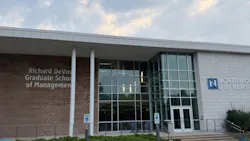
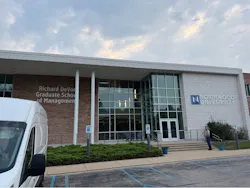
This time, our class reported to a new location on campus, the Richard DeVos Graduate School of Management at Northwood University. It was a change of scenery, but it turned out to be the perfect setting for a day centered around organizational culture, communication, and emotional intelligence.
No Easy Answers
James O'Dell opened the morning with a Four Corners debate exercise. The concept was simple. James would ask a question, each corner of the room would represent a possible answer, and participants would physically move to the corner that best reflected their position. We quickly learned that even simple questions can reveal different experiences, priorities, and points of view. The questions started light and then became more meaningful:
- What is the best flavor of ice cream?
- What modern invention has had the biggest impact on your life?
- What office perk has the biggest impact on employee satisfaction?
- What is the most important foundation of a strong corporate structure?
The ice cream debate was exactly what you would expect from a room full of competitive aftermarket professionals. People defended their choices with far more passion than the question probably deserved. But the exercise became more interesting as the questions evolved. When asked about the modern invention that had the greatest impact on our lives, people began thinking differently. Some answers were practical. Some were personal. Some were shaped by career experience, family life, or the way technology has changed how we work. By the time we reached the question about the foundation of a strong corporate structure, the exercise had shifted from icebreaker to leadership lesson. There was not always a right answer. There were different perspectives. And that, I think, was the point.
Leadership requires guiding people who see the world differently than we do. The ability to listen, understand opposing viewpoints, and consider alternative perspectives may be one of the most important leadership skills we can develop.
Culture Happens Whether You Design It or Not
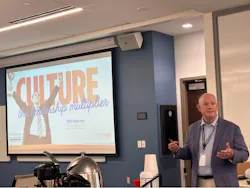
Next, we welcomed Bill Hanvey, president and CEO of the Auto Care Association. Bill's presentation focused on organizational culture, and he introduced a statement that stayed with me throughout the day:
"Culture is the behavioral operating system of the organization."
He followed it with another equally powerful observation:
"Culture happens whether you design it or not."
That statement resonated because it's true. Every organization has a culture. Some are intentional, and others are accidental, but all of them shape employee experiences, decision-making, and ultimately performance.
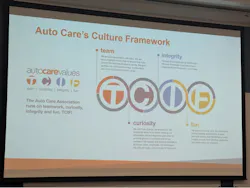
Bill shared the Auto Care Association's four core values: teamwork, curiosity, integrity, and fun. Together, those values form the foundation of the association's culture and serve as guiding principles for how employees work together and serve members. I appreciated the simplicity of the framework. Teamwork, curiosity, integrity, and fun are not complicated ideas. But when they are reinforced consistently, they become more than words on a slide. They become expectations.
Teamwork means collaborating closely and supporting one another to achieve shared goals for the automotive aftermarket. Curiosity means encouraging continuous learning, fresh ideas, and creative problem-solving. Integrity means operating honestly, ethically, and with mutual respect. Fun means creating a positive, engaging, and uplifting workplace.
A Legacy Measured by More Than Results
What made Bill's presentation particularly meaningful was the timing. Here we were spending an entire day discussing culture, leadership, and the influence leaders have on the people around them when Bill announced to the class that he will retire as president and CEO of the Auto Care Association on June 30, 2027.
The official announcement appeared in inboxes across the industry moments after. Because of our setting in the classroom, however, we had the opportunity to hear the news directly from Bill before many others in the aftermarket had time to read it. According to the Auto Care Association announcement, Bill has served as president and CEO since December 2015 and has spent more than 40 years in the automotive aftermarket industry. The association also noted several milestones during his tenure, including guiding the industry through COVID-19, advancing Right to Repair efforts, expanding industry data resources through TrendLens and the Demand Index, building Associations in Motion, and fostering the next generation of industry leaders.
Those accomplishments matter. But standing in that room and listening to Bill speak about culture, I found myself thinking less about the resume and more about the responsibility.
Leaders don't just manage organizations. They shape what those organizations feel like. They set expectations, reinforce values, model behavior, and decide what gets celebrated and what gets tolerated. In many ways, Bill's announcement reinforced the point he was making during his presentation. Culture does not happen by accident. It's built intentionally over time through countless conversations, decisions, and interactions.
As leaders, we often spend a great deal of time thinking about what we want to accomplish. Bill's announcement reminded us that leadership is also about what we leave behind. It's not the organizations, strategies, or results, but the people, relationships, and cultures that continue long after we move on.
If culture truly is the behavioral operating system of an organization, then perhaps the ultimate measure of leadership is whether that culture continues to thrive after a leader steps away.
Leadership Happens One Conversation at a Time
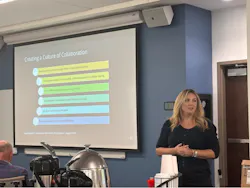
Cheryl Scalione delivered one of the most practical presentations of the week. Her topic: Supercharged Team Performance and Meaningful Connection.
The session focused on trust not as an abstract concept, but as a series of daily behaviors. Cheryl discussed behaviors that build trust, including accountability, transparency, admitting mistakes, being present, following through on commitments, and showing consistency over time. One quote in particular stood out:
"Leadership happens one conversation at a time."
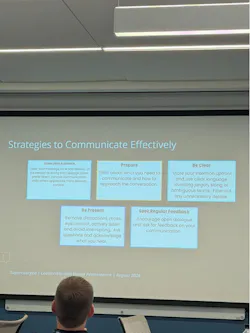
That idea became a recurring theme throughout the day. As leaders, we often search for large transformational moments, yet meaningful cultures are usually built through smaller interactions repeated consistently over time. It happens in the way a leader communicates, in the way they listen, in how they respond during difficult conversations, in the way they handle conflict, and how they show up when things get hard. Those moments define culture more than mission statements ever will. Cheryl also reinforced that proper communication isn't about transmitting information. It's about building connection. Knowing your audience, preparing for conversations, being clear, being present, and seeking feedback helps leaders build stronger relationships.
Intent vs. Impact
The afternoon continued with Tammy Tecklenburg, founder and CEO of dott. Tammy's presentation centered on emotional intelligence and the role it plays in leadership and culture. Almost immediately, she introduced one of the most important concepts of the day:
"Intent is personal. Impact is shared."
It sounds simple, but the more the class discussed it, the more powerful it became. Tammy used the example of a thumbs-up emoji. To one person, the message might mean, "Got it. Thanks." To another, the same response might feel dismissive or passive-aggressive. Same message, but a different impact. The lesson wasn't really about emojis. It was about leadership. Leaders live in their intention. Teams experience their behavior. Those are not always the same thing. Another example involved a meeting invitation sent for 4 p.m. on a Friday with no agenda. The sender may have completely innocent intentions. The recipient may immediately assume the worst. Context matters. Communication matters. Perception matters. And leaders ignore those realities at their own risk. Our teams do not experience our intentions. They experience our behaviors.
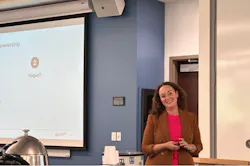
Tammy also introduced H.A.L.T., a practical reminder to pause and ask what might be driving an emotional reaction: hungry, angry, lonely, or tired. She challenged us to notice our default patterns under pressure. Do we fight? Do we flee? Do we freeze? Do we appease? The discussion was thoughtful, practical, and highly relatable because every leader, regardless of title or experience, faces pressure. The difference is how we respond to it.
Northwood's Invitation to Stay Connected
After Tammy's presentation, several Northwood University faculty and staff members joined the class, including Dr. Matthew Bennett, Dr. Steven Poole, and Kimberly Warner. Their message was simple and appreciated: when we leave Northwood, it's not goodbye. It's see you later. They discussed continued learning opportunities, including associate, bachelor's, master's, and doctoral programs, along with ways to stay engaged with the university through career services, career fairs, and future connections with students.
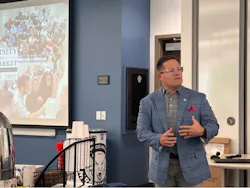
That discussion fit well with the larger theme of the day. Culture does not end when the formal session ends. Neither does leadership development.
The day also included breakout time with our teams, which gave us another chance to process what we had heard and think about how the lessons applied to our own organizations.
Culture Is Personal
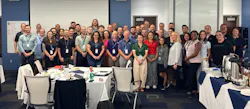
As the day came to a close, I found myself thinking about how interconnected every session had been. The Four Corners exercise highlighted perspective. Bill Hanvey discussed culture. Cheryl Scalione focused on trust and communication. Tammy Tecklenburg challenged us to think about emotional intelligence and self-awareness. Northwood's faculty and staff reminded us that learning and relationships continue beyond the classroom. Different topics, same lesson.
Culture is not created through posters hanging on walls, and it is not created through mission statements or corporate slogans. Culture is created through everyday interactions: one conversation at a time, one decision at a time, one relationship at a time. Perhaps that is why leadership is so difficult.
The technical side of business can often be learned, but the human side requires constant attention, and as leaders we don't just influence results; we influence the experiences of the people around us. Leadership is not just strategic or operational; leadership is personal.
All of this makes me reflect and appreciate my amazing team at EndeavorB2B. It's an honor and a privilege to work alongside some of the highest-regarded professionals in the industry. To my tribe, thank you for letting me be part of your team.
About the Author
 Chris Messer
Chris Messer
Executive Vice President | Transportation
Chris Messer is the Executive Vice President for Endeavor Business Media's Transportation Group.