Leadership 2.0: Notes From the University of the Aftermarket 2026 Leadership 2.0 Program at Northwood University
Key Highlights
- Leadership is defined by strategy, execution, and relationships, with a strong emphasis on genuine connections and trust.
- Team-based survival exercises demonstrate that diverse perspectives and collaborative decision-making lead to better outcomes under uncertainty.
- Industry disruptions, such as the collapse of First Brands Group, highlight the importance of transparency, ethics, and accountability in leadership.
- Effective leaders navigate change by defining objectives, leveraging team strengths, and fostering trust, recognizing that leadership is an ongoing process.
What is Leadership 2.0?
The University of the Aftermarket's Northwood University in Midland, Michigan, is a week-long leadership development program. It's designed for automotive aftermarket industry professionals—including parts manufacturers, warehouse distributors, retailers, shop owners, service providers, and industry association leaders—looking to grow and expand their executive and management skills through advanced training.
Participants engage in sessions covering emotional intelligence, financial literacy, strategic decision-making, adaptive leadership, organizational culture, team dynamics, and networking—all designed to help them become more effective leaders in an evolving automotive aftermarket landscape.
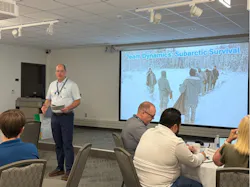
This is the second installment in a five-part series as Chris Messer, executive vice president of Transportation at EndeavorB2B, chronicles his journey through the University of the Aftermarket's Leadership 2.0 Program at Northwood University. Read the first part of the series here: Part 1
One of the things I appreciate most about this program is that there are not many easy answers.
Case in point: Monday's opening question.
What is leadership?
It sounds simple enough, but after spending an entire day discussing, debating, learning, and collaborating with nearly 40 aftermarket professionals, I can confidently say there is not one universally accepted answer.
I woke up Monday morning at the luxurious Hampton Inn in Midland, Michigan, and made the two-mile commute to Northwood University's 400-acre campus. I expected that we would spend the day discussing leadership. What I did not expect was how many different perspectives would emerge from one seemingly straightforward question. And honestly, that was probably the point.
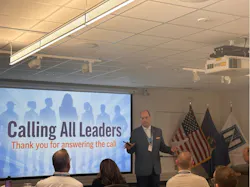
Three Characteristics of Leadership
The day began with James O'Dell, director of corporate education for the University of the Aftermarket, challenging the class to think beyond titles, organizational charts, and job descriptions.
For James, leadership ultimately comes down to three characteristics:
- Strategy: Where are we going?
- Execution: How do we get there?
- Relationships: How do I get others to follow?
Throughout the day, James repeatedly emphasized the importance of relationships. He made a point to recognize the individuals in the room and remind us that our experiences, perspectives, and contributions mattered.
It was not performative. It was genuine.
As we discussed in Part 1, leadership starts with people. Monday continued to reinforce that theme.
Surviving the Subarctic
The morning quickly shifted from theory to application.
Our next exercise was the Subarctic Survival Situation, a team dynamics exercise that placed us in a hypothetical survival scenario.
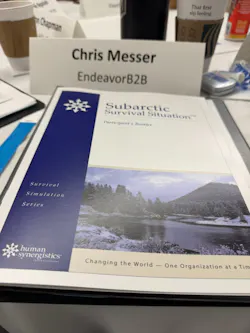
The premise was intentionally uncomfortable. It was approximately 2:30 p.m. on Oct. 5. Our floatplane had crash-landed on the east shore of Laura Lake in the subarctic region near the Quebec-Newfoundland and Labrador border. The pilot had been killed in the crash. The plane had drifted into deep water and sunk. Communications were gone. We were wet, cold, and a long way from help.
Before the plane sank, we were able to salvage 15 items. Our task was to rank those items from most important to least important for survival.
The list included a magnetic compass, a gallon of maple syrup, one sleeping bag per person, water purification tablets, a heavy-duty tarp, matches, braided nylon rope, a flashlight, snowshoes, Bacardi 151, a safety razor shaving kit with mirror, a wind-up alarm clock, a hand ax, a punctured aircraft inner tube, and a book titled Northern Star Navigation.
At first glance, some choices seemed obvious.
They were not.
First, each person ranked the items individually. Then, as teams, we had to come to consensus on a collective ranking. That second step changed everything.
One of the most fascinating aspects of the exercise was not determining which item was most important. It was watching how different people approached the same problem. Some participants immediately focused on survival skills. Others looked at shelter, warmth, and resource management. Some focused on signaling and rescue. Others thought about mobility and whether the group should attempt to travel.
Our team eventually aligned around a common strategy: stay put, get dry, get warm, create visibility, and wait for help.
Not every team made the same decision.
And that was where the learning happened.
Once the expert rankings were revealed, several important lessons emerged. The biggest was that the exercise was not really about ranking equipment. It was about defining the real problem.
Were we trying to travel? Were we trying to navigate? Were we trying to conserve energy? Were we trying to survive until rescue?
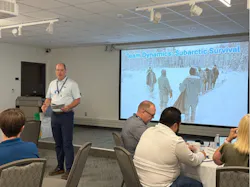
Until a team agreed on the problem, the team could not effectively agree on the solution. That applies directly to business. Teams often struggle not because people lack ability, but because they are unknowingly solving different problems.
The exercise was not really about surviving in the subarctic. It was about leadership.
The survival experts also demonstrated that repurposing resources is simply creative problem solving. A tarp is not just a tarp. A mirror is not just a mirror. A bottle of rum is not necessarily intended for drinking. Each item had potential value depending on how creatively the group thought about the situation.
That lesson translates directly to leadership. Great leaders are often the people who see possibilities in resources, people, or situations that others overlook.
The exercise also reinforced the value of diverse perspectives. Every person brought different assumptions, experiences, and instincts to the discussion. Some of those instincts were challenged. Some were validated. But the group became better because more perspectives were in the room.
In many cases, people did not change their minds because they were wrong. They changed their minds because someone else introduced a perspective they had not considered.
That is leadership.
Not convincing everyone you are right.
Creating an environment where the best ideas can rise to the surface.
Perhaps the most important lesson was that the team almost always outperformed the individual. Healthy debate improved decision quality. Communication turned isolated expertise into collective intelligence.
In hindsight, the Subarctic Survival exercise was a leadership laboratory. Great leaders define the real problem, leverage diverse perspectives, challenge assumptions, communicate effectively, and help groups make better decisions under uncertainty.
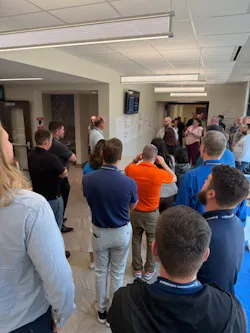
Understanding the Complexity of Automotive Distribution
Following the team-building exercises, the class welcomed Ted Hughes, senior director of community engagement and executive director of AWDA for the Auto Care Association.
I have known Ted for years and consider him both a friend and one of the aftermarket's strongest advocates.
Ted spent more than two decades on the supplier side of the business with MAHLE before joining the Auto Care Association in 2022. He is also a graduate of the Leadership 2.0 program, having completed the program in 2014.
When asked why he left the supplier community to join the Auto Care Association, Ted provided a response that resonated throughout the room: "Previously, I could help one company. In my role with the Auto Care Association, I have the opportunity to help numerous companies."
That mindset speaks directly to leadership.
At its best, leadership is about expanding your impact beyond your immediate responsibilities.
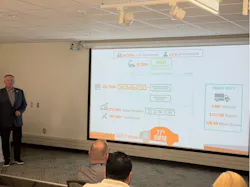
Ted's presentation centered on automotive distribution, e-commerce, and the complexity of the modern aftermarket.
What stood out most to me was not one specific statistic, although there were plenty of impressive numbers. It was the reminder of just how interconnected our industry actually is.
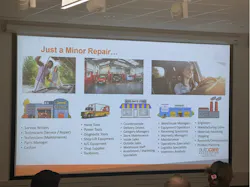
When a technician replaces a failed component, consumers see a repair. Industry professionals see a supply chain.
That repair may involve dozens of companies, hundreds of employees, and years of planning before a vehicle ever arrives in the service bay. Manufacturers, distributors, parts stores, warehouse teams, delivery drivers, counter professionals, category managers, engineers, product planners, sales teams, and service technicians all play a role.
Ted spent a great deal of time discussing the two-step and three-step distribution models that have historically moved parts through the aftermarket. While those channels remain foundational, e-commerce, changing customer expectations, and better data have moved parts faster, more transparently, and more complex.
Distributors carry significant responsibility in making sure the right part reaches the right service provider at the right time. Without that efficiency, the entire system slows down. Ted also discussed ACES and PIES, two Auto Care Association data standards that are foundational to modern aftermarket cataloging. ACES, the Aftermarket Catalog Exchange Standard, supports the management and communication of product fitment data. PIES, the Product Information Exchange Standard, supports the management and communication of product information.
In simpler terms, ACES helps the industry understand what a part fits. PIES helps the industry understand what the part is.
Those standards matter because today's aftermarket is not a simple parts counter conversation. It’s a complex data ecosystem that has to support millions of vehicle applications, countless product attributes, and a customer expectation that the correct part will be identified quickly and accurately.
If vehicle technology has become more sophisticated over the last decade, aftermarket information management has become more sophisticated right along with it.
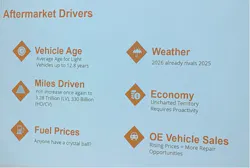
Ted also shared data that put the scale of the market into perspective. The Auto Care Association's 2026 Auto Care Factbook reported that total U.S. light-duty aftermarket sales grew 5.7% in 2024 to $413.7 billion. The report also projected the total light, medium and heavy-duty automotive aftermarket to reach $664.3 billion in 2028. S&P Global Mobility reported that the average age of U.S. light vehicles reached 12.8 years in 2025, while vehicles in operation grew to 289 million. Those older vehicles create continued demand for repair, maintenance, parts, data accuracy, and a distribution system capable of supporting the work.
Ted also cited the large number of repair facilities operating across the United States (more than 270,000). That point matters to our team at EndeavorB2B because VehicleServicePros.com, Aftermarket Business World, and the broader Vehicle Service & Repair Group and Commercial Vehicle Group are built around serving those same audiences.
Ted highlighted several aftermarket drivers shaping demand, including vehicle age, miles driven, fuel prices, weather, the broader economy and OE vehicle sales.
He also discussed consolidation and challenged the idea that consolidation is always negative. In fact, Ted recently explored that topic in his Aftermarket Business World column, The Rich Get Richer: Why Consolidation Doesn't Mean Decline, where he argued that consolidation should be judged by whether the independent channel remains capable of serving repair shops, fleets, suppliers and consumers with speed, choice, technical support and entrepreneurial discipline.
One of Ted's comments about Leadership 2.0 stayed with me: "The industry is becoming more complex than the actual vehicles that are on the road today, and this program is one of the only forums that is focused on building leadership skills that benefit the industry as a whole. The connections I made in 2013 and 2014 were pivotal in my career, and those who attend these sessions always benefit, grow themselves professionally and their organizations' contributions, and ultimately play a key role in advancing the automotive aftermarket's future."
That may be the best argument for a program like this.
The aftermarket does not need leaders who only understand their own companies. It needs leaders who understand the system.
The First Brands Group Discussion
The afternoon shifted toward one of the most engaging and thought-provoking discussions of the day.
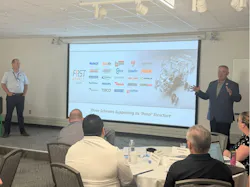
Using a case study developed by Rick Guirlinger, Dr. Frank Morgan, and James O'Dell, the class examined the rapid rise and sudden collapse of First Brands Group.
The case study described the company's aggressive acquisition-driven expansion across a portfolio of well-known aftermarket brands. It also described how the company's financial narrative unraveled amid alleged invoice inflation and fabrication, double and triple pledging of collateral, and off-balance-sheet debt.
According to the case study, First Brands Group reported approximately $5 billion in annual net sales at its peak and employed 26,000 people worldwide. The company later filed for Chapter 11 bankruptcy protection with more than $9 billion in liabilities and only $12 million in cash.
What made the discussion particularly interesting was that nearly everyone in the room had been affected in some way.
Some had customer relationships. Some supplied products. Some competed with the company. Some experienced supply chain disruption because of the collapse. The conversation quickly moved beyond financials and into broader leadership, governance, and ethical considerations.
Three central questions drove the discussion:
- What can the aftermarket do to help prevent a situation like this from happening again?
- How did the First Brands Group collapse impact our businesses?
- What do we need from channel partners and other industry affiliates moving forward?
The debate was spirited, respectful and highly practical.
There were not always clear answers.
But there was a shared recognition that transparency, trust and accountability remain essential components of long-term leadership.
Leading Through Change
After a multi-hour discussion about First Brands Group, the class was nearly dismissed, but not before James O'Dell offered one final thought:
“Whatever it is today, it's going to change tomorrow, and it's our job to lead through this change.”
It was a fitting conclusion to a day spent exploring leadership from multiple angles.
- Strategy.
- Execution.
- Relationships.
- Teamwork.
- Ethics.
- Adaptability.
So, What Is Leadership?
After spending an entire day discussing leadership theories, surviving a hypothetical plane crash in the subarctic, exploring the complexity of automotive distribution, and debating one of the industry's most significant business collapses, I found myself returning to the same question we started with that morning.
What is leadership?
At the beginning of the day, I expected there might be a simple answer, but there isn’t. Leadership means different things to different people.
Some define it through strategy, and others through execution.
Moreover, some define it through relationships, communication, culture, or accountability. Yet as I reflected on the lessons from the day, a common thread emerged: leadership is not about having the biggest title and isn’t about having all the answers.
And it certainly is not about being the smartest person in the room.
The Subarctic Survival exercise demonstrated that the best decisions rarely come from one individual. They come from teams willing to challenge assumptions, listen to different perspectives, and work together toward a common goal.
Ted Hughes' discussion about distribution highlighted that every day, leaders across the aftermarket must navigate an incredibly complex network of manufacturers, distributors, retailers, technicians and service providers. No one person can possibly know everything, but great leaders understand how to bring people together to solve problems.
The First Brands Group case study reminded us that leadership is also about integrity. Strategy without ethics is dangerous. Growth without accountability is unsustainable. Trust, once lost, is incredibly difficult to rebuild.
As the day progressed, I began to realize that leadership is not really about certainty.
It’s about helping people navigate uncertainty.
It’s about creating clarity when circumstances become complicated.
It’s about bringing together diverse perspectives to make better decisions.
It’s about serving others before serving yourself.
Most importantly, it’s about earning trust.
Whether you are leading a team through a business challenge, managing a complex supply chain, navigating industry disruption or trying to survive a hypothetical crash in the Canadian wilderness, the principles remain remarkably similar.
You define the objective.
You leverage the strengths of the people around you.
You make the best decision possible with the information available.
And then you move forward together.
That may not be the textbook definition of leadership.
But after one full day at Leadership 2.0, it’s the definition that feels most accurate to me.
And based on the conversations inside and outside the classroom, I feel the answer will continue to evolve throughout this journey. Because if there is one thing I have learned so far, it’s that leadership is not a destination.
It’s a lifelong process of learning, adapting, and helping others succeed.
About the Author
 Chris Messer
Chris Messer
Executive Vice President | Transportation
Chris Messer is the Executive Vice President for Endeavor Business Media's Transportation Group.