Leadership 2.0: Notes From the University of the Aftermarket 2026 Leadership 2.0 Program at Northwood University
Key Highlights
- Networking in the program focused on building genuine relationships rather than exchanging business cards or LinkedIn connections.
- Financial fluency is presented as a critical leadership skill, essential for making informed decisions across various business functions.
- Participants engaged in a challenge exercise, transforming 44 individual challenges into opportunities for collaboration and support.
- The concept of agile leadership was emphasized, encouraging leaders to look, listen, and learn continuously to adapt effectively.
- Leadership styles were contrasted, highlighting the importance of self-awareness in balancing positive influence with potential pitfalls like control and self-interest.
What is Leadership 2.0?
The University of the Aftermarket's Leadership 2.0 program at Northwood University in Midland, Michigan, is a week-long leadership development program. It's designed for automotive aftermarket industry professionals—including parts manufacturers, warehouse distributors, retailers, shop owners, service providers, and industry association leaders—looking to grow and expand their executive and management skills through advanced training.
Participants engage in sessions covering emotional intelligence, financial literacy, strategic decision-making, adaptive leadership, organizational culture, team dynamics, and networking—all designed to help them become more effective leaders in an evolving automotive aftermarket landscape.
This is the third installment in a five-part series as Chris Messer, executive vice president of Transportation at EndeavorB2B, chronicles his journey through the University of the Aftermarket's Leadership 2.0 Program at Northwood University. Read the series here: Part 1, Part 2
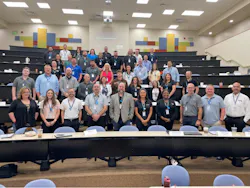
Most of us had settled into a rhythm by Tuesday morning. The Sloan Family Building for Aftermarket Studies had become our home base as familiar faces were becoming friends through conversations in the classroom, over breakfast, in hallways, and during coffee breaks.
Networking was Tuesday’s theme, but not the kind of networking you’d think: no business cards, no LinkedIn connections, no referrals or problem solving. Instead, it was about understanding how leadership is built through relationships and how the strongest leaders are often the ones most committed to helping others succeed.
Starting the Day with Dad Jokes
James O'Dell opened the morning exactly the way you would expect James to open a morning—with dad jokes.
Were they funny? Debatable. Did they accomplish their objective? Absolutely.
After the lighthearted chuckle, the room loosened up, conversations started, and everyone settled into what would become one of the most interactive days of the week. Ted Hughes picked up where he left off on Tuesday, moderating a roundtable discussion that turned into one of the most authentic conversations the class had during the program.
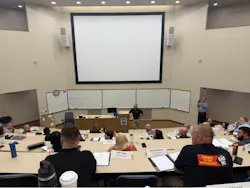
Rather than focusing on distribution, industry data, or market trends, Ted opened the floor by asking how we ended up in the automotive aftermarket, what misconceptions we had when we first entered the industry, and what surprised us. The stories varied. Some classmates grew up around the industry. Some started in completely different fields. Others found themselves in the aftermarket almost by accident. What struck me was how many people admitted they never expected to stay.
Yet here they were years later—still learning, still growing, still invested in the industry.
It reminded me that for many of us, the aftermarket is more than a career; it’s a community.
Financial Fluency Is a Leadership Skill
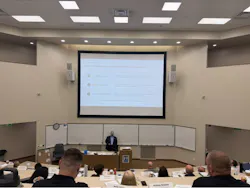
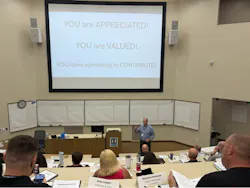
The morning's session featured Steve Gorham, professor of automotive accounting and chair of accounting at Northwood University. Steve’s opening statement got my attention:
"Financial fluency is a leadership skill, not a finance job."
That landed with me. Too often, financial literacy gets delegated to accounting departments and CFOs, yet most major decisions leaders make show up somewhere on a financial statement:
- Hiring decisions
- Growth strategies.
- Product development.
- Inventory management.
- Risk management.
We spent time reviewing income statements, balance sheets, cash flow statements, and statements of equity before diving into O'Reilly Automotive's FY2025 annual report. The goal was not to become accountants, but instead, better decision-makers.
Steve led the class through a Risk Factor Lab where teams reviewed publicly traded companies, identified risks, and discussed possible strategic responses. The exercise was less about finance and more about leadership, and while leaders don’t need to build financial statements, they absolutely need to understand what those financial statements are telling them.
Forty-Four Challenges
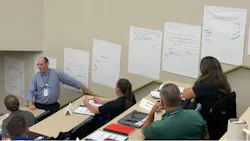
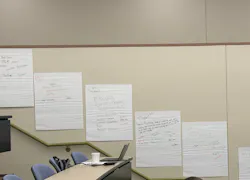
After lunch, James brought the class back into the auditorium for a memorable exercise. (I admit, when James handed out large sheets of paper and asked everyone to write down a significant challenge they were facing, I wasn’t sure where he was going.)
Within minutes, the walls were covered. Some challenges were professional. Some were personal. Some were tactical. Others were strategic. In total, 44 different challenges papered the walls around the room. And then something remarkable happened: people started offering one another help. Not because they were instructed to, but because they genuinely wanted to. One person had experience, another had a resource, and someone else knew exactly who could help.
As participants walked around the room, names began appearing beside challenges, and at the end of the exercise, many of the biggest problems in the room looked less intimidating. We went from a room full of challenges to a room full of potential solutions. And that’s when the theme of the day came into focus: this wasn’t a networking exercise. It was a leadership exercise. James reinforced a message he has repeated throughout the week:
"Be active and intentional. You have value that you can provide to your network."
That message hit differently after watching 44 challenges slowly transform into 44 opportunities to help someone else.
Agile Leadership in a Changing World
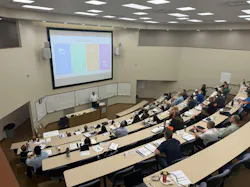
The final major session of the day featured Phil Fioravante, Ph.D., senior managing member of GreenRock Holdings Group. Phil's presentation covered agile leadership, adaptive intelligence, and organizational performance.
While there was plenty of business strategy involved, one phrase kept resurfacing throughout the presentation: Look. Listen. Learn.
Simple, but powerful.
Phil challenged us to think differently about leadership; not as a position, authority, or even as hierarchy, but as a continual process of adapting to changing circumstances. He discussed Porter's Five Forces, leadership models, and organizational effectiveness, but the concepts that stuck with me most centered around adaptability. The leaders who thrive are not necessarily the smartest or the most experienced. They’re often the most willing to learn.
The Positivist and the Dark Side
One of Phil's most thought-provoking conversations centered around contrasting leadership styles. On one side was what he described as the positivist leader. These leaders are intellectually motivated, consistent, goal-oriented, empathetic, self-aware, and capable of building healthy followership. On the other side was leadership's darker counterpart. These leaders can become overly focused on control, power, urgency, self-interest, or fear-based influence. What I appreciated was that Phil didn’t present this as a simple good-versus-bad discussion. Instead, he challenged us to look inward. Every leader has the potential for both, with self-awareness as the differentiator. He added that we should understand how our behaviors impact others, know the influence we have, and continuously evaluate whether we are creating environments where people want to follow.
What Leaders Actually Do
Another portion of the presentation that resonated with me focused on what leaders actually do.
- They create direction.
- They build trust.
- They align teams.
- They encourage learning.
- They influence action.
- They create change.
- They build relationships.
Notice what is not on that list.
- Control
- Authority
- Titles
Nearly every leadership responsibility revolves around people. Once again, relationships.
Leadership Is Consistency
Near the end of the session, Phil shared that leaders need to seek understanding before being understood by focusing on the right questions and making fact-based decisions. Leaders should be patient, but act swiftly and continuously adapt. Then came the statement that tied everything together:
"Fundamentally, leadership is about consistency and remaining focused on continuous and flawless execution."
The more I thought about it, the more it connected to everything we had learned during the first three days.
An Evening Reminder
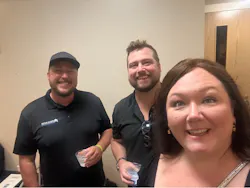
The day concluded at an Auto Care Association YANG meetup where conversations from the classroom continued. Some of the best learning all week wasn’t happening during presentations; it was happening afterward in hallways and over meals.
Your Network Is Your Net Worth
When I first heard that phrase years ago, I assumed it was about career advancement. The older I get, and the longer I spend in this industry, the more I realize it is about something entirely different—it’s about relationships, trust, and surrounding yourself with people who challenge your thinking, expand your perspective, and make you better than you would have been on your own.
Throughout the day, speaker after speaker reinforced different versions of the same message.
- Steve Gorham reminded us that leadership meant understanding the financial implications of our decisions.
- James O'Dell reiterated that leadership is not about having all the answers yourself. Sometimes it’s about knowing who can help. Who, not how.
- Phil Fioravante challenged us to become more adaptive, more self-aware, and more intentional in how we lead.
- And our classmates proved that some of the smartest people in the room are often the people most willing to help others.
After watching 44 different challenges cover the walls earlier in the day, one thing was clear: none of us are expected to have every answer, but collectively, we possess an incredible amount of experience, knowledge, perspective, and willingness to help.
That’s leadership. Not standing above people; standing alongside them.
"Coming together is a beginning. Keeping together is progress. Working together is success." —Henry Ford
Three days into Leadership 2.0, I now realize that leadership and networking aren’t separate concepts. Both are rooted in relationships, built on trust, and require intentional effort. And both become stronger over time because at the end of the day, your network is not simply your net worth. Your network may be your greatest leadership asset.
About the Author
 Chris Messer
Chris Messer
Executive Vice President | Transportation
Chris Messer is the Executive Vice President for Endeavor Business Media's Transportation Group.