I’ve shared the story of how I ended up selling my 2013 Ram pickup with a 5.7-liter Hemi and buying my son’s 2003 Ford F-350 dually equipped with a 6.0-liter diesel. It’s a decision I have yet to regret. The truck has relatively low mileage with only 120,000 miles or so on the clock and for a diesel, that’s not even broken in yet. Another advantage is having friends in the business who know the 6.0 inside and out, advising me on steps I should take to ensure its future reliability. Based on that advice, I’ve amassed the materials needed to “bulletproof” her and I’m relatively confident that once I do, she’ll serve me for some time to come.
Keep in mind that I don’t drive the truck very often. If the weather permits, I’ll take two wheels over four any day. But my son tends to use it quite a bit as part of his RV rental business and the only real problem I’ve ever had with it was on a trip he took to pick up a small travel trailer on the Florida/Georgia line a few years ago. My wife was riding shotgun with him and on their return trip, she called me to explain the truck appeared to be losing power.
I’m not a diesel tech (at that time, anyway) and was thinking of the problem from a gas guy’s perspective. Of course, many of you likely already have ideas on what to look for when the 6.0 experiences these symptoms. Luckily, my wife and son were fortunate enough to find a shop nearby with techs like you and they, too, knew what to look for first.
Oil level and condition come to mind. The 6.0 injection system requires a clean supply of oil to function so that was one area they looked at first. Next was fuel and fuel pressure. Therein lay the problem! While I made sure to change the oil and filter regularly, the idea of checking the fuel filter (let alone, filters) hadn’t crossed my radar yet. The primary filter and secondary filter were well beyond their serviceable limits and two new filters later, they were back on the road. Today, I change the oil filter and oil every 5,000 miles and both fuel filters are replaced every 10,000.
Another 6.0 joins the family
Recently, my son purchased another 6.0 — this one a 2004 F-250 that is nearly as clean as mine. He, unfortunately, has experienced a few issues that I have yet to deal with. When he first purchased it, he noticed that the “Water In Fuel” warning light was lit and brought it by so that I could do a little troubleshooting.
As is my practice, I did a full system scan on the truck and discovered a few other potential issues. Specifically, I found a P0299 (Turbocharger Underboost) and a P0401 (EGR Insufficient Flow Detected), along with four out of eight glow plugs setting codes of their own. Since we live in central Florida, I wasn’t too concerned about the glow plugs. The first two, though, needed some attention.
My son told me that he hadn’t experienced any driveability issues with the truck, and that it ran like a scalded cat! A short test drive confirmed that the 6.0 certainly didn’t lack any power. We checked the fuel module under the truck and didn’t see any evidence of water, but we changed the filters for good measure. Both looked a lot better than the ones they changed that first time on my truck! I cleared the codes and told him to drive it for a few days and we’d see what came back.
The “Water In Fuel” message continued to come and go, so he had a local shop replace the sensor while they had it in for an oil change. That took care of the warning light and no other running issues appeared. For a week or so, anyway.
From good start to hard start
Not long after he purchased the truck, he used it to tow one of his rentals for a customer, a service he offers for free if it’s close to home. After he hooked up at our place, he stepped in the house for a bite to eat before heading out. When he went to start the truck, it turned over, a bit harshly, and way too long before he shut the key off and tried again. He got the same result the second time around.
I heard the truck struggling to start so I went out to see if I could help. A third, long extended crank finally got it running, but I told my son to unhook it from the trailer and use mine instead. The last thing I wanted was to have him call me stranded somewhere far away from my garage and tools.
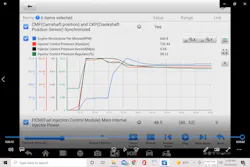
Here’s where another experience came into play. I failed to mention that I did have to deal with a sudden “no start” condition of my own and that’s when I learned the fundamentals of the 6.0’s injection system. I looked at the key PIDs and verified that the engine was cranking fast enough, that there was sufficient battery voltage to the Fuel Injector Control Module (or FICM), and there is where I found a problem. The battery voltage was where it should be, but the 48v needed for the injectors to function was well below its threshold. A new FICM board corrected that issue.
Naturally, one of the first steps I took to diagnose my son’s issue was to review the same PIDs. But in his case, all was where it should be. FICM voltage checked find, Injector Oil Pressure was above minimum, cam/crank and injector synch — all were within specs. I checked for any Diagnostic Trouble Codes and found nothing stored in the ECM either.
Maybe being a gas guy at heart isn’t so bad after all.
Attack the symptoms
Trying to start the truck again yielded the same results — extended crank with the batteries feeling the pain after a bit — and then it would start. If you shut it down and immediately restarted it, the truck fired right up. In my gas days, I would suspect loss of prime in the fuel delivery side of the injection system as a potential cause.
I studied up on the system a bit to see if the same would apply to a diesel application. The fuel pump is located in a module that is mounted on the frame rail, nearly aligned with the driver’s door. In addition to the pump and filter, it also contains a heating element and the “Water In Fuel” sensor. The pump sends fuel to a secondary fuel filter, where it is fed to two rails that carry it to the injector fuel passages on either side of the engine.
The rails have a one-way valve to prevent fuel from draining from the rail, preventing air in the injectors — something I have also learned is a bad thing and a leading cause of injector failure. I also learned that there is a high-pressure relief valve in the secondary filter housing that is supposed to dump excess pressure (over 45 psi or so) back to the fuel module.
To test my theory, I needed to first confirm that fuel pressure was in specification and then check to see if the pressure dropped as the key was turned off. If you know where the official test port is located, you’ll understand why I wasn’t crazy about trying to tap into that. An aftermarket solution was a modified secondary filter cap that had a test port built into it - an accessory I was cautioned against by 6.0 techs I trust. The last option was also a simple one. Crawl up under the truck and connect my fuel pressure gauge directly to the pump outlet.
But I really didn’t want to crawl in the dirt and, at the time, didn’t have room in the shop to bring it inside.
So, I decided to break out my Pico 4425A and a low amp probe as my first step. Now, where to tap into the fuel pump circuit? Aha! Let’s get that probe clamped around the wire going to the Fuel Inertia switch Ford liked to use! It’s easy to get to, located under the right-side kick panel.
The pump will run for 20 seconds after key on but I didn’t need to let it run for long to see that the pump was drawing only 2 amps or so. That is well below what I’m used to seeing, and if that old rule of thumb of “1 amp per 10 psi” were true, I should be reading more like 4-6 amps.
What can cause a fuel pump to draw less current than it should?
Well, it could be shorted electrically but the individual humps looked normal enough. We also need to remember that the current draw of any motor is also related to the amount of work we’re asking it to do. In this case, the pump wasn’t working very hard! My conclusion? Let’s look at the high-pressure relief valve.
Can current provide a diagnostic direction?
I removed the valve and didn’t see anything on a visual inspection that pointed to an obvious problem, but since it was good practice in the 6.0 world to replace the valve with its updated “blue spring” counterpart, I replaced it anyway.
Repeating the current draw test now showed a pump that was trying to build pressure. It would start out at 2 amps and work its way up to 5 amps. OK, I thought, let’s see if my assumption of pressure loss after sitting is legit. I cycled the key on/off three times to allow the pump time to fill the system and build some pressure and looked at the current draw again on the fourth key on cycle. I was rewarded with a steady 5 amp reading!
So where is the pressure being lost? I had no choice now but to climb under the truck and test the actual pressure at the pump module. I never had to perform that test because as soon as I crawled under, I could see and smell the fuel leaking from the module. Wiping it off with a clean rag revealed a leak at the “Water In Fuel” sensor — the sensor that had been recently installed if you recall.
Checking the service information, you remove the sensor by turning it counter-clockwise a bit, and then just pull it out. To install it, you needed to press it in BUT the sensor had to be oriented in a specific way.
This one was not. It was out of synch by 90 degrees.
I removed the sensor and inspected the seal. It was intact so, I thought, nothing from nothing leaves nothing and reinstalled it, this time with the connector tabs pointed downward as outlined in the service information. No more leak and no more extended crank!
I wish that were the end of the story of my son’s 6.0 Powerstroke, but if you follow me on social media, you know that this incident only marked the beginning of my adventure into diesel repair. And that’s a story for another time!
About the Author
 Pete Meier
Dorman Training Center Instructor and Former Creative Director, Technical | Vehicle Repair Group
Pete Meier is the former creative director, technical, for the Vehicle Repair Group with Endeavor Business Media. He is an ASE certified Master Technician with over 35 years of practical experience as a technician and educator, covering a wide variety of makes and models. He began writing for Motor Age as a contributor in 2006 and joined the magazine full-time as technical editor in 2010. Pete grew the Motor Age YouTube channel to more than 100,000 subscribers by delivering essential training videos for technicians at all levels.
Connect with Pete on LinkedIn.
Related

 Dreamstime M 263862880