
I’ve always prided myself on being comfortable with cutting-edge practices and technology. I’ve watched from afar as many industries and professions have adopted AI into their workday and, honestly, I thought it was something for other people, but not for an auto mechanic like me. In a recent PTEN advisory committee meeting, the group was asked how we are using AI in our shops. Every shop owner and technician on the call was pretty quiet because the truth is we really aren’t using AI, let alone using it in any powerful way. Before this meeting, my thought was AI would only be useful for pointing to what the most likely bad part was, which is pretty far from anything technical or ethical.
The conversation stuck with me for a while and eventually manifested into me deciding I was going to use AI to diagnose a car that presented as relatively complex to sort out. Not necessarily the hardest car, but one that another shop had tried to fix and failed and a car that had multiple symptoms going on. My expectation was that the results would prove that AI doesn’t have a place in the repair bay.
In early September 2026, the perfect storm of a car showed up on my doorstep. The car belongs to a first-time client, so I knew nothing about the car’s repair history. It is a 2008 Chevy Aveo, and its complaint list was: check engine light on, runs rough, runs worse when cold, and stalls cold when backing up. This car had been to two other shops over the course of a few months, and after almost $1,500 invested, the vehicle owner was at their wit’s end with frustration. The journey started with the client authorizing two hours of testing time.
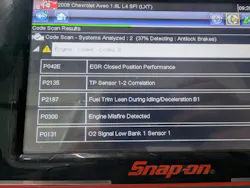
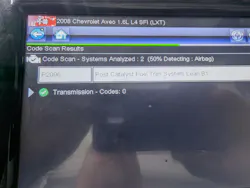
My initial look over included a very short road test and doing a pre-scan with my Snap-on Modis Edge. I noted the following codes: P042E, P2135, P2187, P0300, P0131, P2096. The car ran terribly, and cylinders 1, 2, and 4 were counting active misfires. Long-term fuel trims were disabled, and short-term were over +25. The MAP sensor was reading between 14-16 inHg.
Putting AI to work
Now it was AI’s turn. I chose Google AI on my Pixel 8 phone because it’s free, reasonably powerful, and easy to use. My basic ground rules were to gather baseline data and symptoms and let the AI instruct me what to do for testing, even if it wasn’t the exact step or order I would do. I figured that if and when AI failed, I would just go back and do it my way. I entered the vehicle information, the codes, and the symptoms and asked Google AI, “Where should I start my testing?”
It is worth noting that the codes were quasi-related to oxygen sensors, EGR valve, and throttle body, at least those components were listed in the codes. It seems to me previous attempts to repair focused on the parts related to the listed codes and not what the codes meant. This is a classic mistake I’ve seen plenty of techs make, and I expected Google AI to suggest replacement of these components as likely culprits.
Following the diagnostic process
To my surprise, the AI instructed me, as a first step, to do a visual inspection of the MAP sensor and its related vacuum hose. I actually found the hose had been replaced, and instead of a hard plastic hose, someone had installed a soft hose and kinked it to make it fit. An easy fix to resolve, so I did and then cleared codes and rechecked my scan data. Misfires were mostly gone, long-term fuel trims were working now and showed around +29, short-term floated between +/- 0-3, and the MAP still stayed around 10 inHg.
I shared the result with the AI, and it instructed me to check for a leaking EVAP purge solenoid by temporarily capping where it plugs into the intake. I did and watched the LTFTs drop to 20+. Active misfires were completely cleared up now, and the computer was happily in closed loop, though I recognize the trims would eventually set lean codes. MAP remained at 14 inHg. At this point, I’m super interested because the AI has led me to two issues. Of course, we still aren’t fixed, but it’s really positive progress.
Further updating the AI with the results from the previous steps, it surmised that we have a vacuum leak at either the intake or the valve cover (PCV system). The AI suggested smoke testing the intake or using a brake cleaner or carb cleaner and spraying it at the intake while the engine is running. I am familiar with both tests, so I performed both. The results were zero change in fuel trims and zero leaks found with smoke. Next, it instructed me to disconnect the PCV hose from the intake to the valve cover and cap it at the intake. I did this and started the engine. Fuel trims dropped to zero +/- 3. MAP was still hovering at 14 inHg.
I updated the AI with test results, and it concluded that we’ve proven a MAP sensor line restriction, a leaking purge valve, and a leaking PCV system that requires a new valve cover to resolve, but it pointed out a concern about the low manifold vacuum. It suggested I do a test to see if the sensor is reading accurately. The test is engine off, key on, check MAP reading. Does it match the 29.5 that it should read at sea level? It did match. The AI concluded the sensor is working properly. Now, the AI wants to determine if the issue is caused by an exhaust restriction or by an engine timing issue. It proposes that I pull the upstream O2 sensor and start the engine while monitoring the MAP PID. I do this, and there is no change in MAP readings. Still hovering around 14 inHg.
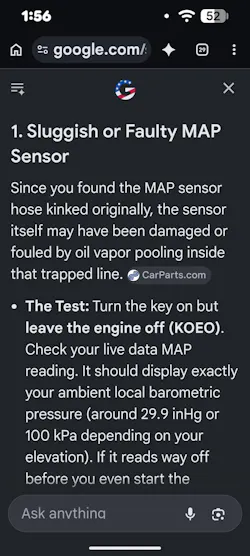
I updated the AI with test results, and it concluded that we’ve proven a MAP sensor line restriction, a leaking purge valve, and a leaking PCV system that requires a new valve cover to resolve, but it pointed out a concern about the low manifold vacuum. It suggested I do a test to see if the sensor is reading accurately. The test is engine off, key on, check MAP reading. Does it match the 29.5 that it should read at sea level? It did match. The AI concluded the sensor is working properly. Now, the AI wants to determine if the issue is caused by an exhaust restriction or by an engine timing issue. It proposes that I pull the upstream O2 sensor and start the engine while monitoring the MAP PID. I do this, and there is no change in MAP readings. Still hovering around 14 inHg.
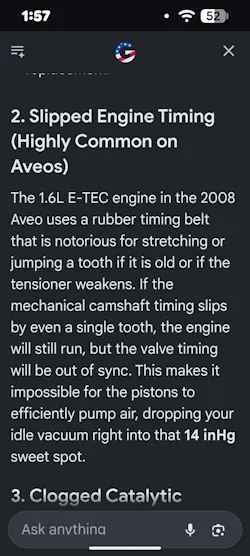
At this point, the AI concludes that we must have a timing belt that is a tooth or two off. It cites cases where the 1.6L engine would run mostly okay when configured like this. I don’t have firsthand knowledge to support or contradict this, but I agree that a base timing issue is likely the only thing left, even though there isn’t a smoking gun for proof. At this point, the AI is pretty much considering this an open-and-shut case. It is worth adding that none of the testing addressed the EGR or throttle body codes, but they hadn’t returned yet, either.
I ask the AI if it could summarize everything and email it to me, and it does. I received a well-written, step-by-step process that makes it easy to share the findings with my client. The AI did almost as good of a job writing it out as I would. Remember, I’m using a free Google AI; I can only imagine how much better the big-name, paid versions are at writing up synopses of processes and test results.
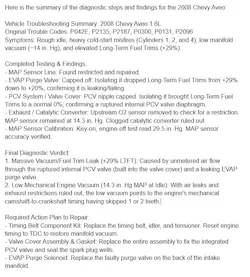
I ask the AI if it could summarize everything and email it to me, and it does. I received a well-written, step-by-step process that makes it easy to share the findings with my client. The AI did almost as good of a job writing it out as I would. Remember, I’m using a free Google AI; I can only imagine how much better the big-name, paid versions are at writing up synopses of processes and test results.
I take a few minutes to process all the steps. I can make an argument for what I may have done differently, probably faster, and gotten to the same conclusion, but I decide that the steps and order were also very reasonable, and the end result was very good. During a period of brutal honesty, I admit to myself that if it wasn’t for the AI, I may not have rechecked the MAP value once fuel trims were good. Once I saw fuel trims were good, maybe I would have assumed that the MAP was good now because the car ran normally. That’s a bit of a tough pill for me to swallow. I pride myself on being pretty darn thorough, and maybe the AI helped me be a little more thorough than I would have been.
Confirming the diagnosis
Also, if it were my testing process, I probably would have suggested additional testing time for the timing belt, and I probably would have suggested pulling an in-cylinder pressure waveform to confirm the timing issue. So, I opted to share the findings with my client, but I put a different spin on the timing belt. Instead of automatically replacing it, I suggested either doing an inspection of the belt’s physical condition or grabbing an in-cylinder pressure waveform. I hate to over-fix anything. The client responds that “the belt is at least 10 years old and way past its service life expectancy; can we please fix everything including the belt as a maintenance item?” By the way, I left open the possibility of future EGR or throttle body issues. My gut expects to have to visit these someday, but for now, I concede the codes haven’t returned.
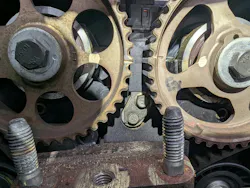
During the repair, with the timing cover off, sure enough, the old timing belt marks don’t line up. The new belt installed with no issues, and post-repair, I showed fuel trims at nearly zero, +/- 3, and the MAP pressure reading at idle was roughly 10 inHg. The car is fixed.
Where AI fits in the repair bay
While there definitely was some complexity, I don’t think this was a particularly difficult car to figure out. However, it did stump two other shops, and I can easily see how they made the mistakes they made. I am very confident that I could have fixed this car without AI. In fact, maybe I would have gotten to a good-running car a few steps faster. Post-repair, I find myself wondering how the testing process would have changed if I informed the AI early on that I had a PicoScope available to use. Maybe the reason it didn’t recommend in-cylinder testing was that it didn’t know I was tooled up and capable of running a scope? I’ll do more experimenting with AI as time goes on. I definitely see this as being a valuable tool for most repair shops.
It is important to note that there were some potential holes or pitfalls in the AI’s process, and I’d never say that AI is a solid lock or guaranteed solution for difficult diagnostic strategies. For sure, I can see how AI could easily lead someone down the wrong path. Maybe in a future article, I’ll get more in the weeds with the potential problems AI could present and how to help mitigate those potential pitfalls.
The big takeaway is that AI was able to propose a reasonable diagnostic strategy that was fluid enough to change as the information fed into it was updated, and that has value. The value of AI isn’t that it is going to replace the auto technician or even replace a diagnostic technician. The value is in AI’s ability to process all the known information and plan a course of action. For top diagnostic techs, maybe AI has less value in the testing process, but for shops in general, it will help them produce reliably fixed cars, and it’ll help the service writer explain why testing vehicle issues costs what it does. At a minimum, any shop owner who is struggling with getting reliable testing results from their team should consider carefully implementing AI, with a how-to-use-it SOP, to see how it can help them produce consistently positive diagnostic results.
About the Author
 Pete Rudloff
Owner, Pete's Garage, Inc.
Pete Rudloff is a nationally awarded technician, national automotive instructor/consultant, technical writer, software developer, automotive trade advocate, and owner of Pete’s Garage Inc. in Newark, Del. Rudloff has a national reputation as friend to the general auto repair shop and is known for fixing difficult to fix cars and facing challenging trade issues head-on. In 2016, Rudloff created FlexCheck Auto DVI in order to help independent auto repair shops nationwide increase their revenue.
Related
 Is it possible that AI will handle automotive repairs in the future?