Paschen's Law: The Physics Behind Every Firing Line
Key Highlights
- Paschen's Law describes how breakdown voltage depends on pressure and gap, influencing spark plug firing under different engine loads.
- Electrode wear and insulation degradation increase the voltage demand, potentially causing misfires at high load conditions.
- Testing firing voltages across cylinders can reveal low trapped pressure or coil issues, aiding targeted diagnostics.
- Fine-wire iridium electrodes and gap adjustments help maintain margin and improve ignition reliability under demanding conditions.
- Understanding the physics behind spark formation enables better troubleshooting and design of more robust ignition systems.

The voltage it takes to fire a spark plug is set by the gas between the electrodes, not the coil. A law published in 1889 predicts it—and it explains load-only misfires, power balance results, and most of what a secondary waveform shows.
The complaint reads like a contradiction. Smooth idle. Power balance shows every cylinder pulling its weight. But the customer feels a stumble climbing the on-ramp, and the freeze frame on the P0303 backs them up: 84% calculated load, 3,400 rpm. The car isn't lying in either place. The difference between the two tests is measured in kilovolts, and the physics governing it was published in 1889 by Friedrich Paschen.
What the Law Says
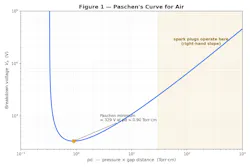
Paschen's law says the breakdown voltage of a gas gap depends on the product of pressure and gap distance. Plotted, that relationship is a U-shaped curve, and for air, the bottom of the U sits near 330 volts. Left of the minimum, too few molecules remain to sustain ionization, and demand rises again; vacuum insulates. To the right, where every running engine lives, demand climbs steadily with pressure times distance.
The mechanism is an electron avalanche. A free electron accelerates in the field, knocks a second loose, two become four, and within nanoseconds the gap is a conductive plasma channel. Higher pressure shortens the distance between collisions, so electrons need a stronger field to reach ionizing energy. Breakdown takes more voltage.
From the Curve to the Cylinder
In an engine, the gap distance is fixed by the plug spec. Pressure is not, and load is the pressure knob. A 0.040-inch gap that breaks down around 2 to 3 kV in free air may fire at 8 to 12 kV at idle, where the closed throttle limits cylinder fill. Open the throttle and pressure at ignition timing runs ten times atmospheric and up; demand can double or better, and boost stacks on top of that. The gap that asked 10 kV at idle can ask 25 to 30 kV at that freeze-frame load point.
Strictly, the law tracks gas density rather than pressure alone: a cold, dense charge raises demand, a hot chamber eases it. A lean charge demands more than a rich one, so a vacuum leak at one runner tags that cylinder's spike.
Supply, Demand, and the Margin Between
Every firing event is a negotiation between cylinder demand and coil supply, and the system ages from both ends. Electrode wear opens the gap and rounds off the sharp edges that concentrate the electric field, raising demand. Heat cycling degrades winding insulation and boot dielectric, capping supply. A hairline crack in the insulator or a faint carbon track adds a rival path that needs, say, 20 kV to flash over. At idle's 10 kV demand, that path never conducts, and the engine runs clean. At 28 kV of demand, the spark exits through the crack at one atmosphere instead of jumping the gap at twelve, because the outside route is cheaper. The misfire monitor logs the result, and only at load.
Test Where the Demand Lives
An idle power balance can't expose a margin problem because idle never presents the bill. Get demand up. On a scope, a snap-throttle test shows firing voltage jumping cylinder by cylinder; the one that spikes and cuts out is your margin casualty. A recorded road test at the freeze-frame load cell does the same with the PCM's own misfire counters, and Mode 6 data sorted by cylinder shows whether the fault tracks load or rpm. In a dark corner, brake-torquing in gear will sometimes light up a tracking boot with visible corona.
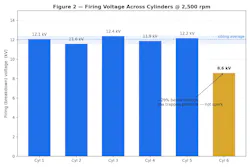
Run the logic the other direction, because Paschen cuts both ways. A cylinder that drops on power balance while showing a firing spike lower than its siblings isn't short on voltage. Low breakdown voltage at a known gap means low trapped pressure, and that branch of the tree is mechanical or fuel.
Read the Firing Line as Instrumentation
Line up firing voltages across all cylinders at a steady 2,500 rpm; they should sit within a couple kV of each other. One cylinder consistently 25% to 30% below its siblings, on plugs of matched age and gap, is reporting low trapped pressure. That's a running relative compression check, no cranking required. It won't separate rings from a valve seat from a wiped lobe, but it tells you which hole earns the in-cylinder transducer.
The same pattern shows the coil's budget. A modern pencil coil stores 60 to 100 millijoules, breakdown spends part of it, and the cost climbs steeply with kV, so spike height and burn time trade against each other: a cylinder demanding 30 kV shows a short burn, while a fouled plug firing at 4 kV burns long and lazy. A marginal coil can meet idle's demand and go bankrupt at wide-open throttle, and the pattern shows it as a tall spike with a burn too short to finish the job.
Margin by Design
Manufacturers run the same math. Fine-wire iridium center electrodes, down around 0.6 mm, concentrate the field at a sharp point and knock several kV off demand at the same gap and pressure. A plug whose fine tip has eroded round quietly hands that margin back. Boosted applications gap down toward 0.026-inch to offset the extra pressure with less distance.
Power balance names the cylinder. Paschen's law names the conditions, and the conditions sort the causes. A failure that appears only when demand is high points to supply: coil, boot, wire, or a gap grown past spec. A failure at all loads with a low firing spike points to the pressure itself. Match the failure to the pressure it happens at, and the parts cannon stays in the drawer.
About the Author
 Noah Nelson
Noah Nelson
Technical Editor | Motor Age
Noah Nelson is the Technical Editor for Motor Age Magazine. As an ASE Master Certified Automotive Technician (A1–A9) with 25 years of hands-on industry experience, Noah specializes in advanced electrical systems, vehicle communication networks, and physics-based diagnostic workflows. He is currently documenting his pursuit of the prestigious ASE/AutoCare Association World Class Technician registry.