What Is ADAS and Why Your Shop Can't Ignore It Anymore
Key Highlights
- 61.39% of shops surveyed lack a systematic process to identify vehicles needing ADAS calibration during intake.
- 25% of shops say they're avoiding ADAS services altogether because of liability concerns.
- Only 7.25% of shops strongly agree they have a clear strategy for educating customers on ADAS-related price increases.
- 46.70% of shops have not pursued formal ADAS training, despite equipment manufacturers offering training options.
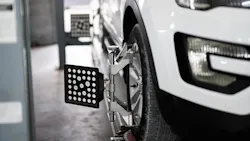
Tom Palermo says there's no getting around it. Advanced driver assistance systems, or ADAS, are here to stay, and the way things are moving, there's more to come.
"I don't see how a shop can get away from doing some work in some way, shape, or form with ADAS," says Palermo, one of the owners of Preferred Automotive Specialists in Philadelphia, Pennsylvania. "If they can do it now, they're not going to be able to do it much longer because these cars, all these systems are all starting to work together. There's just no way around it."
ADAS uses software, sensors, cameras, and radar to improve driver safety and reduce driver error.
Why Is ADAS on Nearly Every New Vehicle?
The primary reason ADAS has become a standard feature on new cars is safety, with Palermo saying it touches almost every aspect of a vehicle, including collision avoidance, lane detection, and blind spot detection "at a minimum."
He says ADAS started with things like backup sensors and rearview cameras but has evolved to include self-parking, collision avoidance, adaptive cruise, blind spot detection, and in some cases, semi-autonomous driving.
"All of those items … they all just kind of blossomed as the technology and vehicles really exploded over the last, I'd say probably 10 to 15 years, to the point now where just about every new car that's purchased has some form of assisted driving capability," Palermo says.
When Is ADAS Calibration Needed?
Palermo says any time things like alignments, suspension work, and windshield replacement are done, it changes the vehicle's geometry, which requires ADAS calibration.
"Even though you may not be modifying the parts, you're changing them back to closer to what they were when they were new, so you have to calibrate that vehicle to those changes, and it could be minute, but it may not even be something perceptible to the average driver, whereas before, you changed something and maybe the car still feels the same when you drive it," he says. "The difference is with this you have all these sensors on the car … and to those particular components, a few millimeters in the wrong direction can mean a lot when you're driving down the road."
He says ADAS calibration may also be needed for repairs that don't directly involve ADAS sensors, pointing to condenser work as an example.
"If you move one of those ADAS parts to get to something and you put it back on, you have to do a calibration," Palermo says. "There is no option because you've disturbed it from where it was calibrated."
Do I Need an ADAS Strategy?
Of those who responded to EndeavorB2B’s ADAS Knowledge and Capabilities survey, 61% said their shops don't have a systematic process to identify vehicles requiring ADAS calibration during intake and service planning, and 38% said their shops had a knowledge gap in understanding the liability and legal implications of ADAS. Twenty-five percent said they're avoiding ADAS services because of liability concerns.
Palermo says it's essential for shops to have a strategy when it comes to working with ADAS systems.
"There's a liability to this, where if you're going to be working with ADAS, you have to make sure that you know what you're doing, and if you don't have the equipment to calibrate it, you want to make sure you find somebody that does to do it," Palermo says. "You don't just want to send the car off into the wild without calibrating it. If you send that car out and something happens to it and you're the last one who put your hands on it, there could be some liability there, obviously, so that's critical from a business perspective."
Are Shops Ready for ADAS?
The ADAS Capabilities Survey showed 39% of shops don't offer ADAS-related services but are considering it, while 49% don't have a business plan for ADAS service expansion. Palermo says shops that don't offer ADAS need to find the right partners to handle the work.
"There's nothing wrong with subletting a calibration to somebody as long as they are qualified, certified, and they're going to give you a good product for when you hand the keys back to your customer," he says.
Of those who responded to the survey, 47% said their shops had not pursued formal ADAS training, but Palermo says manufacturers of ADAS calibration equipment offer many training options for shops. There are other options for training as well, including ASE certification programs, online courses, and webinars.
"It also kind of comes back to the shop has to make sure that their data is right and that they're able to give the technicians the ability to access the information they need to do the calibrations," he says. "That comes down to how the shop is run. Access to information is a huge part of what we do."
Only 7% of respondents strongly agreed that their shops have a clear strategy for educating customers on price increases involving ADAS calibration and related services, something Palermo says his shop wants to get ahead of. He says certifications, along with digital vehicle inspections and pre- and post-scans, help build trust with customers.
"Because of the nature of the cost associated with auto repair now and the additional necessity for calibrations at times, it kind of forces us into having that conversation because we have to justify, 'Hey, we're going to charge X number of dollars for a recalibration,'" Palermo says.
What's Next?
Palermo says ADAS technology will continue to progress.
"I think you'll see it start to take more and more control of the driving experience, if you will, which some people might like, some people might not," Palermo says.
Palermo says he expects to see more autonomous driving capabilities in the future, noting he got a glimpse of Waymo's self-driving technology in action during a recent trip to Atlanta.
"It's kind of weird when you pull up to a light, and you look next to you, and there's nobody in the driver's seat, and the thing takes off from the light," he says. "I mean, listen, the technology's there, and there were some struggles I'm sure in the beginning, but they seem to be perfecting it, and I think eventually, in the next, I don't know, probably 10 years, you might be able to hit a button on your car and say, 'Hey, you know what, I don't feel like driving. You take care of it.'"