Train Your Team to Sell ADAS Recalibration: From Intake to Close
Key Highlights
- Just 27% of front-counter staff feel comfortable explaining ADAS to customers.
- 58% of shops are not currently educating customers on ADAS recalibration.
- Overwhelming customers with too much information can backfire—balance is key.
- Pre-scans before repairs help shops identify ADAS components early in the process.
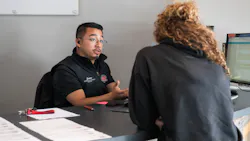
Advanced driver assistance systems, or ADAS, are appearing on more new vehicles every year, making today's cars more capable but also more complex to repair. The sensors and cameras involved with ADAS often mean more work, which can confuse customers who are already navigating a stressful repair.
Ensuring those drivers get the ADAS recalibration they need can mean a balancing act between overwhelming them and not communicating at all. Tom Schearer, president of Schearer's Sales & Service and coach at ShiftPoint Training Academy, is a 2024 Ratchet+Wrench All-Star Award winner with extensive experience navigating this exact issue. He helps break down the strategies used successfully across the myriad shops he's worked with.
Helping the Customer Understand
ADAS and its functions are usually tied to important safety features, such as distance sensors, adaptive cruise control, and lane departure systems. Factory/OE repair information often specifies the need for ADAS recalibration after certain repairs, and insurance companies can require it for a repair to be considered complete on jobs like windshield or bumper replacements.
"If the insurance is requiring it, that's telling us that this is valid, and this is real, and that we have a liability to make sure that we're doing a repair right," explains Schearer. "If we're not doing a proper calibration, there's a good chance that's not going to function right—and we just can't put our name on that."
While shops may understand the importance of ADAS, not every customer will, and some may even view it as optional, or an upsell. With 58% of shops sharing that they are not currently educating customers on ADAS, it's unsurprising that many drivers simply aren't aware of how crucial it is to calibrate those systems.
That knowledge gap can lead to objections over ADAS recalibration. But when you take the time to understand a customer's concerns and discuss it with them, it's often the most impactful method to make the sale on a recalibration job.
"We absolutely get objections from our clients," shares Schearer. "Most of it comes from not understanding. Typically, when we are able to go through and properly educate, they're on the same page with us."
Shops should avoid overwhelming a customer with a barrage of information. That can make them feel more confused. Finding that balance between informing and overwhelming customers is crucial to keeping them on the same page.
"Quite honestly, when we first got started, we just made it such a big deal, and it overwhelmed our clients," says Schearer. "It was almost like we would just scare our customers."
So, how do you communicate the importance of ADAS calibration without inducing anxiety?
Schearer and his team changed their strategy by minimizing the emphasis on ADAS. If a repair job requires any recalibration—such as a control arm replacement or an alignment that requires ADAS recalibration—the shop includes the necessary recalibration in the estimate and presents it to the customer alongside everything else, with a brief explanation.
If a customer has questions about what it is or why it's needed, that's when you can step back and have that discussion with them.
"If the customer has questions, and they're not understanding, then we kind of step back and go into more of an education mode," tells Schearer. "We kind of stopped really focusing on so heavily on the education upfront, because we found it overwhelms them."
Additionally, there are subtle ways to help customers become aware of ADAS and what it does. Having literature in your shop, such as a brochure about ADAS, is a great way to give clients access to that information without dumping it on them.
Equipping Your Staff to Educate
Educating the customer can only be possible if your staff is equipped to do so—but just 27% of front-counter staff feel comfortable explaining ADAS. While those working the front counter aren't expected to have the same skill set as a technician on the shop floor, they need to understand the fundamentals of ADAS and be able to discuss them with a customer.
Training your staff can involve teaching them to look for indicators that ADAS is present on the dash, and covering the basics of adaptive cruise control, lane departure systems, and how distance sensors work. Schearer likes to keep it simple for general staff, avoiding things like model-specific differences and focusing on a baseline foundation for understanding ADAS.
"It's really tough to get into the specifics of 'Honda does this, a Chevy does this, and Audi does that,'" says Schearer. "That's not realistic to put on our support staff, but the basic operating knowledge is what we're focused on."
Schearer has a procedure for staff to identify vehicles that may need ADAS upon intake. They're taught to look for things like sensors in the bumpers, cameras behind the rearview mirror, certain dash warning lights, and other visual identifiers of ADAS. Additionally, if a vehicle has adaptive cruise control, it's usually a sign of features like lane departure, distance sensors, and advanced braking.
Schearer also performs pre-scans at his shops, which identify ADAS components in vehicles before technicians begin working on them.
"Every car that we work on gets a pre-scan done on it before we touch and work on the car. And within that pre-scan, we use a certain company and tool that alerts us whether there is an ADAS-related component or module in that car, and that helps us to know better what that car is equipped with, and if we need to focus on any calibrations throughout the repairs we're doing on that," explains Schearer.
Ultimately, ADAS recalibrations need to be part of your standard and accepted as an essential part of repairing the vehicle. Present it as such, and be a guide for the customer who wants to understand why it's needed. There will always be the occasional client who decides not to pursue it, but most customers aren't just looking for the cheapest job—they want someone they trust.
"Most of the customers really do want to do the right thing. They want to know, they want to understand, so they need somebody to help guide them through the process, and to be an advocate for them," says Schearer.