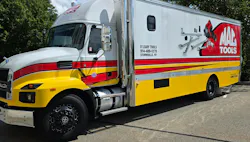
When Steve O’Leary started as a Mac Tools distributor in March 2011, battery and electrical service was a much simpler category.
A jump pack and a basic battery tester could cover many of the needs technicians had. Chargers were there when a battery needed a charge. Electrical testing was often handled with a multimeter. When a battery was replaced without a memory saver, the consequences might have been an annoyed customer who had to reset the clock and radio presets.
A lot has changed in 15 years.
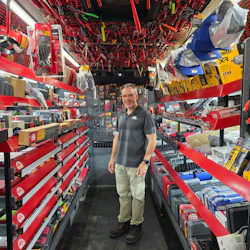
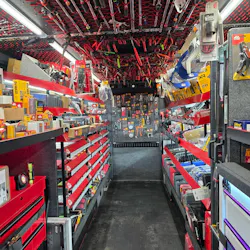
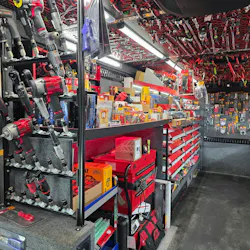
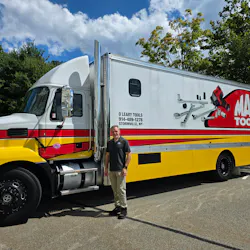
O’Leary now has seven trucks covering New York’s Mid-Hudson Valley, with his own route in Orange County. As vehicles have become more electronically complex, he has watched the battery and electrical products his customers need change right along with them.
“Five years ago, most battery and electrical work started and ended with a jump pack and a basic tester,” O’Leary says. “Today’s vehicles have far more modules, sensors, and tighter voltage tolerances, so a marginal battery can cause a cascade of downstream issues that look like something else entirely.”
For distributors, keeping up with those changes requires more than adding a few new products to the truck. It means understanding how battery service fits into the larger diagnostic process, what technicians are trying to accomplish with the equipment, and, in some cases, being ready to show them how a tool can make the job easier.
More than a charger
One of the biggest changes O’Leary has seen is the role of the battery charger.
“Chargers are a must-have, especially for reflashing work, where shops need a stable power source through the whole process,” he says.
That need for stable power is changing what technicians should expect from professional charging equipment.
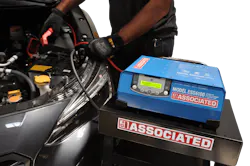
Today’s vehicles can have dozens of electronic modules operating at the same time, and many diagnostic, calibration, and programming procedures require stable voltage for an extended period, explains Kimberly Cottle, CEO and president of Associated Equipment. If voltage drops during module programming or reflashing, the procedure could fail, generate diagnostic trouble codes, or, in some circumstances, damage a vehicle module.
Because of that, choosing a charger is no longer only about how quickly it can bring a discharged battery back up.
“Professional battery chargers have evolved from relatively simple charging devices into essential pieces of diagnostic and service equipment,” Cottle says.
Jim O’Hara, EVP-Merchandising at Clore Automotive, has seen that evolution over his own career. When he joined Clore in 2002, a shop might have had a couple of wheeled chargers that were brought out when needed.
Today, he says, charging should be much more routine.
“Vehicle comes in, the hood goes up, charger goes on,” O’Hara says.
Part of the change comes from what technicians are doing while the vehicle is in the bay. Diagnostics, programming, and other service procedures can place demands on the battery before a repair is even completed.
Battery technology has changed as well.
“Even the ‘easy sells’ have gotten smarter,” O’Leary says. “A lot of today’s chargers can identify the battery type, AGM, gel, standard flooded, and adjust the charge profile automatically, tapering off as the battery approaches full.”
The automation makes the equipment easier to use, but that doesn’t eliminate the need to understand what it is doing.
Cottle points out that AGM, EFB, conventional flooded, and lithium SLI batteries don’t necessarily use the same charging profile. There is also an important difference between charging and power supply or reflash modes. One is intended to restore and maintain the battery, while the other maintains stable vehicle voltage as electrical systems and diagnostic equipment operate.
For O’Leary, those additional capabilities give the distributor an opportunity to do more than simply put a charger in front of a customer.
“It’s still worth walking them through what the charger’s actually doing so they trust it and use it right,” he says.
Find out what the shop needs
As the equipment becomes more capable, recommending the right product also means asking more questions.
Rather than starting with amperage or price, Cottle recommends finding out what kind of work the shop actually performs.
Vehicle mix is one consideration. A general repair shop, dealership, collision center, tire store, or heavy duty fleet facility can have very different charging requirements. Whether the customer services conventional passenger vehicles, start-stop systems, European vehicles, commercial vehicles, or a mix of 12V and 24V applications can help narrow down what equipment makes sense.
From there, distributors can dig deeper. Does the shop perform module programming or ADAS calibrations? Does it need crank assist? How frequently will the equipment be used? Does the charger need to move between bays? What battery technologies does the shop regularly encounter?
“Distributors create the most value when they match the charger to the customer’s work, not simply to the battery,” Cottle says.
O’Hara sees a place for several different types of charging equipment depending on the customer. Smaller smart chargers with power supply capabilities can serve individual bays, while wheeled chargers continue to offer flexibility for shops that need charging, maintaining, jump starting, and other functions.
He describes the wheeled charger as the “Swiss Army knife of the shop.”
The same idea applies throughout the battery and electrical category. The best option is not automatically the tool with the longest list of capabilities. The distributor needs to know what the customer is trying to accomplish.
Diagnosing the draw
Charging is only one side of the equation.
O’Leary says intermittent electrical faults and parasitic draws are two problems his customers continue to face.
“They’re tough because the problem isn’t always present when the tech has the vehicle on the lift,” he says. “It might only show up under certain conditions, or drain slowly enough overnight that it takes real patience to trace.”
At the same time, technicians have more information and more specialized equipment available to help them track those problems down.
David Merendino, senior director of sales - global at Power Probe, says the most important tool is still knowledge.
“A fundamental understanding of wiring schematics is essential, but deeper info on topics like measuring voltage drops across a fuse can help speed diagnostics,” Merendino says.
Tools such as draw testers, fuse testers, and circuit testers can help technicians work through those problems more efficiently, but they do not replace the fundamentals.
That creates another consideration for the distributor selling them.
O’Leary points to Power Probe’s draw and fuse testing products as examples of tools that can be valuable to technicians but may not necessarily sell themselves.
“If the distributor doesn’t know how the product really works, they can really fall behind,” O’Leary says. “While the product is great, it does take more understanding to demonstrate the proper use of the tool.”
For a mobile distributor carrying products across dozens of categories, becoming an expert on every tool on the truck isn’t realistic. Merendino acknowledges that challenge.
“Mobile tool distributors have a huge product line that they offer techs, so it’s challenging to become an expert on every tool,” he says. “Knowing where you can get dependable info is critical.”
Manufacturer training videos can help fill that gap. Power Probe, for example, offers short- and long-form videos and places QR codes on products and advertisements that direct users to demonstrations. Merendino says distributors can use those resources with customers while also learning more about the tools themselves.
It’s a way for distributors to educate themselves without having to become electrical trainers overnight.
Battery service touches more of the vehicle
Another reason product knowledge matters is that the consequences of battery service have changed.
Merendino uses the memory saver as an example.
Years ago, replacing a battery without one might erase the clock or a customer’s radio presets. It was inconvenient, but usually little more than that.
Today, a loss of power during battery replacement can mean having to reset functions such as window or sunroof motor limits or perform certain safety system relearns.
That same interconnectedness is why O’Leary says scan tools have become a bigger part of battery and electrical work.
“Scan tools have gotten a lot more capable on the charging system side, so a lot of diagnostic work that used to require separate equipment is happening right through the scan tool now,” he says.
The change has altered what O’Leary considers a well-rounded battery and electrical offering.
“A well-rounded offering needs to cover testing, charging, and diagnostics together, not just one piece,” he says.
For parasitic draws, he points to specialized testing equipment that can help technicians isolate the source. Load testing on both the power and ground side is another capability he sees value in, particularly because electrical issues don’t always originate where a technician initially expects them.
“A lot of electrical gremlins actually trace back to a bad ground, not the power side people usually check first,” O’Leary says.
Combine that type of electrical testing with smart charging equipment and the diagnostic information available through a scan tool, and the category looks considerably different than it did just a few years ago.
Don’t overlook the jump starter
Not everything in the category requires a lengthy demonstration.
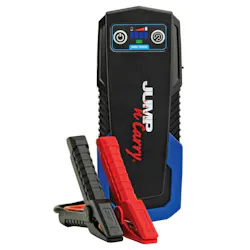
O’Leary says compact lithium jump packs have become increasingly popular with his customers.
“Techs like the smaller footprint and how easy they are to grab and use on the fly,” he says.
O’Hara has also watched lithium jump starters make significant gains in capability compared to where the technology was five or 10 years ago.
That doesn’t necessarily make lead-acid jump starters obsolete. Different customers and applications can still call for different solutions, and O’Hara says distributors should understand those differences rather than assuming one technology is right for every shop.
That goes back to the same question distributors should be asking throughout the category: What does this particular customer actually need?
Getting ready for hybrid and EV service
The next shift is already happening.
As more hybrid and electric vehicles enter repair shops, O’Leary says distributors should pay attention to the equipment technicians need to work around higher-voltage systems.
“Old-school multimeters just can’t cut it anymore,” he says.
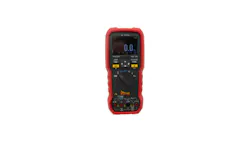
O’Leary points to CAT III and CAT IV rated meters, as well as insulation testers, as products that are becoming increasingly relevant. On his own truck, that includes Mac Tools’ EM830 and EM930 meters and EM680 insulation tester.
“Distributors who aren’t stocking rated meters and insulation testers are going to fall behind as more of these vehicles come through shop doors,” he says.
For shops, however, preparing for that work can present a dilemma.
“Shops are hesitant to make a significant equipment investment without knowing the total amount of EV and hybrid work that will come into their shops,” Merendino says.
Power Probe developed its PPEVTEST with that concern in mind. The tool combines a CAT-rated multimeter, 1 kV insulation tester, and true-Kelvin clamp milliohm meter into one unit designed for electric and hybrid vehicle service.
Electrification doesn’t mean the low-voltage side of the vehicle is going away, either. Cottle notes that although an EV or hybrid may use a high-voltage propulsion battery, it commonly still relies on a low-voltage battery to operate computers, controls, contactors, and safety systems.
Looking ahead, she expects charging equipment to continue moving toward higher continuous output, more precise voltage control, broader battery chemistry support, and better documentation and connectivity.
For the distributor, that means the category will likely continue to grow rather than simply swap old products for new ones.
Keep learning
O’Leary has already watched the transition happen once. What used to be a category built largely around testing a battery, charging it, or getting a vehicle started now touches programming, scan data, circuit diagnostics, battery chemistry, module operation, and increasingly, hybrid and EV service.
The products have become smarter, but selling them can require the distributor to get smarter about the category, too.
That doesn’t mean knowing every specification on every piece of equipment. It means understanding enough to ask the right questions, recognize what a customer is trying to accomplish, and know where to turn when a product requires a deeper explanation.
After 15 years in the business and with seven trucks now covering the Mid-Hudson Valley, O’Leary has seen firsthand how quickly those needs can change.
For distributors looking at what to stock next, his advice throughout the category comes back to the same idea: understand the application, understand the tool, and be prepared to show the customer why it belongs in their shop.
About the Author
 Nadine Atiya
Nadine Atiya
Editor-in-Chief
Nadine Atiya is the editor-in-chief of Professional Tool & Equipment News (PTEN) and Professional Distributor magazines. She has been covering the automotive aftermarket since 2021, after graduating from Kent State University with a bachelor's degree in journalism and marketing.
Don't miss Atiya's next article. Sign up for PTEN or Professional Distributor's weekly newsletter.