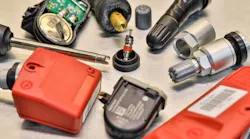
Tire retailers, fast lubes want changes to TPMS info in owner's manuals
Are aftermarket retailers and service providers paying the price for the failure of auto manufacturers to disclose key information about tire pressure monitoring systems (TPMS) in owner's manuals? That is the argument a couple of aftermarket trade associations are making to the National Highway Traffic Safety Administration (NHTSA). NHTSA has asked small businesses to weigh in on a number of existing regulations that have come up for review under the Small Business Regulatory Enforcement Fairness Act of 1996. One of the rules up for review concerns TPMS.
Like this article? Sign up for our enews blasts by clicking here.
Patricia Wirth, president, Automotive Oil Change Association (AOCA), says dealer information overstates the life cycle of TPMS sensors, which only extends to battery life anyway, not sensors. So when a fast lube checks tire pressure on a car, the sensor valve stem can break, through no fault of the technician. The average breakage response cost is $103, and thus far 88 percent of customers — who have received no education or anticipated maintenance/cost schedules from automakers — deny responsibility for what Wirth refers to as “mystery” parts and expects the service provider to pay for it.
Unlike all other important and expected vehicle maintenance requirements, owner’s manuals say nothing about TPMS maintenance schedules and/or anticipated component replacement benchmarks; i.e., 5 years/30,000 miles for replacement of sensors; 1 year/10,000 miles for sensor valve stem replacement; etc.
The problem for tire retailers is a bit different. Roy Littlefield, executive vice president, Tire Industry Association (TIA), says consumers, after having new tires installed and finding that their TPMS "telltale" indicator will not go off, take the car to the dealer, who installs a new sensor with the customer going back to the retailer and billing him for the repair cost. Littlefield says that represents dealer "extortion."
On most vehicles, the low-pressure telltale symbol serves two purposes: one to indicate a tire with low inflation pressure and the other to indicate a malfunction. Since the owner’s manual is not required to explain the difference, the burden often falls on the tire retailer, who must explain why a telltale that stays illuminated after the bulb check represents a low tire and a telltale that blinks for 60-90 seconds and then stays illuminated represents a malfunctioning TPMS. Littlefield argues that when the vehicle manufacturer uses the letters “TPMS” to indicate a malfunction, it should be explained in the owner’s manual to avoid any confusion.
Both Littlefield and Wirth want the NHTSA to upgrade information on TPMS systems auto manufacturers should include in those manuals. Manual contents are specified under Federal Motor Vehicle Safety Standard S4.5. Other rules the NHTSA is reviewing pertain to windshield defrosting and defogging systems; windshield wiping and washing systems; brake hoses; lamps, reflective devices and associated equipment; and light vehicle brake systems.
Safelite hits proposed glass changes
One of the major aftermarket auto glass installers has some big problems with a proposed new federal glazing standard. Rich Glover, AVP of Manufacturing and Distribution,
Safelite Glass Corp, wants NHTSA to alter its proposed changes to Federal Motor Vehicle Safety Standard (FMVSS) No. 205, Glazing Materials. "Two components of the proposal have the potential for being overly burdensome for the aftermarket automotive glazing suppliers," he says.
NHTSA proposed the changes in June 2012 because it wants to harmonize the U.S. national glazing standard with an international standard. That would be the Global Technical Regulations (GTR) adopted by the United Nations/Economic Commission for Europe.
The changes to the FMVSS 205 would modernize the test procedures for tempered glass, laminated glass, and glass-plastic glazing used in front and rear windshields and side windows. Last June, when NHTSA proposed the changes, it said most of them "would constitute minor amendments."
Subscribe to Aftermarket Business World and receive articles like this every month….absolutely free. Click here.
About the Author
 Stephen Barlas
Stephen Barlas has been a full-time freelance Washington editor since 1981, reporting for trade, professional magazines and newspapers on regulatory agency, congressional and White House actions and issues. He also does a column for Automotive Engineering, the monthly publication from the Society of Automotive Engineers. He covers the full range of auto industry issues unfolding in Washington, from regulatory rulings on and tax incentives for ethanol fuel to DOE research and development aid for electric plug-ins and lithium ion battery commercialization to congressional changes in CAFE standards to NHTSA safety rulings on such things as roof crush standards and data recorders.