Will new CAFE standards push light trucks off the road?

At first glance, it seems that smaller vehicles gradually will rise to dominance based on the sharp increase in the CAFE standards. However, this is a somewhat unrealistic view, as it is still important to factor in consumer demand. Pickup trucks, SUVs, crossover vehicles and even sports cars still are popular with drivers and are likely to remain a big part of the vehicle mix as we move forward.
Like this article? Sign up for our enews blasts here.
One of the important trends to watch in the coming years will be how engine technology evolves to allow manufacturers to continue to meet consumer demand. An excellent example is the shift in engine technology in the pickup truck segment in the past two years.
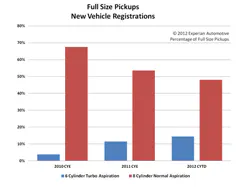
Six-cylinder, turbo-charged engines in full-size pickup trucks are up by 274.4 percent from 2010 and 25.5 percent from 2011. Traditional V8 engines in full-size pickup trucks are down 20.8 percent since 2010 and another 10.3 percent since 2011.
As seen above, here are some pickup truck engine facts for 2012:
|
VIO Today: |
69.9 percent of all full-size pickups are 8 cylinder and normally aspirated |
|
VIO Today: |
9.5 percent of full-size pickups are 8 cylinder and turbo/supercharged |
|
VIO Today: |
12.4 percent of all full-size pickups are 6 cylinder and normally aspirated |
|
VIO Today: |
2.2 percent of full-size pickups are 6 cylinder and turbo/supercharged |
|
New 2012 CYTD Sales: |
48 percent of all full-size pickups are 8 cylinder and normally aspirated |
|
New 2012 CYTD Sales: |
9.9 percent of full-size pickups are 8 cylinder and turbo/supercharged |
|
New 2012 CYTD Sales: |
6.8 percent of all full-size pickups are 6 cylinder and normally aspirated |
What are the implications for the aftermarket? First, changes in the numbers of vehicles in operation move at a somewhat glacial pace. Even if smaller vehicles are to gain market share year-over-year, these gains still will be relatively small in the universe of vehicles that represent business opportunities for the aftermarket. Second, automakers know they still need to meet consumer demand for functionality and driving characteristics. Contractors still need full-size pickup trucks to get the job done. Americans still have a love for big vehicles.
For the aftermarket, it’s important to continually monitor vehicles in operation, particularly on a regional level, to have an accurate read on what parts are most necessary to stock. In addition, it is important to understand that technology advancements are a leading indicator of what vehicles are likely to be on the road. The more manufacturers shrink engine size but improve power output, the more likely it will be for larger vehicles to maintain relatively high levels of market share.
The bottom line: Small-vehicle sales growth still might be on the horizon. However, the evolution of engine technology will ensure that the aftermarket will still need to be prepared for a diverse population of vehicles on the road.
About the Author
 Marty Miller
Senior Product Marketing Manager, Experian Automotive
As Senior Product Marketing Manager for Experian Automotive, Marty Miller is responsible for the strategy, development and marketing of Experian’s AutoCount Vehicles in OperationSM. Miller is focused on working with Experian’s automotive clients to help them meet their product and inventory management needs by providing a better understanding of their markets.
Miller is a recognized expert in the automotive information industry, with vast experience in the aftermarket area. Before joining Experian in 2009, Miller was an entrepreneurial consultant providing data preparation, analysis and process design to automotive-related companies. He also has experience performing corporate analysis prioritization, sales consulting and product management for R. L. Polk.
He holds a bachelor’s degree in computer science from Bowling Green State University in Ohio.