Pedler: Torque, Tech, and Trust: Inside Team Torque & Tech’s First Rebelle Rally

What Is the Rebelle Rally?
The Rebelle Rally is a grueling, eight-day off-road navigation competition that pushes teams of two women across over 1,500 miles of desert terrain in the American Southwest. Unlike traditional rallies, the Rebelle forbids GPS navigation. Teams rely instead on paper maps, compass bearings, distance calculations, and mental resilience to find checkpoints—some marked, some not—across ever-changing terrain.
Vehicles must be street-legal, teams must be self-sufficient, and even small mistakes are costly. But what sets the Rebelle apart isn’t just the terrain—it’s the requirement that competitors solve problems under pressure, communicate clearly, and make decisions with imperfect information, day after day.
For Team Torque & Tech—Sam Russo, director of Demand Innovation & Strategic Alliances at Pivotree, and Lauren McCullough, CEO & cofounder of Tromml—their rookie year wasn’t just about survival. It became a masterclass in leadership, trust, and self-awareness.
The Interview
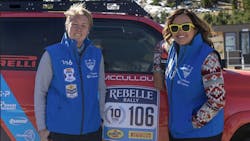
Lauren McCullough (left) and Sam Russo (right).
What was the most counterintuitive thing you learned?
Lauren McCullough: I thought the hardest part would be being off-grid—the camping, not having my phone, the lack of amenities. But honestly, that part was easy. I didn’t miss my phone at all. I thought I’d reach for it constantly, but I didn’t. The lack of amenities wasn’t even close to the hardest part.
She added that the mental preparation she expected to need for off-grid life wasn’t what challenged her. “The camping was easy-peasy compared to some of the other stuff.”
Sam Russo: For me, I don’t know that there was something that surprised me in that way, because I had watched so many videos and basically lived in Rebelle before we ever got there.
What did surprise Sam was discovering a strength she hadn’t fully recognized before. “We learned that I was actually good at land navigation. I can look at the map, look around me, and orient myself. That became really important.”
Is there a checkpoint you still think about—one that haunts you or made you feel unstoppable?
McCullough: There was one where I just didn’t have the confidence to commit. We were coming off a dry lake bed, deciding whether to go for a black-diamond checkpoint with no physical marker. I was worried about losing more points after a really bad day.
They went for it—and then got lost. “We thought we saw a lake on the horizon. It turned out to be a solar farm. We had no idea where we were. That decision haunted me because I think if I’d trusted my gut—or committed fully one way or the other—we wouldn’t have lost the entire day.”
Russo (recounting one checkpoint in vivid detail): We thought we knew exactly where we were, and time was ticking down to the checkpoint close and each minute feeling more precious than the last. Everyone was hunched over their maps. I got out, wandered off to take a bathroom break, and then suddenly I saw them. Cow bones scattered everywhere across the ground in what looked like an immense graveyard.
It was white against brown earth and skulls, ribs, leg bones—dozens of them, and maybe more. I ran back to grab the camera because at least we weren't having as bad a day as these guys had experienced.
That eerie moment triggered the realization they were wrong. “All I could hear in my head was someone saying, ‘You’re not where you think you are.’ We had maybe 10 minutes before the checkpoint closed.”
They found it—barely. “I didn’t care about the points. I needed to know it was really there.”
Did the vehicle ever surprise you?
McCullough: The 4Runner handled rough terrain better than I expected, even at higher speeds. The biggest challenge wasn’t performance—it was packing. We spent so much time packing and repacking. Other teams had vehicles set up better for overlanding. That was definitely a rookie lesson.
Russo: The only time I was nervous was when the wheel speed sensor went out—not because of speed, but because it disabled ABS and traction control. Slamming on the brakes and having the rear slide with you is … unsettling.
They were eventually able to put the sensor back together with J-B Weld. Aside from that, she credits industry support in the form of parts. “The aftermarket really showed up for us. The tires, suspension, axles, control arms—everything held. That car had 150,000 miles on it, but the suspension that it went out with was brand new and upgraded.”
What item in your gear ended up becoming essential? What was useless?
McCullough: A last-minute purchase ended up being essential: Velcro. So much Velcro. I Velcroed everything. If something fell under the seat, that was two minutes of lost focus. As a navigator, anything that keeps your tools exactly where you need them is essential.
On the flip side: “We made recovery gear way too accessible. We never used it. Next time, I’d bury it deeper.”
Russo: I love Lauren for that Velcro. The dashboard was covered in Velcro. Pencils, timers—everything. And the stuff I thought I’d need? A fold-out toilet seat. Never used it; straight into the dumpster. The thing that ended up being essential was a stupid-cheap compass from a grocery store. Lauren had a compass, but the 4Runner has no interior compass. She’d be like, “We need to go north,” and I’m like, “I don’t know where north is.” So I hooked the grocery store compass onto my vest zipper.
If the 4Runner could talk, what would it say?
McCullough: Probably stop getting frustrated. When you’re frustrated, your mental acuity goes down. You can’t fake it ‘til you make it. Trust yourself and your instincts, not just where other people are. Following dust clouds got us in trouble more than once. And, be nicer to me around turns.
Russo: These girls don’t know where the hell they’re going, but a dash compass would help.
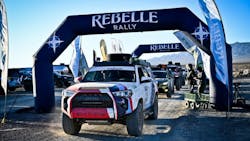
Team Torque & Tech's 4Runner
Was there something the rally forced you to unlearn?
McCullough: Powering through uncertainty isn’t always the best option, because I think you feel like not moving is failing. Moving in the wrong direction is worse than stopping.
Russo: Exactly. Don’t keep going just because you chose a direction. Stop. Turn around. We’re both wired to push forward, and that worked against us.
Did the rally change how you see your own limits?
McCullough: I learned how I respond to failure. After a few wrong turns, I stopped trusting my instincts and couldn’t make a decision. That happens to me in real life, too—analysis paralysis. Learning to recover confidence faster was huge.
Russ: No, because I know that I did not reach my limit. And that’s because I played it safe. Next time, I won’t. That’s the difference between surviving your rookie year and really competing.
What were the best and worst parts of base camp?
McCullough: Proper food felt luxurious. Hot meals and good lighting for plotting made a huge difference. The worst? Setting up tents in high winds. That was miserable.
Russo: A toilet and the shower trailer. The worst part was the silence—those heavy moments when uncertainty weighed on both of us.
Do you have a rally ‘alter ego’?
McCullough: I feel like we were just so ourselves. I think we were exactly how we are in life. Sam and I didn’t know each other all that well. I think Sam thought I was a lot more extroverted than I really am. When you get to know someone more intimately, the way they present and the way they are is a little bit different. Then, when we were doing good or toward the end of the rally, we really got each other’s energy.
Russo: This was the first time we've hung out that long. I know my personality and the personality you see here, at conferences, and at work is my actual personality. So, I don’t really transform. But I do have to constantly work on my communication style. It was a great test of patience, empathy, and understanding.
What’s next for Team Torque & Tech?
Team Torque & Tech wants to give a special thanks and shout out to the many aftermarket companies and friends that helped them get to the Rally. They have already secured their spot in the 2026 Rebelle Rally and are working on securing financial sponsorships. (The entry fees, gas, and transportation costs are steep.)
What they’re certain of is this: the Rebelle Rally isn’t just an endurance event. It’s a crash course in leadership—how you communicate, how you recover from mistakes, and how well you trust both your data and your instincts.
And that lesson, they both agree, doesn’t stay in the desert.
Follow the team here: https://www.instagram.com/teamtorqueandtech/
About the Author

Courtney Pedler
Courtney Pedler fell in love with the automotive aftermarket more than 35 years ago, starting behind the parts counter before discovering her true calling: aftermarket content and data.
For the past 25 years, she’s devoted her career to making parts information smarter, cleaner, and easier to use, believing that great data drives great business and keeps us all out of trouble.
As founder and CEO of Autology Data Management Group, Past Chair of the Aftermarket Content Professionals Network (ACPN), and proud recipient of the 2025 Women In Auto Care Lifetime Achievement Award, Courtney blends deep industry expertise with an infectious enthusiasm for a thriving aftermarket.