A look back at the contorted supply chain links
Regular guest commentator Steve Hughes, president of HCS International, looks back on how the nation’s ports handled inbound cargo ship traffic. We asked Hughes about the root causes of the links that separated at the busy West Coast ports. Also, Hughes expressed disappointment with the labor unions, representing the dockworkers, who passed up an opportunity to improve the flow of goods into the country.
Why are the distribution bottlenecks happening at such a monumental scale?
The reason we see such monumental disruption in the international shipping network is simply that the ocean shipping network was never designed for, nor could have anyone imagined a global meltdown throughout the entire supply chain as we have experienced from COVID.
When did you notice the disruptions taking hold?
I knew we would be facing major issues as early as April of 2020. With that said, I don’t think anybody knew that the supply chain would blow up to the scale at which we see it now. Looking back on this past January, many major players in the shipping industry predicted ocean shipping issues would be resolved by midyear. So, no pun intended, the situation has been very fluid and impossible for experts to predict.
What was going through your mind when you realized that this problem could be anything but transitory?
Coming from the supply chain side of our industry, the first thought that came to mind was the repercussions we would see on fill rates, which are now worse in some cases than I could ever have imagined. Then when freight rates started to climb, I realized that this trend would hurt margins, which would ultimately cause inflationary pressures.
Explain what happened to the cargo ships and the containers enroute to port.
There were no issues with cargo ships and containers while seaborne. On the contrary, the issue lies with both the origin and the destination. The issue on the origin side is that there are more containers than the available capacity to ship. On the destination side, the issue is a massive quantity of incoming containers mixed with an unwieldy number of empty containers, which overloaded the port terminals. That, in turn, caused traffic jams inside the terminals due to limited space. One step further, the congestion wound up compounded by a systemic issue that prevented the trucks from picking up containers efficiently.
Should COVID-19 be faulted for the broken supply chain, or are there any underlying causes responsible for what is happening?
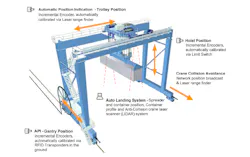
COVID-19 is definitely the cause of today’s broken supply chain. However, there are systemic issues that we have seen over the years. That should have been addressed at the terminals and ports. Automation at our ports is absolutely necessary to efficiently manage the volume. Ports around the world are automated. Automation, visibility and process changes at the gate are vital for efficiency and competitiveness in the future.
And yet, shockingly, there is a big move to stop automation at our nation’s ports in Congress. I cite House Resolution number 5376, section 30102, of the Build Back Better Act.
Keep in mind that the ports in Asia work 168 hours a week. Our nation’s ports, specifically the west coast, work approximately 114 hours a week.
So, we are already behind in productivity based upon working hours. Yet, Asia’s and Europe’s major ports are automated, making them more efficient to move more containers per hour than our non-automated facilities. If Congress or the unions are successful in halting future automation at our ports, they would not be able to handle large disruptive volumes we see— even if they ramped up to a full 24/7 operation.
When will the shortages end?
There’s no short answer here. The International Longshore and Warehouse Union (ILWU) contract is due to expire on June 29. Privately, I had hoped that the West Coast-based ILWU would accept a contract extension of 12-24 months in 2022. If this had happened, I hoped that we would see relief start as early as May. However, the ILWU rejected a contract extension proposal they were offered. Instead, they now insist on negotiating a new contract, pushing for higher wages and stopping all future automation at ports on the West Coast. This action by the ILWU will no doubt cause even further disruption and delays in the supply chain. Consequently, I don’t expect any relief until September 2022, at the very earliest.
The sheer magnitude of the issues facing us will require everyone to forge through 2022. There are no simple options or solutions for importers. Forgive the metaphor but, it’s typically not recommended to jump ship in the middle of a Category 5 hurricane. Importers must ride it out as best as they can.
About the Author
 Alan Segal
Alan R. Segal specializes in project management for suppliers, consultants and retailers. He practiced category management for Sanel Auto Parts Co. and Advance Auto Parts before launching his own firm, Alan R. Segal-Best Business Practitioner. He has worked in the auto care industry since 1991. Connect with Alan on Facebook or LinkedIn.