Safety equipment and personal gear: Don’t be the next story
Key Highlights
- Place personal protective equipment like safety glasses and gloves at points of use to encourage consistent use and reduce hazards.
- Maintain a clean shop environment by properly storing parts, tools, cords, and chemicals to prevent trips, damage, and chemical-related risks.
- Store hazardous battery components outside the main shop area and use specialized PPE for high-voltage work to minimize injury risks.
- Regularly inspect lifts, lift pads, and safety equipment, and ensure lockout/tagout procedures are followed to prevent equipment-related accidents.
- Conduct routine testing of critical tools like torque wrenches and electrical gloves to catch issues early and ensure safety for both technicians and customers.

Safety in an automotive shop is one of those subjects everyone knows is important, but it is incredibly easy to become blind to the hazards we work around every day. We spend so much time around lifts, grinders, presses, chemicals, batteries, electrical equipment, compressed air, tools, and vehicles that things which might immediately concern someone walking into the shop for the first time can start looking completely normal to us. Something does not have to be safe to become normal. We just have to walk past it enough times.
Make safety accessible
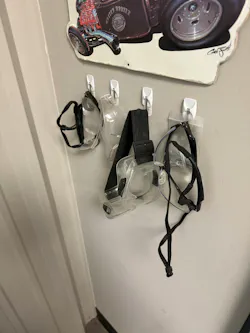
One of the easiest ways I have found to encourage the use of personal protective equipment is simply putting it where people need it. At the entrance to our shop, we keep safety glasses readily available. You do not have to hunt through a toolbox or walk across the building to find a pair. If you are walking into the shop, the glasses are right there. It is a simple thing, but sometimes the difference between using safety equipment and not using it is whether it is within reach.
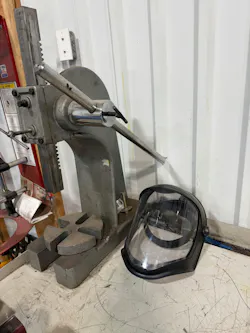
We take the same approach with specific pieces of equipment. We have a face shield located next to our grinder because that is where you are going to need it. We also keep a face shield next to our arbor press. An arbor press may not immediately come to mind when people think about eye and face protection, but you are applying a tremendous amount of force to parts and tooling. Things can break, slip, or come apart. Having the face shield right there removes the excuse of not knowing where one is or deciding that the job will only take a few seconds.
We also keep gloves attached to every lift. Again, this is not complicated. If you want people to wear gloves, put gloves where the work happens. Personal protective equipment sitting in a cabinet on the opposite side of the building technically exists, but that does not necessarily mean someone is going to use it. I would rather spend a little extra money making PPE convenient than find out after someone gets hurt that the equipment they needed was somewhere else in the shop.
Keep it clean
Housekeeping is another part of safety that gets overlooked. Anytime parts are removed from a vehicle in our shop, they never go on the floor. They go on a rack, cart, or another designated location. That keeps the parts accounted for, helps prevent damage, and keeps them from becoming a trip hazard. The same thinking applies to cords, hoses, tools, and equipment around the vehicle. You do not need your shop to look like an operating room, but there should be some thought behind where things are placed.
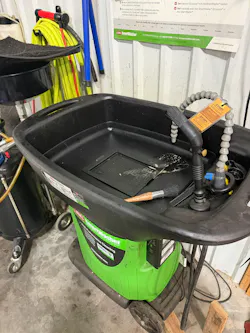
Chemical handling deserves the same consideration. In our shop, we use a non-solvent-based parts washer. There are plenty of reasons to think carefully about the chemicals and cleaning products we bring into a shop. Sometimes the best way to reduce a hazard is to look at whether there is a different product or process that will accomplish what you need without introducing the same risk. That does not eliminate the need to follow the instructions and safety information for whatever product you are using, but reducing unnecessary hazards is a good place to start.
High voltage safety
Since we do quite a bit of hybrid battery work, we also think seriously about where potentially hazardous battery components are stored. We try to keep hazardous battery internals, particularly lithium battery components and other alternative battery materials, outside of the main shop whenever practical. We have a 20' shipping container in a gravel area physically separated from the building. If we ever experience a catastrophic battery failure, having those materials away from the occupied shop helps reduce the potential for injury and property loss.
I am not suggesting that every shop needs to buy a shipping container. The point is to think about what happens if the worst reasonable situation actually occurs. We have all seen stories involving battery fires and thermal events, and it is easy to think it cannot happen in our shop. Every shop where something catastrophic has happened probably thought the same thing beforehand. Plan for the problem before you have the problem.
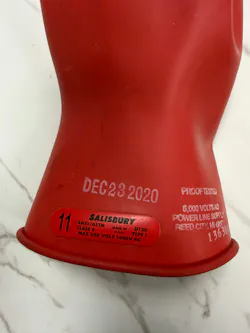
High-voltage vehicle work also requires specialized PPE. When I’m training, I showcase a set of expired rubber insulating gloves. I keep them because they are a good visual example of something that should not be trusted simply because it is sitting on the shelf and looks like the correct equipment.
OSHA requires rubber insulating gloves to be inspected for damage before each day's use, including an air test. Once issued for service, they must also be electrically tested every six months. Gloves can require testing sooner if their insulating value is questionable, after repair, or under other conditions. The date on the glove is therefore only part of the story. You need to know its condition and testing status before trusting it with your life.
Lift safety
Lifts are another area where I think familiarity can create complacency. We put thousands of pounds into the air and then stand underneath them every day. I photographed the lift pads in our shop specifically because they are in good condition. That is what we want to see. Look at the pads. Look at the lift arms. Look at the locks and the components you interact with every day. If something is damaged, worn, leaking, moving differently, or just does not look right — deal with it.
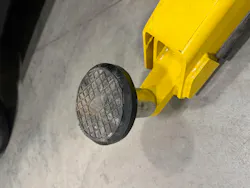
Having a lift professionally inspected annually does not mean we ignore it for the other 364 days. An annual inspection should be one part of an ongoing process. The people using the equipment every day are in the best position to notice when something has changed.
Lockout and tagout equipment
The same philosophy is why we have lockout and tagout equipment available. If a piece of equipment is unsafe, there should never be confusion about whether somebody should use it. Whenever practical, get unsafe equipment out of the work area. When that is not practical, it needs to be clearly taken out of service using appropriate procedures. A tag sitting in a drawer does not protect anybody. It has to be available, and more importantly, it has to be used.
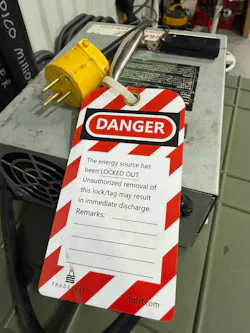
Safety should extend to your customers too
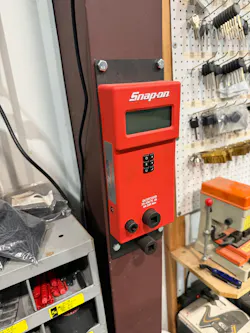
Safety also extends beyond protecting the technicians working in the building. We have a Snap-on Torque Tester, No. QCDTC3250, bolted in our shop that we use to check our torque wrenches monthly. We still send our torque wrenches out annually to a qualified testing facility, but I do not want to wait an entire year to find out that something has changed.
Testing once a month gives us another opportunity to catch a problem between those annual inspections. A torque wrench that is significantly inaccurate is not only a concern for the technician using it. It can become a safety issue for the person driving the vehicle after it leaves our shop. Wheel fasteners, brake components, suspension components, and plenty of other critical fasteners depend on us doing our job correctly. Safety does not end when the technician clocks out or when the vehicle leaves the bay. Our customers trust us to return vehicles that are safe to drive.
Don't wait until it's too late
That torque tester represents something I think is important about safety in general. There is a big difference between meeting an interval and actually paying attention to the condition of your equipment. If something can be checked reasonably and regularly, why wait until the last possible day to find out there is a problem?
I have worked in places where there was always the possibility that somebody could get seriously hurt, and one thing I never wanted to do was make the phone call telling someone's family that an injury had occurred. You never want to explain that someone lost an eye because you did not provide a six-dollar pair of safety glasses. You do not want to explain that somebody was injured by a machine everyone already knew was unsafe. Those are preventable conversations.
Pick a day this month and walk around your shop specifically looking for safety problems. Take pictures and video. Look at your grinders, presses, lifts, lift pads, chemicals, PPE, electrical equipment, torque wrenches, battery storage, cords, walkways, and everything else you normally walk past without thinking about it. Better yet, ask another shop owner you trust to walk through your facility and then return the favor at theirs.
Do not wait until your shop becomes the story everyone else tells when they talk about safety.
Tools mentioned:
- Safety glasses
- Face shields
- Gloves
- Parts rack
- Non-solvent parts washer
- Rubber insulating gloves
- Lockout and tagout equipment
- Snap-on Torque Tester, No. QCDTC3250
About the Author
 Keith Perkins
Keith Perkins
Keith Perkins has been in the industry for over 19 years, serving in various capacities, including engine machinist and assembler, dyno tuner, diagnostic technician, instructor, technical information specialist, repair technician, and many more roles through the years.
Currently, Perkins co-owns and operates the L1 Automotive Group with his wife. The L1 Automotive Group is comprised of three companies: L1 Automotive Diagnostics and Programming, Level 1 Automotive, and L1 Automotive Training.
Perkins currently holds the title of ASE Master Certified L1 Technician and ASE certifications A1-A9, L1, L4, X1, P2, xEV Level 2, and various other industry certifications. He also serves as a Subject Matter Expert for the ASE A1, A2, A7, A8, L1, and L4 tests.
Perkins has served on the Board of Directors for NASTF since 2023. He enjoys spending time with his wife of 18 years, Liz, and his two daughters, Rylynn and Bailey, in his off time. His favorite non-automotive activity is skydiving!