What power tools should every automotive technician own?
Key Highlights
- Battery-powered tools offer cordless convenience, but require attention to battery life, size, and heat management.
- Air tools excel in continuous power applications, such as die grinders and air hammers, especially in rust-heavy environments like the Rust Belt.
- Impact wrenches and electric ratchets are versatile tools that improve efficiency, with specific models suited for different tasks and tight spaces.
- Choosing the right tool involves considering warranty, brand compatibility, and the specific demands of your shop's vehicle types and regional conditions.
- Both power and air tools have their place; selecting the best options depends on your shop's workflow, budget, and the performance needs of your projects.
Power and air tools are an essential part of your toolbox in the shop. Both are great options; however, preference changes with the end user and the region you work in. Battery-powered tools give you a cordless experience and freedom to use them wherever and whenever. Whereas with air tools, you need the air supply from a suitable compressor to use them.
A few considerations you should note before purchasing any battery-powered tools are battery life, battery size, and heat generated. Air tools can run at full power for extended periods of time if the air pressure is sufficient, and this is helpful in areas like the Rust Belt where rust and corrosion are heavy on vehicles. If you live in the southern regions of the U.S., as I do, we generally run all cordless tools for the convenience of not dragging an air hose around. There is also the factor of buying into a company's battery lineup versus any brand of air tools that use the same air hose connection. Let’s look at some examples of power and air tools in the shop.
Daily use battery-powered tools
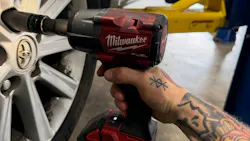
One of the first examples is a 1/2” impact. The one that I use daily on the job is the Milwaukee Tool M18 FUEL 1/2" Mid-Torque Impact Wrench w/ Friction Ring, No.2962-20. I chose this for a few reasons: it’s lighter than the high-torque version, it is sufficient to use on wheels and suspension parts, and paired with a Milwaukee Tool M18 REDLITHIUM FORGE XC6.0 Battery, it lasts 1-2 days on a single battery charge with heavy use.
Having a lighter impact leads to less fatigue on the job if you have to use it for an extended amount of time. It is also an upside for a newer technician buying tools to have one that can do the majority of the repairs needed. Your mileage may vary depending on what region you’re working in, as I mentioned earlier, and what brands of vehicles you work on.
Warranty is important to consider as well with these tools. For example, Milwaukee Tool offers a five-year warranty on their battery-powered tools. Another thing to note is that many battery-powered tools come in kit versions, which include one or two batteries, a charger, and the tool to help get you started in that battery line. After you get a few batteries, you can just buy bare tools instead of kits to save some money.
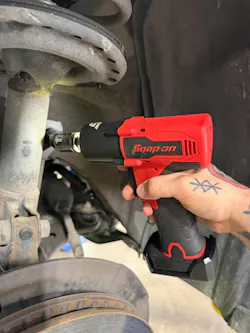
Continuing with battery tools, another one I want to highlight is the Snap-on 14.4V 3/8" Drive Impact Wrench, No. CT861AMDB. It is an upgraded version of their 3/8” drive cordless impact. As technology advances, so does battery and tool performance in the cordless world. This particular impact features a rocker-style trigger versus a more traditional forward and reverse selector. This allows for quick direction changes, which can be beneficial on stuck or rusty fasteners. Aside from using penetrants, working a fastener back and forth is a common tactic for rusted and corroded bolts. This impact does well with passenger cars and light duty trucks due to its size and power combination.
Air tools to keep in rotation
Now that we’ve covered a few battery-powered tools, I want to highlight some air tools. One tool that really shines well with being air-powered is die grinders. Die grinders are very common in automotive shops and have a wide range of applications, from surface prep like cleaning hub surfaces on brake jobs, cutting seized shock stems out in tight areas, and cleaning mating surfaces with the appropriate prep disc for the job.
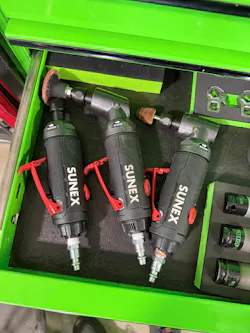
There are a few die grinders from Sunex Tools I want to mention — the 115 Degree Angle Die Grinder. No. SX5204, 0.5hp Straight Die Grinder, No. SX5207, and 0.5hp 90 Degree Angle Die Grinder, No. SX5208. Having multiple die grinders and different angles can really help you on the job. All of these die grinders are 0.5hp and have a 1/4" collet for arbors or carbide burrs.
Personally, I keep one with a surface prep pad, one with a wire wheel, and one with a cut-off disc so I can quickly change between different grinders on a job instead of having to swap out the arbors. This is one place air tools can save you some money when buying multiple tools, especially if they are not all the same brand; you don’t have to worry about batteries to power them, just an air source that works for all your air tools. Depending on the tool, air tools are generally cheaper than their battery-powered counterparts.
Another air tool that is essential to your toolbox is an air hammer. Before this year, there were no battery-powered options for air hammers until Milwaukee Tool unveiled their new M18 FUEL STRIKER Hammer Chisel as a cordless option. When using an air hammer, the consistency of the air being delivered to the tool helps with maximum force for longer periods of time. This is where air can be a better option since battery life will deplete and must be recharged as use of the tool lengthens. I have used the Snap-on Super-Duty Air Hammer, No. PH3050B, for the majority of my career. The trigger has phenomenal control, and I have been very happy with the performance of this tool.
A specialty power tool
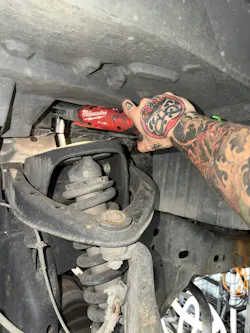
Jumping back to impacts, there is a variant of the 3/8” and 1/2” drive impacts with the right-angle impact wrench. Right-angle impacts can help you get into tight spots that a normal impact would be too bulky for. Generally, there is less torque in a right-angle impact due to its design, but there are a few that get the job done well. One of them is the Milwaukee Tool M12 FUEL 1/2” Right Angle Impact Wrench w/ Friction Ring, No. 2565-20. I use this one a lot for sway bar links due to the mounting location of the links, as well as for brake calipers. Being able to get the right-angle impact in tighter areas helps you be more efficient, and without having an air hose attached to the tool, you have less to worry about when twisting and turning to try to get access to some fasteners.
The first tool to invest in
The last tool I want to highlight is the electric ratchet. This has become one of the most used tools in our industry. Having an electric ratchet makes doing most jobs quicker and more efficient than having to turn bolts out with a traditional ratchet. These are not impact wrenches, so they will not have high torque, but electric ratchets allow you to break a fastener free like a traditional ratchet, then pull the trigger and spin the bolts out. In my opinion, this is one of the first power tools a technician should invest in. Pretty much any job you do in the shop, an electric ratchet can be used. I often use mine to run down the fasteners until they are snug before torquing them to specification. The Milwaukee Tool M12 FUEL 3/8” Ratchet, No. 3053-20, has 70 ft-lbs of torque and 400rpm of speed, making it a good mix between power and speed, as well as interchangeable triggers for different user preferences.
Final thoughts
I do think if you plan to buy battery-powered tools, do some browsing to see which brand offers the most versatile selection for your application to help keep your toolbox uniform and your tools on one battery platform. For air tools, make sure the tools deliver sufficient performance for your needs and for what your shop air can accommodate. Most air tools have a psi rating for their optimal running pressure and performance. Everyone’s needs vary, but I believe battery- and air-powered tools both have their places in the shop, and finding what works best for you can be dependent on many factors.
Tools mentioned:
- Milwaukee Tool M18 FUEL 1/2" Mid-Torque Impact Wrench w/ Friction Ring, No.2962-20
- Milwaukee Tool M18 REDLITHIUM FORGE XC6.0 Battery
- Snap-on 14.4V 3/8" Drive Impact Wrench, No. CT861AMDB
- SUNEX Tools 115 Degree Angle Die Grinder. No. SX5204
- SUNEX Tools 0.5hp Straight Die Grinder, No. SX5207
- SUNEX Tools 0.5hp 90 Degree Angle Die Grinder, No. SX5208
- Milwaukee Tool M18 FUEL STRIKER Hammer Chisel
- Snap-on Super-Duty Air Hammer, No. PH3050B
- Milwaukee Tool M12 FUEL 1/2” Right Angle Impact Wrench w/ Friction Ring, No. 2565-20
- Milwaukee Tool M12 FUEL 3/8” Ratchet No. 3053-20
About the Author
 Chris Biediger
Chris Biediger
Chris Biediger is an ASE Master Technician and a Toyota/Lexus specialist. He spent almost 10 years at a Toyota dealership before venturing off with his old foreman to become his new foreman to run an independent Toyota shop, Hill Country Yota Works in New Braunfels, Texas. Biediger has been a technician for 12 years now, and aside from the shop, he also runs TxToolGuy on social media, showcasing tools, shop life, and diagnostic videos.