How to diagnose misfires without guessing
Key Highlights
- Verify when and how the misfire occurs, and use related DTCs and repair history to guide testing.
- Assess engine mechanical condition with starter-current relative compression tests or intake-pressure waveforms.
- Use downstream oxygen sensor behavior to help distinguish fuel-related misfires from ignition faults.
- Compare injector and secondary ignition waveforms to identify circuit or component problems.
- Use OEM-recommended spark plugs, proper torque, and careful installation to prevent repeat misfires.
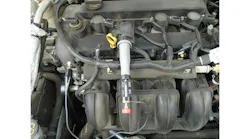
If you’ve spent any time as an automotive technician doing driveability diagnosis, you don’t even need to read the DTC description to know what you’re dealing with when you see a P030X DTC on your scan tool. Misfire DTCs can be a quick, easy diagnosis and repair, or they can set you up for a real struggle if you don’t have the right tools and techniques in your repertoire. If you are like the vast majority of technicians that I’ve encountered, a misfire DTC is likely to put you on a fast track towards the ignition system, with a high probability of swapping coils and/or spark plugs to see if the misfire changes cylinders. You may find that method to be quick and fairly effective, so I’m not here to talk you out of a process that works for you, but where do you go when the old standby fails you?
Let’s start with a few considerations that we should keep in mind when diagnosing misfires. First, and of utmost importance, not all misfires are caused by the ignition system. While the ignition system might be the most common cause and a good place to start, you should always remember that fuel injection and base engine mechanical concerns can also cause misfires.
Second, while swapping coils and spark plugs can be a familiar and comfortable diagnostic step, it may not always be the wisest or most viable option. We’ve all encountered engines with some coils and spark plugs that are difficult to access at best, or require intake manifold removal for service. Removing and reinstalling that intake manifold might not be the most difficult or time-consuming process, but it’s certainly not one I want as one of the first steps in my diagnosis. Even when access is not an issue, keep in mind that you are only one baked on spark plug wire or coil boot away from additional parts and labor that might not have been otherwise necessary at this time.
With the breadth of possible causes behind that misfire DTC, it’s wise for you to have other diagnostic tools and techniques at your disposal.
Back to basics
As automotive technicians, our first step in any diagnostic procedure should always be to verify the concern. For a misfire DTC, this should mean more than just verifying the MIL is illuminated and a DTC is present. Road test the vehicle as necessary to verify whether or not a misfire can actually be felt, and under what conditions. Knowing this information can help guide your diagnostic process and narrow down possible causes.
For example, if a vehicle is exhibiting a P0300 Random Misfire DTC, but no misfires can be felt, perhaps a crankshaft position sensor relearn procedure is in order due to previous repairs? If multiple DTCs are present, is there a potential correlation between the DTCs? Here are a few examples:
- Misfire DTCs on adjacent cylinders - possible cylinder head gasket leak
- Multiple Misfire DTCs on the same bank - possible camshaft timing issue
- Multiple Misfire DTCs along with Lean DTC(s) - possible fuel delivery issue
Knowing when the misfire(s) occur can also help to guide further diagnostics. We want to ensure our diagnostic steps align with the conditions under which the misfire occurs. As an example, if a misfire only occurs under higher RPM and load, don’t be surprised if a cranking compression test or a cylinder leakage test doesn’t show any faults. These tests are not replicating the same conditions as the fault.
I also try never to overlook a vehicle’s maintenance and repair history, as this information can be a good source of clues as to possible causes.
Mechanical faults
In my experience, base engine mechanical faults are often one of the last places technicians look when diagnosing misfires, despite the fact that we know mechanical failures still occur. Camshaft lifter and roller follower failures are not all that uncommon, especially for certain engines, so having some diagnostic techniques centered around assessing the mechanical condition of the engine can make a lot of sense. Few technicians are excited to break out the compression gauge or cylinder leakage tester, but we can use technology to our advantage to gain insight into the mechanical condition of the engine in much less intrusive ways.
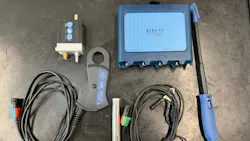
Using a current clamp like the PicoScope TA019 or TA388 to measure starter motor current draw with ignition or fuel disabled can be a quick way to not only assess starter motor and solenoid condition, but also to assess the relative compression of the engine’s cylinders (Figure 1). An engine with even compression will show even, regular pulses in current draw as the starter motor works to overcome each cylinder’s compression stroke (Figure 2). An engine with low compression in one or more cylinders will show lower pulses where the starter motor is not having to work as hard to move the engine through that cylinder’s compression stroke. If you encounter this, you can add in a test lead connected to an injector or coil circuit to determine which cylinder is at fault.
Another testing method you may want to consider becoming familiar with is using a pressure transducer such as the PicoScope WPS500X in order to look at waveforms of intake manifold pressure (vacuum) during engine cranking or at idle. As with the relative compression test, you are looking for consistency in the pulses. Discrepancies in these waveforms can point towards a number of different mechanical issues, such as incorrect valve clearance, worn lifters or roller followers, or even carbon buildup on the valves of GDI engines. Personally, like a traditional vacuum gauge, I look at this as more of a go/no-go test. If all is well, this helps to rule out mechanical issues as a possible cause. If a fault is seen, further diagnostic steps will be necessary in order to find the root cause.
Fuel or ignition?
If mechanical faults can be ruled out, technicians sometimes still struggle with determining if the misfire is caused by a fuel injection issue or an ignition system issue. One trick that can help here is to monitor the relevant downstream oxygen sensor when the misfire first occurs. If the downstream oxygen sensor goes lean, this is an indication that the catalytic converter is not having to process unburned fuel, and thus is letting the excess oxygen pass through. That would indicate a lack of fuel to the misfiring cylinder.
Conversely, if the downstream oxygen sensor goes/stays rich, this is an indication that the catalytic converter is having to process unburned fuel, and thus is using the oxygen available as a result of the misfire. That would indicate an ignition system issue (or mechanical concern if not already ruled out). One caveat to this test is that its results can be skewed if the PCM shuts off the offending cylinder’s injector as a result of the misfire. For this reason, it is best to perform this test after clearing DTCs and to monitor data on the first instance of the misfire.
If signs point towards fuel, you may want to listen to the suspect injector compared to a known good injector if access is possible. More often than not, you can hear a difference in a faulty injector. Another option is to use an oscilloscope like the PicoScope 4425A to compare current and voltage waveforms of the injector circuits.
For suspected ignition issues, a coil-on-plug probe like the PicoScope TA204 or TA398 paired with your oscilloscope is a great way to compare secondary ignition patterns even on difficult-to-access cylinders. To make the most of a tool like this, you’ll need to understand how to interpret these patterns, but here are two of the most common discrepancies you may find:
- High peak kV and short spark duration: High secondary circuit resistance. This is likely caused by a wide spark plug gap or corrosion in the COP secondary connections.
- Low peak kV and short spark duration: Low overall output is a good sign of a failing ignition coil, but could also be caused by voltage drop in the primary circuit.
An ounce of prevention
When diagnosing and repairing misfires or performing ‘tune-ups’, I like to take steps to help curtail the possibility of future misfire concerns. I am a strong advocate for using only the OEM-recommended spark plugs and ensuring they are properly torqued. In addition, I always recommend inspecting the ignition coils for signs of corrosion and servicing the ignition coil boots/seals/springs if the coils themselves are still in good condition. Finally, use a good-quality spark plug socket in good condition that you are comfortable with for the vehicle that you are working on. While they don’t fit in every situation, I’m a big fan of using a deep spark plug socket such as the Matco Tools SPS206PXLA whenever possible. I find deep sockets like this helpful for removing and installing the spark plugs with much less chance of inadvertently cracking the porcelain insulator. In addition, they prevent the fishing expedition that can occur when your spark plug socket wants to hold onto the spark plug a little too well and not come back out with the extension.
Over the years, I’ve seen far too many misfire concerns that were the direct result of poor parts choices, incomplete repairs, or careless mistakes made by a previous technician. A job done right is also a job done once!
About the Author
 Brian Noel
Brian Noel is a full-time Automotive Mechanics Technology Professor at Cosumnes River College in Sacramento, CA. He teaches the Ford ASSET program as well as a variety of traditional automotive courses. Noel is a Ford Senior Master Technician, ASE Master Automobile Technician, ASE Advanced Level Specialist, and CA BAR certified SMOG inspector, repair technician, and instructor. He also holds a Bachelor of Science degree in Career and Technical Studies from California State University, Sacramento, and is working towards a Master's degree in Educational Technology, also from California State University, Sacramento.
Related
 untitled_design__20241101t124735
 Dreamstime Xl 243067235