High Voltage Leakage: How Is That Detected?
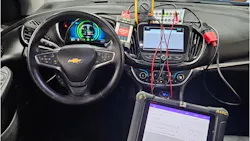
When it comes to figuring out what's wrong, you must know what's right. Theory is a must, but it will never replace experience. You need both. This article is about high voltage systems that find a path to the chassis of a hybrid, plug-in hybrid, electric car, fuel cell, or any vehicle with a system voltage over 60 volts. Historically, Honda had packs as low as 100 volts, so that is my baseline. We use the term xEV to refer to all vehicles that use high voltage to power the wheels.
I make a living taking the complex and making it available to the average technician so you can understand the high-voltage motor vehicles and keep up with the times. I also reopened Van Batenburg's Garage, Inc. this year, specializing in EVs. This is making our EV training even better.
Trying to fix any vehicle that had been "tinkered" with by those who should never touch a car should be avoided. That includes salvage-titled, highly modified cars, towing in a car from another shop you don't know, and more. There may be some situations that make sense, but the odds are not in your favor. There's not much to gain if you never know the original issue and look at someone's mistakes and poor workmanship. The ability to use critical thinking is paramount.
Getting Started
Your brain can analyze data and make decisions. Brains exist in all mammals, but there's one thing we can do that other mammals cannot—pause and think things over. Other creatures work by instinct; humans can do that, and at times it works. Analyzing, diagnosing, and repairing an xEV cannot be done by instinct or guessing. You may look something up on the internet and try replacing a part, and you might get lucky, and it fixes the xEV. But will it stay fixed? Did you get to the root cause, or did you merely relieve a symptom only to have the problem return? To master this world of high-voltage vehicles, you need to keep learning. If you're not a "lifelong learner," the technology will bypass you.
"You can't understand anything until you understand everything" when it comes to analyzing and making a diagnosis. The scan tool you use separates the xEV by systems; it's in those systems that trouble codes are stored. If the scan tool is an OEM tool, the code should be accurate to the degree that the software engineers were able to program the xEV and the scan tool they made for that model. Aftermarket repair shops often use scan tools that are not OEM scanners. The aftermarket scan tool companies will communicate with all makes and models that have an OBD-II connector. The first modern electric cars made by OEMs that also sold internal combustion engines after 2010 were OBD-compliant. The 16-pin connector was used for data, even on their pure EVs. Tesla, Rivian, Lucid, and other EV start-ups that were EV-only have their own data output systems. This includes my Zero electric motorcycle. Zero has never made internal combustion engines, so a new data output system was designed.
Battery Pack Type A: Loss of Isolation
Knowing how a Type A detection system works when faced with a code for a high voltage leak to chassis ground will help you get to the root cause. When the xEV is in "Power On" mode, most OEMs will check the HV battery for an HV leak to the chassis. ACDC calls this Type A. This test is done before the contactors are closed. When in "Power On" mode, the HV battery is not connected to any other HV part. There are exceptions. They are the older Honda IMA systems, Tesla, and newer Ford xEVs. This may be all OEMs soon, as I see these changes in the newer xEVs we work on and study. Make sure you're protected at all times when working with a brand of xEV you're not familiar with until it's de-energized. There are no "rules" an OEM must follow, so be careful!
A Simple View of Type A
Once the xEV has been set to "Power On," a 12-volt circuit in the HV battery ECU will look for a leak by comparing two sections of the HV battery for leakage. Just like an EVAP system that separates the EVAP system and looks for decay in the integrity of the pressure or vacuum in the entire system, the tricky part when working with high voltage is that the 12-volt detection system must never come in contact with the high-voltage system. We will explain how that detection system works in Type B. Once the HV battery is tested and passes, the contactors will then close in a certain sequence, and other HV components will be powered in a precise order.
Before we start or "READY" an xEV, there's a test of the high-voltage battery pack to determine if a Loss of Isolation (LOI) has occurred since the last time it was driven. This test can also run while being driven. Most OEMs have an intensive class on this subject. My thanks to General Motors for allowing me to sit in on a Canadian GM class in 2011 to add to my understanding. Another OEM field service tech I met a few years back told me they have a different way of detecting the high-voltage insulation, but when I asked for more information, he said he'd get back to me. I'm still waiting.
How the Type A Detection System Operates
High-voltage leak detection circuits can monitor for an HV leak by placing a voltage divider between the positive and negative posts of the HV battery. That effectively divides the pack in half. If you had a 400-volt pack and measured voltage at the halfway point, you would have 200 volts at each voltage-sensing circuit. Before starting the xEV, the comparative circuit readings—assuming they were the same—would indicate that the pack was not compromised. With learned memory, any small changes over time would be accepted as normal, and the battery would pass an "HV Leak Test." Then the contactors would cycle through their closing and testing phase. If the HV battery split voltage readings showed a larger-than-expected variation between the two sides, a determination could be made that the HV battery has a leak to the chassis. The contactors would not close, so no "READY" light and a code would set. This is a simplified circuit. Consider what could happen if there was water intrusion. We have seen this in our shop recently with an older Toyota Hybrid SUV.
Generic Test for Type A
Connect your best scan tool and clear the codes. Use a BOB on the OBD 2 connector. Connect a DVOM to pin 16 and 4 and monitor the 12-volt system. Keep it over 12 volts. Set the car into "Power On" mode (the old KOEO) and let the Type A detection system run for 20 minutes. If the code resets and the HV contactors were open, you have your suspect. The 20 minutes is to be sure moisture isn't a factor, as that can take time to show up. Water was the issue with the Toyota mentioned before. The root cause was a leak in a roof rack mounting gasket.
Battery Pack Type B: Loss of Isolation
This system is quite different from the Type A (LOI) Detection System. This system is fast to react. As HV components, cables, and more are energized with high voltage, if there's a short to chassis ground that has enough current to kill, the contactors will open instantly, the HV capacitors will discharge, codes will set, and "lock" out the ability of the driver to "READY" the xEV. These types of codes should be treated with utmost care, as something is wrong with the HV safety system. There are HV leaks that allow small amounts of current to leak to the frame, but the xEV will drive normally and still set a code. If you don't diagnose and repair the vehicle, it will eventually shut down.
Type B High Voltage Leak Detection
Using the schematic ACDC produced, you will see the "AC source" (#5) sends alternating current to "Capacitor A" (#3) and chassis ground (#8). The interesting thing about the use of this capacitor (usually a DC device) is that it can transfer the AC current through a capacitor without having the high voltage connect to the low voltage of the sensing circuit. That sine wave floats on top of the HV DC in the HV battery (#2) and other HV components the HV battery connects to. Think for a moment about a double-headed drum. If you pound one end of the drum, the opposite end will vibrate at the same frequency as the side you are playing. When the AC current is applied to the low voltage side of Capacitor A, an AC sine wave (#10) is sent onto the high voltage DC cable. That sine has an amplitude and a frequency. The frequency never changes, but the amplitude will if there's an HV connection to the chassis. A very small circuit (#9) makes an extremely low-current connection back to the detection resistor (#4) to compare amplitude levels (#6). Those electrical engineers are quite clever. Depending on how big the leak is (the height of the amplitude), the system can either turn on a warning light and set a code, put the xEV into limp mode, or, if the amplitude is too low, the contactors open and the high voltage is turned off. Calling a tow truck is next. One more fact to consider: when any high voltage component is mounted in the vehicle, it's always bolted securely to the chassis in more than one place. This is to ensure that a person will not become the ground path if a component has a high-voltage leak to the chassis.
Generic Test for Type B
Sometimes an OEM scan tool can determine the source of the leak, and your job of finding it is over. Older xEVs were not as advanced. This test is very similar to the Type A test. Watch for a code while you do this. First, clear all codes and make sure the trouble light is off. Monitor the 12-volt battery and keep it above 12 volts. If resting voltage is over 15 volts, the low-voltage battery is a lithium-ion type. This was designed for a Prius two decades ago at our "Up Your Voltage" class. Still works fine today. Wait 20 minutes between each test to make sure that test is complete. The order can be done in any logical way if you know the power flow of the high-voltage system(s).
- Turn to "Power On" (old KOEO mode), wait up to 20 minutes. No codes—it's not the HV pack.
- Get the "READY" light on (Note: if it's a PHEV, try to keep the ICE off). If it codes, what was powered up? DC-DC converter, contactors, etc.
- When the ICE starts, and it codes, why? What HV component is used to start the ICE?
- Turn on A/C (if electric) and see if that's OK.
- Drive the car forward and reverse (road test time). Drive hard for 20 minutes.
- If electric AWD, use lots of power. Go slow first, then add power.
- Plug in to recharge the pack. Does it happen then?
I assume you get the idea. These new xEVs will keep you busy. Don't turn your back on these vehicles—they're not going away.
About the Author
 Craig Van Batenburg
Craig Van Batenburg
Craig Van Batenburg is the CEO of ACDC, a hybrid and plug-in training company based in Worcester, Mass. ACDC has been offering high voltage classes since 2000, when the Honda Insight came to the USA. When EVs were introduced in 2011, ACDC added them to their classes. Reach Craig via email at [email protected] or call him at (508) 826-4546. Find ACDC at www.FIXHYBRID.com.