Electric Motor Evolution: 2000 to 2026
Key Highlights
- Electric motors are smaller, lighter, and more efficient than traditional internal combustion engines, offering benefits like no emissions and torque on demand.
- The three main motor types in xEVs are permanent magnet synchronous motors, induction motors, and the latest externally excited synchronous motors, each with unique advantages.
- Neodymium magnets are crucial for high-performance motors but are geopolitically sensitive due to reliance on Chinese supply; alternatives are being developed to reduce costs and dependency.
- Tesla popularized induction motors to avoid magnet supply issues, while companies like Toyota are innovating with less expensive magnet materials and new motor designs.
- Advances in testing equipment and materials science continue to improve motor durability, efficiency, and cost-effectiveness, shaping the future of electric vehicle technology.
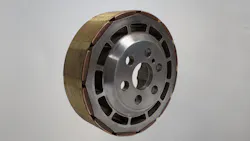
Why use an electric motor when an internal combustion engine has been doing a perfectly good job for over 125 years? There are many reasons to drive electric vehicles, but until now, battery technology hasn't been cheap enough to make it a mainstream vehicle.
The modern hybrid technology was first mass-marketed by Toyota in model year 1998, but it needed an ICE to make up for the lack of range that a battery of the ‘90s lacked. The electric motor could only spin up to 6,500 RPM. Electric motors have only gotten better and less expensive to manufacture. Internal combustion engines are dominant in the world of transportation and have been for any technician living today. What advantage does a modern electric motor of 150 hp (112 kW) have over a modern 150 hp gasoline ICE, like the Chevy Volt? The electric motor is smaller, lighter, less expensive to make, has no emissions, more available power, torque on demand, easier to diagnose, simple to fix, fewer moving parts, fewer sensors, no need for a flammable liquid onboard, lower cost for energy, and more. The electric motor that drives the wheels of an xEV (what ASE calls any high-voltage vehicle such as an HEV, PHEV, EV, etc.) has been changing for the better over the last quarter of a century. From new magnets, quieter operation, lighter weight, more torque and rotational speed, more durable winding in the stator, and lower cost. There's newer testing equipment for techs too. These small powerful machines are one-quarter the size of a V-8 with more torque.
How did all this come about?
Nikola Tesla
Nikola Tesla started to experiment with the rotating magnetic field principle in 1883 and then built and tested his multi-phase alternating current induction motors, including a three-phase design in 1887. He officially patented the technology in May 1888.
What Motor Types Are Used in xEVs Today?
Modern electric drive vehicles use one of three types of motors.
Type 1. This is called a "Three-Phase Alternating Current Brushless Interior (or Exterior) Permanent Magnet Synchronous Motor." They're used in over 90% of all xEVs.
Type 2. Called a "Three-Phase Alternating Current Brushless Induction Asynchronous Motor." Installed in many Tesla models, GM eAssist, and others, they're known as IM, induction motors.
Type 3. The latest one is a "Brushed Externally Excited Synchronous Motor." This is new from Nissan, introduced in 2025. We'll examine all three types.
Type No. 1: Three-Phase AC Brushless Permanent Magnet Synchronous Motor
If you were trained by the Honda Motor Company when the Honda Insight gas-electric hybrid first came out in model year 2000, the Honda instructors told the technicians that the Honda IMA (integrated motor assist) motor was a DC motor. This is a quote from Honda: "We use an 'ultra-thin DC brushless motor' to highlight its direct-current (DC) power source and its simple, lightweight construction compared to bulky alternating-current (AC) systems." My hybrid training started in 2000 with the purchase of a Honda Insight.
The Honda motor had three orange cables going to it, and most technicians were confused, as they should've been. Honda was alone in their description of their electric motor, as every other OEM at that time (Toyota and more later) described its HV motor as a three-phase AC motor. Who was right? What is it—a DC motor or a three-phase AC motor? If you're familiar with the high-voltage switching that occurs in an inverter, it depends on what you're sending through the orange cables from the inverter to the electric motor.
When the high-voltage battery is supplying power to the inverter, it starts as direct voltage and direct current. The inverter can't change the voltage to AC voltage. It simply used the direct voltage by switching the polarity rapidly to create a square wave that is both positive and negative. This will then produce alternating current that's fed into the stator windings.
Honda is correct: in any three-phase motor, it's a DC motor when the high-voltage battery is sending direct voltage. At the same time, the inverter is sending a manufactured alternating current. To keep things easy to read and comprehend, we'll refer to the motor as a three-phase AC motor. Let's get back to the motor construction.
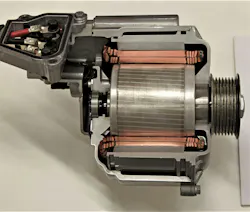
Creating AC
This technology is used in every motor today. Alternating current will create an electromagnet from a coil of wire wrapped around laminated steel plates. These coils are arranged in a circle called a stator. Feed them alternating current at a certain frequency, and they'll produce a rotating magnetic field with North and South electromagnets changing location. A coil between the North and South will be at zero volts as there's no current flow. That coil will be non-magnetic at that time. Until recently, high-voltage three-phase electric motors in vehicles were either induction or permanent magnet types.
PM Motors
Interior (or Exterior) Permanent Magnets are arranged on or in the rotor. The rotor is the spinning part that powers the wheels or whatever needs to rotate. This rotation determines the name: Rotor. Most PM electric motors have an interior magnet rotor, as fewer magnets are needed, but there have been exterior rotors that rotate around the outside of the stator in a drum of sorts. This is an expensive part of the motor, so work is constantly being done to reduce costs.
Synchronous Motor
The rotational magnetic fields (stator) can be measured in RPM, but the speed is most often referred to as "frequency." Frequency and RPM can describe the same thing in this context. The speed of the electromagnets in the stator will match the RPM of the rotor. In a synchronous motor, the speed of the rotating magnetic field equals the speed of the rotor—it's synchronized.
Magnets
Some metals have magnetic qualities naturally. Some metals like cobalt, iron, and nickel are easy to make into a magnet. When these metals are placed into an external magnetic field, their magnetic properties align, and they become strong permanent magnets. Most high-voltage electric motors in xEVs use high-quality permanent magnets made of a rare-earth metal called "neodymium." Only a few types of permanent magnets are used in motors that power xEVs. The need to "reduce, recycle, and reuse" is clearly a theme this world needs to embrace as we deal with the effects of a growing world population. The most popular PM used today is a neodymium magnet, also called a NdFeB, NIB, or Neo magnet. We'll call them neo magnets. They're made from standard iron, boron, and neodymium. Rare-earth magnets are used in many other applications, such as wind turbines, robotics, and many other motor applications. "Rare" is a bit of a misnomer for a material like neodymium, as the high demand only increased the production output. It's not rare. China is the leading country that mines and sells neodymium. Some attempts have been made to extract rare earth metals in the US and other parts of the world, but most rare earth metals still come from China. That country threatened to stop exporting neodymium and other rare earths in 2011, which sent prices for the metals soaring. If China were to use rare earth access as a geopolitical tool again, it could significantly impact companies that use rare earths to build their motors, so research has been going on for a long time to find a substitute. During your education in xEVs, you'll see politics play a large part in the evolution of transportation.
How Neo Magnets Work
Neo magnets can produce a strong magnetic field in a small package. When paired with dysprosium, Neo magnets have high "coercivity." Coercivity is the ability to resist demagnetization once magnetized. Heat is the largest factor in a magnet losing its magnetic qualities. In any motor, the heat is managed as you would expect, with a computer, sensors, and strategies to keep the motor in a "safe" temperature zone. In a permanent magnet motor, the magnets are often embedded in the rotor, although the first motors that Honda used in model year 2000 had the magnets bonded to the exterior of the rotor with a fiberglass belt trapping the magnets, just in case things got out of control. A modern rotor has slots that the magnets are slid into and glued in place.
A less expensive PM was developed by Toyota. It used a fraction of the amount of neodymium that was used before. The new magnet Toyota developed uses no terbium or dysprosium, which can be added to neodymium to improve its operability at high heat, above 212 degrees Fahrenheit. This magnet makes motors less expensive. How does all this impact an xEV technician? Once you think you know enough about motors, a new one will be innovated, as true inventions are rare. Instead of neodymium or dysprosium, this new PM uses less expensive rare earth metals—lanthanum and cerium. Lanthanum and cerium are still predominantly mined in China. Instead of magnets with a uniform concentration of neodymium, Toyota's magnets concentrate neodymium around the edges of the magnet.
Type No. 2: Induction Motors
Induction Motors (IM) are referred to as a "Three-Phase Alternating Current Brushless Induction Asynchronous Motor." Here's the breakdown of all those words. Three-Phase Alternating Current (AC) is no different than the stator in a PM motor other than the software will have a different strategy. Brushless—like Type 1. Induction motors don't use magnets. This is the biggest difference. The rotor is sometimes called a "squirrel cage" and is mostly made of aluminum and copper. The magnetic poles in the rotor are induced by the magnetic fields produced in the stator.
What is "asynchronous"? The speed of the rotating magnetic field created by the stator is either faster or slower than that of the rotor. The rotor is excited by the stator, and if the speed of the rotational field matches the rotor, the rotor would stop spinning. When the "induction" motor is a motor, the rotor is going slower than the rotating magnetic field. If the "induction" motor is in generator mode, the rotor is going faster. This type of motor is less expensive to manufacture but requires more energy from the battery pack. Tesla used this for years, as Elon Musk was worried about the supply of magnets sourced in China. About 10 years ago, Tesla installed a PM motor in the rear and continued to use the IM in the front drive motor. In model year 2012, General Motors used an IM motor in its eAssist HV hybrid system.
The Nissan BSMT
This new motor is less costly to produce. Nissan calls this a "Brushed Externally Excited Synchronous Motor" or BSMT. The stator, inverter, and resolver are like both Type 1 and Type 2. The big difference is it has no PM or squirrel cage. It uses an easily replaceable brush set that creates magnets in the rotor that have coil windings inside it. It may be used only in Japan and not in the US. Munro and Associates will tell you it's in the US, but my sources at Nissan didn't confirm if it's sold here when I reached out to them.
About the Author
 Craig Van Batenburg
Craig Van Batenburg
Craig Van Batenburg is the CEO of ACDC, a hybrid and plug-in training company based in Worcester, Mass. ACDC has been offering high voltage classes since 2000, when the Honda Insight came to the USA. When EVs were introduced in 2011, ACDC added them to their classes. Reach Craig via email at [email protected] or call him at (508) 826-4546. Find ACDC at www.FIXHYBRID.com.