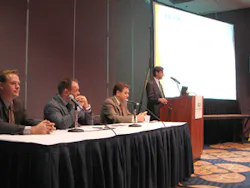
(Oct. 31, 2007) The aftermarket industry has been closely following the progress of proposed Right to Repair legislation here in the U.S., but there are similar efforts underway in other parts of the world as well. During the "Right to Repair: A Global View" seminar held yesterday at AAPEX, representatives from industry trade groups in the U.S., Canada and Europe updated attendees on the status of these initiatives.
While the debate around access to diagnostic tools and repair information in the U.S. is currently centered on the proposed Motor Vehicle Owners' Right to Repair Act, there are already existing mechanisms, including the National Automotive Service Task Force (NASTF), that help provide information to independent repairers.
"You can't get an appointment in some areas," says Scott Smith, manager of government relations for the Automotive Industries Association (AIA) of Canada. "The dealer network cannot serve the existing fleet in Canada."
AIA Canada found that 60 percent of automotive companies blocked access to their Web sites by Canadian technicians. Of the five leading OEMs that sell vehicles in Canada, only GM consistently provided information access to repairers. Efforts to get the manufactures to voluntarily provide access have so far been fruitless.
AIA Canada estimates this lack of access costs repairers between $1 billion to $4 billion per year. Repairers there have responded by utilizing third-party information and local workarounds, but Smith says this is clearly not a sustainable solution.
AIA has begun a letter-writing campaign to members of parliament, and is trying to get Environment Canada (the equivalent of the U.S. EPA) and the agency in charge of enforcing Canada's Competition Act to develop new regulations to address this problem. At least one member of Parliament has also introduced what is called a private members bill (C-425) to amend the Competition Act and CEPA.
In Europe, the Motor Vehicle Block Exemption Regulation currently requires OEMs to provide repair information and diagnostic tools to independent repairers. However, that regulation is set to expire in 2010. The EURO 5 Regulation, which takes effect in 2009, is targeted at emissions information, but does include provisions that manufacturers must make diagnostic tools available to the aftermarket at a reasonable price.
EURO 5 is only applicable to new model cars, however, which Philipp Hess, technical advisor for FIGIEFA, says "leaves us with a very large gap where we have cars already on the market that are not covered by any legislation."
FIGIEFA, International Federation of Automotive Aftermarket Distributors, has launched its own Right to Repair campaign to make this information and diagnostic tools available to repairers in the EU.
"From AAIA's point of view, the independent automotive repair businesses should not be denied access to this information," says Aaron Lowe, vice president of government affairs for the Automotive Aftermarket Industry Association (AAIA), which hosted the seminar.
Lowe provided an update on the right to repair legislation in the U.S. While there are now 34 co-sponsors of the Right to Repair bill in the U.S. House, there is no parallel bill in the Senate, and no hearings have been scheduled.
In the U.S., opponents of the legislation have generally responded that the information and tools are already available, that the NASTF already exists to resolve these issues, and that what the aftermarket is really after is proprietary information on OE parts.
"That is not what this bill is about, and it never has been about that," Lowe concludes. "This is about helping the service industry. [The issue of independent repairers] being dependent on their biggest competitors for information is not going to settle itself without some kind of federal oversight."
About the Author
 Brian Albright
Brian Albright is a freelance journalist based in Columbus, Ohio, who has been writing about manufacturing, technology and automotive issues since 1997. As an editor with Frontline Solutions magazine, he covered the supply chain automation industry for nearly eight years, and he has been a regular contributor to both Automotive Body Repair News and Aftermarket Business World.