Key Highlights
- Rechargeable batteries, USB-C charging, and multi-function designs are reshaping portable automotive lighting.
- Technicians benefit from a mix of inspection lights, headlamps, pocket lights, underhood lights, and area lighting.
- Runtime, durability, serviceability, charging convenience, and consistent output matter alongside brightness.
- Demonstrate lights in person and ask customers where they work and what areas are difficult to see.
- Position quality lighting as a long-term investment that supports safer, more efficient repairs.
Lighting is one of those categories that’s easy to overlook, but without it, we get nowhere fast.
ATD Tools’ Senior Marketing Communication Manager, Brian Lamoureux, thinks of lighting like this: “You can’t repair what you can’t clearly see,” he says. “Proper lighting improves visibility during diagnosis, inspection, and repair. As vehicles become more complex and components are packaged into tighter spaces, quality lighting becomes even more important.”
As a tool distributor, especially this time of year when the daylight hours have grown shorter, you likely notice when you walk into a shop that has good or bad overhead lighting. However, no matter the quality of the overhead lighting, your customers will find themselves in areas where that light can’t reach – under dashboards, in engine compartments, underneath the vehicle, etc.
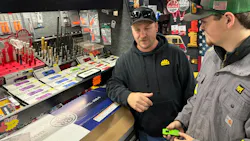
For Mac Tools distributor Tony Fielding, selling lighting products has never been an issue. When his customers walk on his truck, one of the first things they’ll see is a shelf full of lighting products.
He notes that after spotting the lights, many of his customers will realize that’s just what they were looking for.
“And I might sell five or six of them at one stop,” he says.
Fielding has been with Mac Tools for about eight and a half years now and before that spent two years with another flag. When his previous job of 23 years came to a close, a friend of his pulled him into distribution, and he hasn’t looked back since. Now, he runs a route through southern Arkansas from Little Rock down, visiting independent shops, truck shops, rental companies, body shops, dealerships, and even an asphalt dealer. He runs about 1,000 miles a week making his customers have everything they need. And when it comes to keeping his customers’ shops and workspaces well lit, he knows this is a product category everyone needs.
Updates in lighting technology
While the technology behind lighting may seem simple, over the past decade many strides have been made to enhance these products. Keeping a pulse on these updates can help you make more sales as you introduce your customers to tools and equipment that can help them do their jobs more efficiently.
“One of the biggest recent advancements in automotive lighting has been improvements in lithium rechargeable battery technology,” Lamoureux explains. “Today's batteries provide longer runtime, allowing technicians to work longer between charges.”
However, this change in battery type has altered more than how a light is charged. Geoff Evans, director of product management for Streamlight, notes that the shape of the device no longer needs to be cylindrical to accommodate the round batteries of the past. The non-traditional shapes have made a big difference for those using the lights, as the fear of the light rolling away is no more.
Along with the battery type, there’s been a transition to USB-C charging, aka the “universal” charger, which makes charging a simpler endeavor because many devices are now using the same type of charger.
Apart from battery and charger updates, Evans also mentions that discharge rates have been evolving, allowing lights to have a higher momentary peak lumen performance.
“Think throw or turbo modes like we have on our Wedge series,” Evans explains. “But also, depending on the battery, we get more sustained performance for our professional users. We want to provide for our customers a light that's 500 lm, and we want it to be 500 lm for five hours. We want a little flatter performance curve.”
Lastly, Olight’s Channel Marketing Manager, Sam Foster, talks about the push towards multi-functional lighting products.
“The biggest trend we have noticed in portable lighting technology in the last few years is the inclusion of multiple light sources in one platform,” Foster says. “This allows the end user to carry multiple capabilities in one compact tool.”
Brightness and runtimes are only part of the equation now, he explains; users are looking for lights that combine spotlights, floodlights, and UV lights all in one compact solution.
New products in lighting
With the vast amount of lighting products available, it can be hard to know what to stock on your truck, and while we can’t cover every option in this article, we can go over some of the latest products from a few of this industry’s lighting manufacturers.
Earlier this year, Olight released the Oclip 2 Series – a product designed for handsfree use.
“It features a versatile clip that can attach to a work shirt or a variety of other locations, Foster explains. “It also features a dual-axis directional system that allows you to rotate the clip and tilt the head to point the beam where it is needed. Two strong magnets allow you to mount it under the hood or on another suitable steel surface in and around a car, then adjust the beam toward the work area.” The light also features a spotlight, floodlight, and red light.
The newest addition to the SABER lineup is a rechargeable paint gun light. The light mounts directly to the paint gun, assisting users with color match, metallic distribution, and finish quality.
“The light features adjustable color temperatures from 2700K to 6500K, handsfree motion-sensing controls with double-wave activation, and a CRI rating greater than Ra96 for highly accurate color representation,” Lamoureux says. “It can also help painters identify issues such as uneven coverage, dry spots, and other finish imperfections before the vehicle leaves the booth.”
As for Streamlight, their latest automotive lighting tool is the Wedge SL. Its thin design fits easily in a shirt or pants pocket, and because it takes up less space, users can have more gear on them.
“This was designed to give technicians a bright, reliable inspection light,” Evans says.
It offers 500 lm in ‘Throw mode,’ which gives technicians a quick, instantaneous burst of light when they need to take a look at something.
Though the Mac Tools 420-lm Rechargeable Work Light, No. TL420 may not be their latest lighting product, Fielding notes it’s among the most popular with his customers for its durability and reliability.
“I've had people drop them several times, actually run over the corner of them with their cars, and they still work,” he says. “The TL420 is probably the best light that I've ever sold and will continue to sell, as long as they have them.”
Types of lights technicians need
Lighting is a necessary part of completing just about any job in the shop, but different jobs will require different lighting solutions.
For personal use, Lamoureux recommends technicians have these products on hand:
- An inspection light
- A headlamp
- A compact pocket light
For the inspection or pocket-sized lights, Evans notes that those are perfect for initial diagnostics, when technicians are “chasing down the problem” and checking to see if there’s a leak or a seal out of place. Once that inspection is complete, the technician will likely want to switch to a headlamp or a positionable work light to keep their hands free to dig into the issue.
For large jobs, Lamoureux recommends shops provide:
- Underhood lights
- Flood lights
- Area lights
Another consideration that Evans mentions may get overlooked with these shop lights is that some of your customers may work outside, so something like a pen light isn’t going to cut it for them when it’s getting dark at 4 p.m.
“Having a variety of lighting options helps technicians put the right amount of light exactly where it's needed,” Lamoureux says, “improving both efficiency and repair quality.”
Fielding agrees with the sentiment and tries to keep a variety of lighting products on his truck.
“Just keep all different kinds on the truck, everything possible,” he says. “I would say two of everything on there. Nine times out of 10, if you’ve got some people on the truck and one of them wants [the product], somebody else is going to want one too.”
What technicians want from their lights
There are many factors to consider when trying to sell lighting tools and equipment to your customers. It’s your job as a distributor to understand what your customers are looking for, so you can put the right lighting solution in their hands.
“One of the biggest mistakes technicians make is focusing solely on lumen ratings,” Lamoureux says. “Brightness is important, but it only tells part of the story.”
He recommends also discussing:
- Runtime
- Durability
- Charging convenience
- Warranty coverage
- How the light performs over its entire runtime
“A light that gradually dims may not provide the same usability as one that maintains consistent output,” Lamoureux notes.
Taking a closer look at durability, you understand what your customers are putting their tools through on a daily basis – drops from heights, exposure to harsh solvents, extreme hot or cold temperatures, etc. Evans explains that technicians need tools that stand up to the rigors of shop life.
Some of Fielding’s customers have certainly put their tools to the test. A magnetic base is a popular feature among his customers, and while very handy, the downside of this is that the lights can easily be forgotten wherever they are stuck. In one instance, he had a customer leave their light stuck under a woman’s vehicle, and it wasn’t until two or three weeks later that she came back to return the, luckily unscathed, light.
Fielding also recalls an incident that ended far more poorly for one of his customers. They accidentally left a work light in some brake fluid over the weekend. Unfortunately, come Monday morning, the chemical had eaten through the plastic shell of the light.
Not all cases of busting a tool are this extreme, which is why serviceability of a product is another important consideration for technicians.
“A light nowadays, or especially a light from a professional lighting tool company, is an investment,” Evans says. “So, [technicians] want something that's serviceable, something that you can replace the battery in someday.”
Being able to replace parts as they fail will vary from one light to the next, but the importance of having that capability remains the same.
In the case of the melted light mentioned above, where serviceability isn’t an option, the next factor to consider is warranty and, along with that, customer service.
“A tool backed by a lifetime warranty and dependable customer support can pay dividends in the long term,” Foster says.
Other factors Evans recommends distributors consider are the performance characteristics of the light and its form factor. Discuss with your customer whether the light is right for what they’re trying to do – does it have a long enough runtime, is it bright enough, will it stay bright enough for long enough?
Then thinking about form factor, Evans goes over ways the technician may be using the light, such as whether they’re wearing it or if they’re setting up the light via a stand, a magnet, or a hook. If they plan to wear the light, is it comfortable?
“Performance characteristics and then form factor,” Evans says, “are important to be matched to the job at hand.”
Sales tips for lighting products
Lighting solutions are an essential part of every technician’s toolbox, but they may need help understanding that one lighting solution does not rule them all.
1. Demonstration over specifications
“Lighting is one of those categories where a live demonstration can be far more effective than discussing specifications,” Lamoureux says.
Fielding notes that he demonstrates all the lights on his truck, going over all the product’s features and warranty coverage. He wants to ensure his customers know what they’re buying, so they can be happy with their purchase.
“Demonstrating brightness, runtime, handsfree functionality, and mounting options helps technicians immediately understand the value of the product,” Lamoureux explains. “It's also important to highlight features that solve everyday shop problems, such as strong magnets that securely hold a light in place, motion-activated headlamps, or underhood lights that automatically conserve battery power when not in use.”
2. Ask questions
If a customer is having a hard time deciding what light will be best for them, the best thing you can do is ask them questions. Fielding likes to start with the question, “Where do you spend most of your time and where are your bad spots that you have trouble seeing?”
“I let them tell me exactly what they're looking for,” Fielding says, “and how they're going to apply the light, and then I'll tell them, ‘Hey, I recommend this or this.”
3. Don’t forget about lighting
It’s easy to overlook or even underestimate lighting as a whole, but a technician can’t properly do their job with ample lighting.
“It’s just as commonly used a tool as a socket wrench or that really nice set of screwdrivers or that really comfortable set of combination wrenches,” Evans says. “Those are things that our technicians use every single day. But the first tool out of their bag, out of their box, or out of their shirt pocket is always going to be a light.”
4. Sell the investment
Technicians want tools that will last. Constantly having to replace a tool only slows their workflow and hurts the shop’s income.
“Technicians are smart,” he says. “They know they're going to be in this job for a long time. They want to buy that one tool that's going to last them 5-10 years versus one that they're going to have to throw away in a week and have to replace perpetually.”
About the Author
 Emily Markham
Editor | PTEN and Professional Distributor
Emily Markham is the editor of Professional Tool & Equipment News (PTEN) and Professional Distributor magazines. She has been writing about the automotive aftermarket since 2019, after graduating from UW-La Crosse with a bachelor's degree in English. During her first three years with EndeavorB2B's Vehicle Service & Repair Group, Markham also wrote for Fleet Maintenance magazine.
Don't miss Markham's next article. Sign up for PTEN or Professional Distributor's weekly newsletter.
Related
 Streamlight Switchblade