Taking on the heavy weights: An overview of how to sell heavy duty tools and equipment
Key Highlights
- Heavy duty tools are larger and heavier, requiring a focus on ergonomics, safety, and efficiency improvements to meet evolving vehicle needs.
- Latest products like Lisle's Brake Spring Fork and OTC's Suspension Bushing Kit help technicians perform faster, safer repairs, boosting shop productivity.
- Educating customers on proper tool use and safety, along with offering training classes, can prevent injuries and ensure effective tool utilization.
- Understanding customer needs through targeted questions helps match the right tools, whether basic or advanced, to their specific repair requirements.
- Building strong relationships with shop owners and maintaining inventory are crucial for capturing heavy duty sales, which are often driven by urgent maintenance needs.
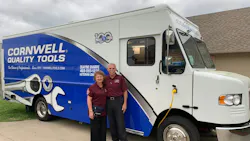
Depending on the kind of tools and equipment you’re trying to sell, the level of difficulty in making that sale varies. Hand tools tend to be an easier sale, while scan tools can be trickier. And products like flashlights tend to be impulse buys. Cornwell Quality Tools distributor team, Duayne and Susie Sharpe, have worked for 10 years selling tools to shop owners and technicians. One of the categories they've seen distributors struggle with selling is heavy duty.
“Heavy duty is a real challenge for any tool guy,” Sharpe notes. “So often, the shop owners don't want to pay our prices.”
And Sharpe would know – before selling tools, he worked for many years at Caterpillar and Komatsu, two heavy equipment manufacturers, and was the guy distributors would try to make a sale to. From his experience, he knows that, typically, the larger the shop, the more likely they are going to be searching for the lowest price, and that tends not to be the tool guy.
However, that’s not always the case. Along his route just southeast of Dallas, Sharpe has a few 18-wheeler shops that buy from him. This is no coincidence, though, as he is always looking for an opportunity to get ‘in’ with his customers.
“Keep your eyes open when you're walking through the shop,” he advises. “I saw a transmission jack the other day sitting over in the corner, and I could tell it hadn't been used for a while. So, I walked over and said, ‘What are you guys doing with this?’ ‘Well, it failed, and it's out of warranty.’ ‘Let me take a look at it for you.’
Just trying to get an opportunity. And if I can't do anything, I can't do anything. But at least they know I'm interested in trying to help them instead of blowing it off.”
Heavy duty sales may not be the easiest to make, but if you can find an ‘in’ with your customers, you may be half there already. To help you make the final push to transition that stop into a full-fledged customer, this article will tackle many of the most important aspects of selling heavy duty tools and equipment, such as how they are evolving, some of the latest products in this category, safety and training for these tools, what your customers want out of this equipment, and advice on making the sale.
Evolution of heavy duty products
Tool and equipment manufacturers spend a lot of time figuring out how they can improve their products to make them more beneficial to their users. Understanding how these products have evolved over the past few years can help give distributors their ‘why’ when a customer wants to know what point there is in buying a new tool or piece of equipment.
Looking at heavy duty tools and equipment in particular, when you consider the size of the vehicles they’re being used on, it makes sense that these products are much larger, and often much heavier, than the tools and equipment used on passenger vehicles. For that reason, Justin Fisette, product marketing manager for Bosch Mobility Aftermarket, explains there’s a continued focus on ergonomics, safety, and user experience.
“Making it easier to lift, remove, transport, and replace these components can get trucks back on the road faster and improve profitability,” Fisette says.
Evolutions in the products also come from evolutions in the vehicles themselves.
“Over the years, the diesel engine has evolved, and the scan tool has had to move along with it,” notes Denis White, EDU manager for TEXA USA. “The check engine light comes on for many reasons … and the scan tool is the only tool you have to see that.”
Broken down like this, it’s easier for technicians to see why they should care about these updates. The evolutions not only help them become more productive and efficient but also keep them safer while on the job.
The latest heavy duty products
Knowing what to stock on your tool truck can be dizzying while looking at all the options you have available. When it comes to heavy duty tools and equipment, specifically, Sharpe notes that he tries to have brake tools, U-joint pullers, truck jacks, seal installers, wheel sockets, and large torque wrenches stocked, as these are what “move the most.”
One of the latest heavy duty tools from Lisle is their Brake Spring Fork, No. 39780. Eddie Lisle, sales manager for Lisle Corporation, says that they’ve recently updated the design for this one.
“Now, there's a better cradle hook, and then there's a strike cap on the end for stubborn springs,” he explains. “Those springs need to be replaced because after a while they can rust; they can lose tension, [and] it reduces your stopping power. So, it's kind of a standard replacement type tool that you would need to use during a brake service.”
For OTC, Fisette notes their newest tool, the Suspension Bushing Adapter Kit with Pump, No. 4247-FR, is an expansion of their heavy duty suspension bushing remover.
“It uses a massive 25-ton hydraulic cylinder with an air-powered foot pump to save hours on bushing service,” Fisette says. “It also allows the service to be done on the vehicle, instead of disassembling multiple components and taking the leaf spring to a shop press.”
Because the tool mounts to the vehicle’s suspension, Fisette explains, users won’t need to support it during operation, creating less risk of injury for them. Alignment adapters are also included to ensure the new bushing is correctly pressed back into place.
Looking at the diagnostic side of heavy duty tools, TEXA USA’s TXT Multihub 2 works with multiple vehicle brands, meaning users are covered regardless of what shows up in their bay. AI is now also integrated into the device.
“A great example is a guy will have a code on a Cummins, and it will take us to the code,” White explains. “And then if you click on a button, you can search AI for known fixes for it. But also, there's another button that will allow you to go to a wiring diagram that is embedded in our software, and it will take you to the component that the code is about.”
The AI in the device is not OpenAI like you find with ChatGPT. All the information the AI pulls from has been validated by TEXA, White notes, so technicians won’t have to worry about any misinformation.
Educating your customers on product training and safety
You’ve likely heard the saying, “The customer is always right,” and while in some cases, it makes sense to follow this advice, in others, it could end badly.
“Anytime you can have a tool that's specifically designed to do the job, you're going to prevent, maybe, yourself from getting hurt [or] damaging the vehicle,” Lisle says. “If you don't have the right tool, the job can also take a lot longer to complete.”
No technician is going to want to put themselves at a disadvantage in getting their work done, but they don’t always realize that they’re using the wrong tool for the job.
“While they may look similar to automotive tools, heavy duty tools are designed and tested for greater strength, capacity, and component size,” Fisette explains. “They’re specifically created to serve the heavy duty market and to withstand the use and abuse that comes with heavy duty service.”
Sharpe sees technicians try to use and/or buy the incorrect tool for the job most often among his younger customers.
“They've gone to a tech school,” he notes, “but they don't have the practical experience of working on stuff.” Luckily, with Sharpe’s background of working on machinery, gasoline, diesel, and heavy equipment, he’s able to use his experience to help guide them.
It’s also important to encourage your customers to utilize the resources available to them when learning how to use a new tool. TEXA USA offers classes on their IDC 6 software to help technicians familiarize themselves with the technology.
“It is very intuitive,” White says, “but just because it is intuitive doesn't mean we don't offer classes for it.” Even a technician who believes they know all there is to know about a tool could learn something new from attending a class on it. White notes that the goal with these classes is to help users get the maximum potential and benefits out of their purchase.
What are technicians looking for in heavy duty tools
When you’re trying to get inside your customers’ heads, the best thing you can do is just ask them. Helping them find the product they need means understanding exactly how and what they’ll be using the product for.
White recommends asking these questions if your customer is looking for a heavy duty scan tool:
- What brand/s are you working on? (Cummins? Peterbilt? International?)
- Are they automated or manual transmissions?
- What brake system are they using?
- Do they have ADAS?
- How far do you want to go with the diagnosis?
“There are technicians out here that can get by with the very basic of tools,” White says, “and there are technicians out there that need the most advanced tools that are out there.”
Though these questions are somewhat scan tool specific, the same idea applies to any product you’re trying to help your customers find.
Apart from understanding the ‘what’ and ‘how’ of the tool, you’ll also want to consider aspects such as quality and reliability. Sharpe notes that sometimes his customers come to him after having seen a product online to get his opinion. If he has experience with the tool, he lets them know if he feels it’s worthwhile. If he hasn’t worked with that tool previously, he knows he can call up some of his customers to see what they think before reporting back.
“Quality, warranty, and brand reputation are vital considerations when buying tools,” Fisette says. “Heavy duty tools are more expensive, so buying quality ensures you get the most value from your purchase. At such a high price point, shops must think about how much time and money they’ll save with the purchase. If a tool gets a truck or piece of equipment back to work faster, that’s a good investment.”
Advice for distributors on selling heavy duty tools
Heavy duty tools and equipment may not be the simplest products to move on your truck, but there are ways you can set yourself up for success.
1. Don’t skip your heavy duty customers
Though it may be tempting to avoid heavy duty altogether, you could be losing out on this untapped market.
“When a heavy duty shop needs something,” Lisle says, “they need it.”
Due to the nature of many fleets needing to have maintenance inspections done about every 10,000 miles, if something is wrong with that truck, the shop wants to get it fixed as soon as possible so it can return to the road.
“That’s why heavy duty tools are so important,” Lisle explains. “I think people often don't care about price as much with heavy duty tools just because that maintenance is required. You're going to need to do that brake job on it to pass the inspection.”
2. Figure out what’s frustrating them
One of the easiest ways to start a conversation about a sale is to figure out why they were cursing like a sailor when you walked in the door.
“Find out what their pain points are,” White says. “Once you understand the pain, then you have to fit the tool to the need, and that's how you qualify your customer. You ask the questions.”
3. Have a storage plan for your heavy duty stock
“The old adage of ‘You can’t sell it if you don’t have it’ is a tough proposition in the heavy duty market because of the cost and sheer size of the tools,” Fisette says. Keeping dozens of truck jacks on hand isn’t realistic for the majority of distributors, but you might be able to manage one or two if you have the space.
Sharpe has two garages at his house where he can store everything that won’t fit on his truck. If you don’t have that kind of space available, consider renting a storage unit for larger items and overflow.
4. Talk to the shop owners
The cost of many heavy duty products means that most technicians aren’t making these purchases, so you’ll need to speak with the shop owner.
“Make a relationship with the shop owner, get in their heads, and make sure that they like you because if they don't like you, they're not going to buy from you,” Sharpe explains. “If you're walking in and they're going, ‘Oh God, here he is again.’ You got a problem.”
This is where Sharpe's wife, Susie, shines. She wants nothing to do with the computers, handling money, or running credit, Sharpe notes, but she's great with relationship building.
"She doesn't know a stranger," Sharpe says. "She hugs everybody, whether they stink of diesel fuel or differential grease. She doesn't care."
It's that sort of outgoing personality that can help change someone who won't set foot on your truck to someone who's a consistent customer. And though, as was mentioned earlier, the heavy duty shops may not come to you for all their purchases because they’re looking for the lowest price, if you can befriend the shop owner and become someone they can rely on, you could still get some of their sales.
Sharpe notes that sometimes he has customers who buy a product from someone else but come to him for help. He provides that help because he knows it will strengthen his relationship with that customer.
“We've made a good relationship with the service manager [at the Ford dealership], and they buy all of their torque wrenches, their air impacts, and several of their other different types of tools from us because of the service we provide.”
About the Author
 Emily Markham
Emily Markham
Editor | PTEN and Professional Distributor
Emily Markham is the editor of Professional Tool & Equipment News (PTEN) and Professional Distributor magazines. She has been writing about the automotive aftermarket since 2019, after graduating from UW-La Crosse with a bachelor's degree in English. During her first three years with EndeavorB2B's Vehicle Service & Repair Group, Markham also wrote for Fleet Maintenance magazine.
Don't miss Markham's next article. Sign up for PTEN or Professional Distributor's weekly newsletter.