The value of showing up
Key Highlights
- Simms has over 40 years of experience in the automotive industry, blending technician skills with distribution expertise.
- He makes approximately 120 stops weekly, emphasizing punctuality, reliability, and open communication with customers.
- His routine starts early, with a focus on efficiency, time management, and maintaining a clean, organized truck for daily operations.
- Building strong relationships with technicians and shop owners is central to his business, with a focus on personalized service and trust.
- He adapts to industry changes by offering overnight shipping and staying informed about new products to meet customer needs.
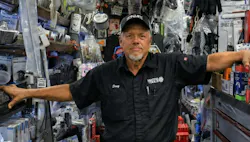
More than 40 years in the automotive industry have given Douglas Simms a unique perspective from both sides of the tool truck.
Running a route across northeastern North Carolina and into southern Virginia, Simms visits a mix of independent repair shops, dealerships, and heavy duty truck facilities. Some days are heavier on dealerships, while others are spent primarily visiting truck shops. Altogether, he estimates he makes around 120 stops each week.
With that many customers to keep up with, consistency has become a big part of how Simms runs his business.
“For me, it’s just being there on time, being reliable, being open on the phone,” he says. “I always answer my phone. It doesn’t matter what time it is. Being available for the guys, getting them whatever they need.”
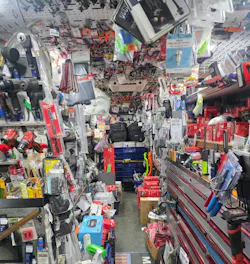
From technician to distributor
Before becoming a distributor, Simms spent 21 years working as a GM technician.
He started in 1986, attending college through a two-year GM apprenticeship program. After spending another two years as a helper, he went on his own as a commission-based technician in 1990.
A long commute and other challenges with dealership life helped solidify the decision to switch careers, and in September 2007, Simms started running a Matco route.
His experience as a technician gave him a head start when it came to knowing tools, but becoming a distributor introduced him to parts of the industry he hadn't encountered before.
“You let your customers kind of teach you about other things that you don’t know about,” he says. “I didn’t know a lot of body stuff. I’m really good with body now, as far as supplying them with what they need. Heavy duty trucks, I didn’t know a lot about trucks at all.”
Those lessons have continued throughout his time on the road. Simms still pays attention to what technicians are working on and isn't afraid to get under the hood with them. His years as a technician have also made him a resource when someone on his route runs into a difficult repair.
“I’ve worked on cars a long time and still continue to work and fix cars over the phone,” he says. “I’m looking at them with them every day. I’m under the hood. I pay attention to what they’re doing.”
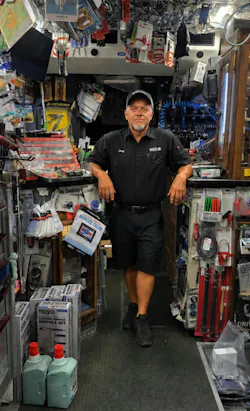
Life on the route
Nearly two decades into the business, Simms has his routine down, but that doesn't mean the days are short.
He gets up around 6 a.m. and is on the truck by 6:45. Depending on where he's headed that day, his first stop may be as early as 7 a.m.
“I try to run as early as I can, so I find the earliest shop that’s open during that day, and I’ll hit them as early as I can,” he says. “Usually, I’m running hard through lunch. There’s really no lunch hour.”
The route itself is only part of the work.
By around 5 or 5:30 p.m., Simms is heading home to check in orders, restock drinks and snacks on the truck, empty the trash, sweep the truck, and make sure everything is ready to go again the following morning. He checks the tires and fluids, balances his cash, checks, and credit card payments, and places another order for the next day.
“I usually finish at eight,” he says. “That’s my goal, to get done by eight.”
Keeping everything moving is why Simms considers time management one of the hardest parts of the job. A few extra minutes at one stop can quickly affect the rest of the day, but rushing customers isn't much of an option either.
“You’ve got a lot of shops to hit, a lot of guys to see every week,” he says. “You’ve got to make sure and get to the next shop because you’re not only selling tools, but you have to get paid as well.”
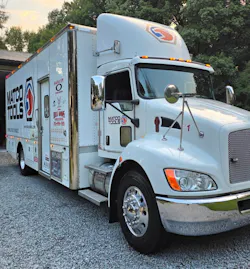
Building a business one stop at a time
With around 120 stops each week, Simms knows every shop can bring something different.
“Every day is different. Every shop is different. Every person that comes on the truck is different,” he says.
Some interactions are easier than others. Regardless of how the last stop went, Simms tries not to carry it with him.
“I might have an attitude. They might have an attitude,” he says. “But you have to deal with that with each one. You have to deal with it separately, and then you have to get back in the truck, put a new face on, and then go to the next stop as if they were my first shop of the day.”
Then he does it again, sometimes more than 20 times in a day.
Over the years, those weekly visits have given Simms a close relationship with the people on his route. If he has to miss a stop, he makes sure they know ahead of time. When a recent doctor's appointment meant missing part of his afternoon route, someone at every affected shop knew he wouldn't be coming and could pass the message along.
Simms knows that for some technicians, his weekly visit is about more than picking up a new tool.
“The guys, they like that 10 minutes on the truck just to get away from work a minute,” he says. “I think that’s a good part of why we’re still in business, tool trucks in general. The guys like that little break away from work for just a few minutes a week.”
At the same time, the way technicians buy tools has changed considerably since Simms started his route in 2007. Online retailers have given his customers more options and made getting a tool delivered the next day easier than ever.
Simms' response has been to try to match that level of convenience himself.
“If a guy needs something fast, I’m going to get it,” he says. “I do a lot of overnights.”
Rather than telling a customer to wait until his next regular shipment, he'll have a tool sent overnight when it makes sense.
“I have to be willing to call Matco, get it overnight, and get it in their hands myself rather than hitting the internet and buying it for themselves tomorrow,” he says.
He also keeps an eye on new products, reading industry publications and searching online for new releases.
“Everybody that comes in that first step is going to ask you what’s free and what’s new,” he says. “I always have new stuff every week. It might be one product. It might be five. But something's always new!"
Passing it on
Approaching 60, Simms plans to continue running his route for at least another five years. After that, he'd like to start enjoying a little more time away from the truck.
But after nearly two decades with many of the same customers, he doesn't picture retirement as simply handing over the keys one afternoon and heading home.
“These guys become part of your family. There’s 300 of them out there,” he says. “I don’t want to just cut and dry leave them and hope somebody else will come into my place.”
Instead, Simms hopes to eventually bring someone into the business who can spend time learning the route, meeting his customers, and understanding the way he's taken care of them over the years.
“I want to work somebody in where they’re in my spot,” he says. “They know my ways. They know my route. They’re consistent as me, and hopefully they’ve learned from me on how to continue the route like I have.”
About the Author
 Nadine Atiya
Nadine Atiya
Editor-in-Chief
Nadine Atiya is the editor-in-chief of Professional Tool & Equipment News (PTEN) and Professional Distributor magazines. She has been covering the automotive aftermarket since 2021, after graduating from Kent State University with a bachelor's degree in journalism and marketing.
Don't miss Atiya's next article. Sign up for PTEN or Professional Distributor's weekly newsletter.