Selling solutions in hand and specialty tools
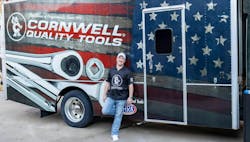
Hand and specialty tools are the backbone of the automotive industry. They are there for quick fixes or long repairs, offering the precision, control, and versatility technicians need. While their design and function may seem simple, their importance cannot be overstated. A basic design doesn't mean the tools haven't evolved over time, adopting new technology and preventative measures to address wear and tear.
As distributors, it's essential to know how to display these products so that they don't go unnoticed, how to effectively demonstrate them, and how to keep yourself updated on the latest innovations so you're offering your technicians the most effective tools for the job. We sat down with GripEdge, Cal-Van, and Cornwell distributor Jared Hull to cover all the basics of how to sell these tools.
Stocking the truck
Nine years ago, Hull started his career in mobile tool distribution after working as a service writer for a car dealership. He'd always enjoyed working on and being around cars and spent most of his free time at a friend's repair shop. It didn’t take long for Hull to realize the job at the dealership wasn't bringing him the fulfillment he craved. When a Cornwell dealer stopped in one day, Hull shared his dissatisfaction.
"He said, 'Hey, you should be a tool man," Hull recounts. "'You have the personality for it.' I was like, 'Dude, I don't think I have the money for that.' He told me what it takes to get into it, and I was like, 'I do have that.' The district manager came over to my house and literally the next day we did the paperwork, sat at my dining room table, and had a beer together."
One month later, Hull was flying out to Colorado to pick up his very own truck, kickstarting his career. Based just south of Fort Worth, Texas, he makes stops mostly at diesel, body, and automotive repair shops.
When it comes to hand and specialty tools, Hull keeps his truck stocked with the standard fare — pliers, wrenches, ratchets, and so on. For specialty tools, he admits it’s “anybody’s game,” but he tries to keep tools he feels will help his technicians work more effectively.
It can be a somewhat monotonous category of products to stock, with many distributors carrying the same tools on every truck, but Hull makes an effort to keep things fresh for his techs and manages to sell these products weekly.
"Your customers have wrenches, they have sockets, find the thing they don't have," Hull says. "As for what I stock, I want to have something that gets my customer out of a pinch. When they need it, they need it now, not next week."
Hull keeps his eye out for new releases, making sure he's the first dealer that has the latest products. For most technicians, they’re looking for hand and specialty tools that will help them do their job faster, saving them time and money.
Sarah Shelstrom, director of demand generation at GripEdge, says the hand and specialty tools technicians need can vary from shop to shop depending on what kind of repairs they typically do. She suggests stocking up on extractor sets; GripEdge offers a number of options including the 32-PC 1/4" & 3/8" Drive Metric & SAE Master Socket Extractor Set, No. MX32S, and Broken Bolt Extractor, No. BBX14S. If you stop at shops that work on European vehicles, keep triple square products on deck.
“While investing in hand tools can be expensive and price may be a factor, technicians will invest in tools that are solutions,” Shelstrom says.
Vice President of Sales at Horizon Tool, Matt Kenny, advises distributors to keep pullers, installers, press tools, timing and locking tools, brake and suspension service tools, and engine or driveline-specific kits ready to go for technicians in the market for specialty tools. If you’re looking to stock these types of tools, Cal-Van offers a number of them including the Universal Brake Bleeder Adapter, No. 24630 and the Automotive Yoke Puller, No. 49750.
“Specialty tools are increasingly essential rather than optional,” says Kenny. “As modern vehicles rely on tighter tolerances and more complex assemblies, having the correct specialty tool on hand often determines whether a job is completed efficiently or turns into a costly workaround.”
If you want to keep things fresh in the hand and specialty tools you offer, consider something as simple as having different color options for basic stock like pliers, ratchets, pry bars, and more.
Innovations in hand and specialty tools
The automotive industry has seen countless new innovations and technologies introduced over the years. The area of hand and specialty tools is not exempt from this with companies constantly developing new ways to keep tools working longer and more efficiently. Kenny notes that significant improvements have been made in specialty tools to address the increasingly complex vehicle systems, tighter engine compartments, and expectations for efficiency and durability in the industry.
“Key advancements include improved metallurgy and heat-treatment processes for greater strength and longevity, more precise machining for tighter tolerances, and the integration of modular or application-specific designs that reduce the need for improvised solutions,” Kenny says. “Specialty tools are now more frequently engineered around specific OE service procedures, ensuring accuracy and reducing the likelihood of component damage.”
In the past few years, GripEdge launched a new technology called Rounding Prevention Technology (RPT) which does exactly what you would expect: prevents the rounding out of fasteners and removes damaged ones.
"This took the technology of your everyday hex, torx, and triple square hand drives, and it changed the market for hand tools,” Shelstrom explains. “RPT not only prevents rounding, but, in a situation where you have a stripped out hex, torx or triple square fastener, GripEdge products have the ability to remove that damaged fastener. Rather than pushing the material of the fastener outward, which causes stripping, the technology pulls the material inward to the tool.”
Organize to entice
Hand and specialty tools can sometimes feel monotonous, with so many options hitting the market without much change in features or functions. To combat this monotony and make sure your truck is the kind of shop that technicians are excited to browse, Hull suggests changing your organization and rotating out the products you already have.
“February through March, I’m going to beat ratchets into every guy out here,” Hull says. “Every guy that walks in, I’m going to pitch him a ratchet. Whatever I’ve got left over at the end of March goes on the ceiling, out of sight out of mind. Now pry bars go on the wall and every guy that walks in here I’m going to say, ‘Man, do you have the best pry bars in your toolbox? Because these here are it.’”
By rotating out his hand and specialty tools, his customers can expect something new on a consistent basis. While the products themselves may not be new, moving them around the truck helps bring attention to tools that might otherwise go unnoticed.
Don’t let products sit stagnantly in their boxes. If you can display products in an engaging way or how they would be stored in a technician’s toolbox then take that route. Hull takes things like pliers and puts them in a tray, allowing customers to pull the tray out and interact with the product like they would if they were messing around in their own toolbox.
On the bottom of one of Hull’s shelves, he has a custom display for pliers, painted pink courtesy of his daughter.
“It blows my mind how many pliers I’ve sold off that,” Hull says. “I lined the Lisle Disconnect Pliers in there the day they came out and I was selling 10 to 12 a day. Guys would come in and they’re very touch feely. They’re picking them up, playing with them.”
Get creative with your organization and allow your customers to touch and interact with products; it could be the very thing that helps you get the sale.
Demonstrating
We here at Professional Distributor love to talk about the importance of demonstrating tools. It shows up in nearly every article we write, and it’s for good reason. If you can show your customers how a tool works and what problems it fixes, you help set yourself up for success. When attempting to sell hand and specialty tools, it can be easy to fall prey to the same quick demonstrations you show to every customer. While these demos are certainly effective, you might be missing out on the opportunity to form strong connections with your customers and show them just how knowledgeable you actually are.
“For mobile tool dealers, demonstrations and education are critical,” Kenny explains. “Technicians respond best when they can see exactly how a tool solves a real problem they encounter in the shop. Dealers who understand common repair pain points and can explain why a specific tool exists — and what problem it eliminates — will build credibility and long-term customer trust.”
There are two main demonstrations you can perform for customers, the first is one that you’ve created on your truck, and the second is the demo you do inside the customer’s shop.
That second demonstration, Hull has found, is almost always a sure deal.
“When you can take a tool into a shop and test it against theirs and yours wins, you have a guaranteed sale,” Hull explains. “Showing someone how something works always beats telling them how it works or how it could work.”
Time is money in this industry, and you might not have the time in your busy day to go into every shop and show off the power of the product you’re offering. If you’re looking for a quick way to demonstrate these products, GripEdge offers a demo block to demonstrate their RPT technology. It’s an easy approach to keeping your customers engaged and educated when on your truck without needing to go out to a vehicle.
Promoting tool longevity
Hand tools specifically can be some of the most abused tools in a technician’s toolbox. Whether it’s from misuse or overworking, they can see a lot of wear and tear throughout their lifespan.
“I’ll tell you one thing that’s constant is the ability of a technician to use a tool for what it is not intended for,” Kenny says. “If it fits and they have it in their hands, that’s what they’re going to use.”
While it’s impossible to replace every single broken tool that comes back to your truck, developing a policy for these incidents and leaning on the warranties from manufacturers can save you a lot of stress and make your customers feel taken care of when disaster strikes.
Warranties
Many manufacturers offer some kind of warranty for tools; GripEdge and Cal-Van are no exception to this.
“GripEdge offers a limited lifetime warranty based on manufacturer defects on most products,” Shelstrom explains. “If during the tool’s normal and intended use, the tool is found to have defects in manufacturing or workmanship, GripEdge will replace the tool with the same or similar product.”
Cal-Van takes a similar stance, offering warranties that give technicians the confidence that their investment is protected.
“These warranties help reduce downtime and financial stress when a tool fails due to material or manufacturing defects,” Kenny explains. “While specific coverage varies by product, Cal-Van's warranty philosophy reflects an understanding of the demands placed on tools in real-world shop environments and a commitment to standing behind their performance.”
For Hull’s customers, they can expect to be taken care of like family when a tool breaks.
“That warranty is only as good as the guy that shows up and takes care of it,” Hull says. “If you’re the guy that shows up every other week or every third week or whenever you get around to it, those guys aren’t going to buy anything from you because if a wrench breaks and you show up three weeks later and say, ‘Well, I have to order parts.’ Then it’s another two weeks. This is a $200 ratchet they haven’t been able to use in five weeks. So, you’re done selling and he’s going to tell every one of his buddies that work next to him, ‘Never buy from this guy, he never shows up.’”
What keeps techs coming back, Hull believes, is the service you offer them even after the sale is through. When you go the extra mile with the service you provide, your customers will come back to you over anyone else.
Preventing breakage
Outside of warranties, you can get ahead of customers coming back with broken tools by researching the products you put onto your truck. Many manufacturers consider the many uses technicians assign to their hand tools. Whether it’s working technology into the tool, like GripEdge’s patented RPT, or making the tools with materials that can better withstand the pressures of shop environments.
“We use S2 grade steel to provide maximum toughness and wear resistance," Shelstrom notes. "It gives the tools the durability to withstand high-torque and high-impact applications."
At the end of the day, your job is to sell your customers the products they need to be efficient at their job. You want to be sure that the hand and specialty tools you offer are reliable.
“One of my favorite things is to walk into a shop where a tech is really struggling with something, and they’re frustrated,” Hull says. “I see what they’re doing and I go, ‘Man, stop right there.’ I’ll run out to my truck and get something that’s a solution to what he’s doing. That’s what we’re really after here, selling solutions.”
About the Author
 Elli Carder
Elli Carder
Assistant Editor | PTEN & Professional Distributor
Elli Carder is an assistant editor for Endeavor Business Media's Vehicle Repair Group. With a background in professional and creative writing, Carder helps edit for both Professional Tools and Equipment News (PTEN) and Professional Distributor magazines, as well as VehicleServicePros.com.
Don't miss Carder's next article. Sign up for PTEN or Professional Distributor's weekly newsletter.