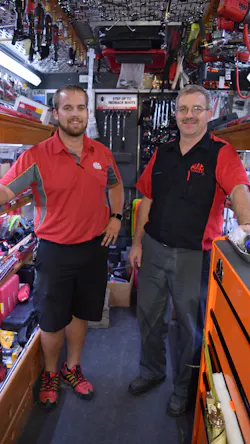
Every morning, John and Doug Mansell leave Centre Hall, Pa. to begin their routes in and around Huntington and Mifflin Counties, and State College, respectively.
While the namesake makes it sound like selling tools may be a given, John jokes, “I still don’t consider myself a salesman.”
While both Doug and John operate under the same company name - Mansell Tools - and have a presence with one Facebook page; they otherwise operate completely independent of one another. Each is responsible for their own inventory, and servicing separate routes.
Differences in routes
Although they work within 60 miles of one another, there’s a stark contrast between the Mansells’ routes.
Doug, John’s son, has a more suburban and metro route that services the college town of State College and surrounding area. He travels approximately 350 miles per week.
Home to Penn State University, State College and the surrounding area provide a more consistent economy due to the influx of students and university employees who are part of the population.
“There’s always going to be stability. It’s funny, my dad is 30 miles [south/southeast]. It’s a completely different area. The value of stuff is more over here than there,” explains Doug. This is especially evident when comparing trade-in and used toolbox sales between the two routes - Doug can often make more than what John might on a used box.
“As a college town there’s a whole different dynamic,” adds John.
While John sees a more traditionally seasonal influx of consumers, the State College area stays consistently busy due to the additional 40,000 students that reside in the surrounding area throughout the school year. Doug adds that year-round residents will then keep the repair shops and dealerships busy during the summer months for his customers.
“Even if the outside economy goes, the roller coaster doesn’t have as steep of a decline,” adds John.
This is compared to John’s more rural route that services Huntingdon and Mifflin Counties. To get to his route, John’s route requires a drive to the other side of the Seven Mountains range every morning. Clocking in approximately 550 miles a week, John leaves the house around 6:30 a.m. and doesn’t return until 6 or 6:30 p.m., putting in approximately 12-hour days, including windshield time.
Other differences include the primary payment types of customers, age and job title. Doug’s customers trend younger, and tend to be technicians instead of shop owners. Doug also sees more dealerships.
“I don’t want to say they don’t worry about quality, but it’s more of a price game,” Doug explains. “A mom-and-pop shop will pay an extra couple bucks. It’s definitely a relationship with everybody, but it plays a (smaller) role when it comes to dealerships. The younger guys at dealerships are worried about price because they might not be making as much, and they want to buy a couple extra beers on the weekends.”
Doug says his customer payment breakdown is about 75 percent credit card, and 25 percent cash.
“He does a lot of cash and checks,” says Doug, of his father’s route. “Guys give him (cash or check) for payments each week. My guys swipe cards. It’s a completely different world. I’ll do more in credit cards in a day, than he’ll do all week.”
This is also attributed to the customer base for each route. John tends to see more shop owners, and the bulk of his payments are cash or check.
“My guys (customers) are reasonably frugal,” John says. “They don’t spend a lot of money.”
This difference in customer bases also can determine the amount of foot traffic that each truck sees on a weekly basis.
“Doug gets more foot traffic than I do,” John adds. “He has more dealerships. Mine are more hourly, his (customer base) is more flat rate.”
Differences in business methods
John says that working with his son gives him motivation. While competitive by nature and employing different approaches to the job, both agree that working together provides the opportunity to bounce ideas off of one another, and to vent about issues they are facing with the business.
“The interesting thing is, what works for him might not work for me. And vice versa,” explains John. He uses toolbox trade-ins as an example. Because of the younger and more consistent market in State College, Doug may have more success reselling the same box that John had been unable to sell on his own route.
Prior to becoming a “Mac Man,” John spent a number of years in the heavy duty trucking industry - including repairing heavy duty trucks, driving a truck and recruiting for Landstar Inway. With this previous work experience, John says he tends to be more mechanically inclined than his son. (As an example, his customer asked about replacing head gaskets on a Duramax diesel, and John made sure to mention the need for a 12-point hex because all the bolts are notoriously this size.)
John sometimes likes to bring in a new tool to show off to customers. Doug prefers not to. But both are more inclined to walk into the shop to greet techs and shop owners, then head back out to the truck to wait for customers to enter the truck.
Both distributors focus on building relationships with customers, and employ no-pressure sales tactics. John adds that there’s an additional benefit to not pressuring customers to purchase.
“Low-pressure sales lead to a whole lot less repossessions,” John says. “You don’t have as much buyer’s remorse. You may have some, and you deal with it a little bit.”
“I’m not pushy,” adds Doug. But, “you’ve got to know when to say ‘Are you buying this?’ You’ve got to know when to try to close it.”
At 26 years old, Doug spent a year and a half at Penn State, before entering the logging industry. He grew up with the Mac Tools brand as a prominent aspect of his childhood. John says he never anticipated his son would start his own route, but he’s happy that he did.
“I’m a father, and I’m proud of his success,” John says. “He does very well.”
Mansell Tools Top 5 Tools
- Mac Tools 3/8” and 1/2” Axis Ratchets
- Mac Tools 1/2” Cordless Impact, No. BWP151
- Mac Tools 1/2” air impact, No. AWT050M
- Power Probe III
- Mac Tools screwdrivers, No. SDB12CR
About the Author
 Erica Schueller
Editorial Director | Commercial Vehicle Group
Erica Schueller is the Editorial Director of the Endeavor Commercial Vehicle Group. The commercial vehicle group includes the following brands: American Trucker, Bulk Transporter, Fleet Maintenance, FleetOwner, Refrigerated Transporter, and Trailer/Body Builders brands.
An award-winning journalist, Schueller has reported and written about the vehicle maintenance and repair industry her entire career. She has received accolades for her reporting and editing in the commercial and automotive vehicle fields by the Truck Writers of North America (TWNA), the International Automotive Media Competition (IAMC), the Folio: Eddie & Ozzie Awards and the American Society of Business Publication Editors (ASBPE) Azbee Awards.
Schueller has received recognition among her publishing industry peers as a recipient of the 2014 Folio Top Women in Media Rising Stars award, acknowledging her accomplishments of digital content management and assistance with improving the print and digital products in the Vehicle Repair Group. She was also named one Women in Trucking’s 2018 Top Women in Transportation to Watch.
She is an active member of a number of industry groups, including the American Trucking Associations' (ATA) Technology & Maintenance Council (TMC), the Auto Care Association's Young Auto Care Networking Group, GenNext, and Women in Trucking.
In December 2018, Schueller graduated at the top of her class from the Waukesha County Technical College's 10-week professional truck driving program, earning her Class A commercial driver's license (CDL).
She has worked in the vehicle repair and maintenance industry since 2008.