A primer on leak detection technology
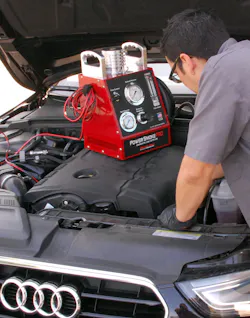
The ability to quickly and effectively fix leaks of all types can be a tall task for technicians. They can occur in many of the systems found on the vehicles today, and addressing them can be both time-consuming and frustrating for those who don’t have access to the proper equipment.
That’s why mobile tool distributors need to have a firm understanding of leak detection technology. Those that put in the time and effort to gain the requisite knowledge to meet the needs of their customers can see a significant and measurable increase in sales of leak detection offerings.
“A distributor first has to understand all the options that are out there and then clearly know what the customer’s real needs are,” says Glenn Richardson, national technical supervisor - director of international marketing, Star Envirotech, a provider of custom diagnostic smoke technology (www.starenvirotech.com). “Learn the options and ask your customer what he or she needs.”
Smoke machines have long been a reliable and time-saving means to quickly detect evaporative emission control system leaks, intake manifold leaks, exhaust leaks, water leaks and more. Current iterations of low-pressure leak detectors are widely considered to be a cost-effective options for shops that do not service turbo, diesel and boosted systems for heavy duty vehicles. However, with more and more automakers employing those systems to improve fuel economy and reduce emissions, many shop owners and technicians have started to invest in high-pressure smoke machines. This is because the higher pressure puts stress on the leak locations in those systems and makes them easier to pinpoint.
“High-pressure diagnostic leak detection is what technicians are asking for and what they want to learn about,” says Alex Parker, executive vice president, Redline Detection, a provider of diagnostic equipment for auto repair and leak detection (www.redlinedetection.com).
Distributors must be able to ask their customers the right questions to ensure they can help them make a proper purchase. According to Parker, these questions should include:
- Do you work on turbo, diesel, boosted or heavy duty vehicles?
- How are you finding leaks now?
- How long does it take to find leaks currently?
“Also ask the technician if he or she has ever replaced a turbo, only to have the customer come back with the same complaint and find out that the turbo was fine and that the leak was at the gasket or turbo housing,” says Parker. “Now you have an unhappy customer and a technician who is losing money on what could have been a profitable job. This common leak could have been diagnosed, pinpointed and repaired in minutes with a high-pressure diagnostic leak detector.”
Shops that would benefit greatly from high-pressure leak detection technology are those that regularly conduct the following types of jobs:
- Turbo
- Turbo housing
- Boost leaks
- Loss of power
- Lowered fuel economy
- Drivability concerns in boosted vehicles
“Also, intake and difficult-to-diagnose upstream aftertreatment leaks are now quick and easy to diagnose, pinpoint and repair,” says Parker. “This technology takes what used to be a many-hour job often requiring multiple tries to a simple, 10-minute test that any technician can do, and which will be 100-percent guaranteed to pinpoint the issue.”
So what specifically should shop owners and technicians look at when considering an investment in the latest in leak detection technology? According to Star Envirotech’s Richardson, the following features should be examined:
- Flow meter
- Pressure/Vacuum gauge
- Test mode (without smoke)
- Remote
- Digital read-out
- Size
- Warranty
- Cost of use
- Optional accessories
- Portability
- High- and low-pressure testing
- Safety features
“The more the smoke machine can do, the better chance the tech has to quickly find and fix a leak issue,” says Richardson.
Technicians should also select a smoke machine that offers variable pressure, says Parker. This affords them the ability to adjust the machine to locate different leaks that are visible at different pressures.
Prices for smoke machines vary greatly, so it’s critical for a distributor to find the proper match for each specific customer.
“You can buy a very inexpensive low-pressure machine but, if your customer wants it to do only high pressure, then you would be doing your customer a disservice,” says Richardson. “You buy an expensive high-pressure unit, and the customer only wants it for EVAP intake and exhaust leaks. Again, bad call.”
Richardson also points out that some smoke machines are capable of both high-pressure and low-pressure testing. It’s not two machines in one housing, but rather a new technology that allows for low and high pressure from one integrated machine and delivering smoke from one hose. Richardson says that this is a worthy investment for smaller shops. Larger shops? Not so much.
“For a few hundred bucks more, you can have both individual machines that could be used at the same time by two different technicians,” he says.
“Again, learn the options and ask your customer what he or she needs,” Richardson continues. “A distributor first needs to understand all of the options that are out there, then clearly know what the customer’s real needs are.”
[Editor's Note: While this article first appeared in print in Professional Distributor's September 2016 issue, the information it provides continues to be relevant.]
About the Author
 Mike Schmidt