World Class Wednesday: Ryan Stazak: Learning Everything from Everybody
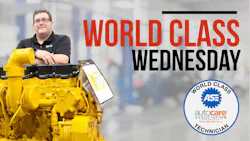
Earning the title of Automotive Service Excellence World Class Technician is no small accomplishment. To be recognized as World Class, these individuals have obtained ASE certification in 22 specialty areas: A1-A8 (automotive), T1-T8 (medium/heavy truck), B2-B5 (collision repair), and L1-L2 (advanced).
Not only is achieving certification in these areas impressive, but becoming World Class is no small feat. As of 2025, only 2,000 technicians have achieved World Class status.
In this Q&A, Motor Age sat down with Ryan Stazak — an ASE World Class technician and On-Highway Technical Communicator and Truck Engine Program Manager at Altorfer Caterpillar in Chicago, Illinois — to learn more about his journey in the automotive industry and how gaining World Class status has helped advance his career.
Motor Age: Please introduce yourself and tell us about your experience in the automotive industry.
Stazak: I spent over 15+ years in automotive and heavy diesel repair, specializing in diesel engine diagnostics, failure analysis, and engine upfitting. I have worked on everything from Semi-Trucks to Cranes.
I achieved ASE World Class status at age 32 in 2023. I currently support groups of dealer technicians from multiple truck and equipment manufacturers with On-Highway and industrial diesel engine support.
As a teenager, I started in a small independent automotive repair facility and machine shop, learning everything possible. I am very fortunate to have started my career in a machine shop; that odd start gave me a different outlook on how I look at a failure. I even spent some time in a parts department to learn that side of the industry!
Motor Age: What's the most memorable repair you've ever completed?
Stazak: The most memorable repair I ever completed was an aftertreatment issue on a Class 8 truck, early on in my career.
The truck kept throwing multiple aftertreatment codes and would not regenerate. It had already received three replacement DPFs under warranty. I remember checking every component according to service guidelines. I was getting ready to condemn the DPF and even got approval to replace the DPF after many hours on the phone with Techline.
During an attempted regen, another technician mentioned that the air smelled like peanuts, suggesting the factory across the street must be making nut products again. Later that day, I accidentally tapped my bump cap on the DPF while rolling out from under the truck. The next thing I saw was two squirrels running out of the exhaust pipe and across the shop.
After that repair, I truly understood that "firing the parts cannon" at a job is not the answer, and finding the part causing failure is the proper way to repair. Sometimes the root cause of failure is not what you think it is.
Motor Age: Tell us one thing about you that we can't guess from your certifications.
Stazak: I want to learn everything I can from everybody. I learned that regardless of what you know, you can learn from everyone you work with.
If someone is willing to teach me something, I am willing to listen. The best technicians learn from peers and even other trades to find solutions. We all need to improve how we teach each other in this industry, and even teachers can learn from their students. Some of the best advice I have received over the years has come from fresh minds in the industry.
Motor Age: What automotive technology trend are you most excited about? Most concerned about?
Stazak: Hybrid diesel powertrain systems are becoming more relevant in the industry. I look forward to seeing how they will impact the trucking industry.
I think that the powertrains may become more reliable with combined hybrid drive systems, which could make aftertreatment more reliable by keeping engines within optimal RPM range for emissions.
I fear how future emissions requirements will affect the reliability of diesel aftertreatment systems as those systems become more complex. As an industry whole, we are seeing more consequential failures due to these systems.
Motor Age: How has ASE certification helped advance your career?
Stazak: ASE Certification helped employers take me seriously when I looked for work. Walking into an interview with certifications shows you have the skills, discipline, and willpower to earn them. I truly believe I would not be where I am today in my career if I hadn't been certified and learned as much as I did studying for the tests.
About the Author
 Emily Kline
Emily Kline
Emily Kline is a Special Projects Editor for FenderBender and ABRN, ABW, Motor Age, and Ratchet+Wrench. She also produces an annual publication for SATA called Painter's Playbook, is a Senior Contributing Editor for NAPA INSIGHT, and oversees Ratchet+Wrench's Shop Goods issues and FenderBender's Ultimate Collision Repair Shop.
She has worked in the Vehicle Service & Repair Group at Endeavor Business Media for over 3 years, learning about vehicle repair and the automotive industry as a whole. She has a bachelor's degree in English from Saint Mary's University of Minnesota in Winona. As a writer, she enjoys her fair share of reading and has no shame in using the long Minnesota winters as an excuse to stay indoors and cozy up with a good book.