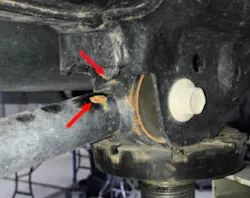
1. Confirm that the condition exists. Set the suspension height to neutral or high and visually inspect the right rear lower control arm and lower control arm support bracket. Look for contact/witness/wear marks between the two components (that was not caused by collision damage).
2. If such witness marks are found, disconnect the lower control arm from the bracket.
3. Using masking tape, mark the support bracket to use as a guide for removing excess material.
4. Using a cut-off wheel, remove the excess material from the bracket. DO NOT remove more than five mm. Removing more than five mm could negatively impact the strength of the bracket.
5. Remove the masking tape used as the cut line guide. Using a bonded abrasive disc, remove burrs and smooth the surface of the cut.
6. Buff the witness marks at the control arm.
8. Using a two-part epoxy primer, coat the exposed metal.
9. Cover the primer with a black topcoat.
10. Reconnect the control arm to the bracket.
11. Set the suspension height to the low setting and test drive over uneven surfaces to verify that the noise has been eliminated. Visually inspect the control arm and bracket while in the low setting to verify that the two components are no longer making contact.
About the Author
Information courtesy of Mitchell 1
Information for Technical Service Bulletins comes from ProDemand, Mitchell 1's auto repair information software for domestic and import vehicles. Headquartered in San Diego, Mitchell 1 has provided quality repair information solutions to the automotive industry since 1918.