Tool Review: FJC Electronic Leak Detector
Content brought to you by PTEN. To subscribe, click here.
Q: How did the tool/equipment function as far as saving you time?
A: The tool saved me time by allowing me to quickly pinpoint refrigerant leak locations that would have taken longer to find with UV dye or other methods.
Q: How has using this tool impacted your shop's profitability?
A: Having a simple green, yellow, and red scale on the tool makes it easy to show the customer via photo or video that there is a leak in the system, and this transparency contributes to more sold work.
Q: What kind of setup was involved before using the product?
A: Set-up involved ensuring the vehicle had a charge left in the system and making sure the tool was out of the way of any wind or shop fans that could trigger a false reading.
Q: How easy was it to use?
A: Operation was straightforward and consisted of powering up the unit and ensuring the battery had sufficient charge (battery icon on display) before probing for leaks. The manual states the display will flash for 3 minutes as the sensor heats up. However, I found that upon power-up, the tool was immediately ready for use.
Q: How was its packaging? Did it come with any accessories?
A: The leak detector comes in a durable, plastic carrying case, and a USB-C charging cord was included as well.
Q: Was there a manual included? If so, did you use the manual, and was the manual easy to understand?
A: Yes, a manual was included (14 pages). It was fairly easy to follow.
Q: What features did you like?
A: I liked the simplicity of the interface. It was easy to switch between sensitivity levels and view the peak detection record.
Q: Is there any way you could think of to improve or add to this tool?
A: It would be nice if the sensor protector/tip was slightly smaller so that it could fit in tighter spaces. The ability to fit through a passenger compartment face vent to check for an evaporator leak would come in handy.
Q: What types of jobs/repairs did you use this tool for? Please provide a few specific examples.
A: I used this tool to inspect for leaks on vehicles with low cooling complaints. On one vehicle, I identified a suspect spring lock connection on a low-pressure line.
Q: Have you used a previous version of this tool? If so, what are some new features compared to the old version?
A: No, I have not owned a previous version of this tool.
Q: Is there anything you had questions or concerns about in regard to the tool?
A: I had a question regarding the manual versus auto reset function on this tool. The manufacturer was able to clarify this for me.
Q: On a scale of 1 to 10, how would you rate this tool overall? Why?
A: I'd rate this tool a 9.5. Right out of the gate, this tool performs its job well and takes the guesswork out of A/C diagnostics, whether it be used by itself or as a way to confirm the results of a leak test performed via another method.
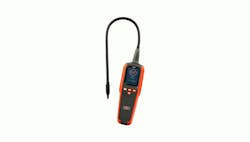
The FJC Electronic Leak Detector, No. 5110, is designed to detect all CFC, HFC, HCFC, and HFO refrigerants, including R-134a and R-1234yf. It features automatic calibration, a mechanical pump, three sensitivity levels, and a low-battery indicator. Includes four AA batteries. Compliant with SAE J2791, SAE J1627, and EN14624 standards.
About the Author
 Benedict Grubner
Benedict Grubner
Express technician at Mercedes Benz of Burlington
Benedict Grubner is a part-time express technician at Mercedes-Benz of Burlington, located in Burlington, Massachusetts. He has served in this position since 2019. His credentials include a Massachusetts non-commercial vehicle and 7D vehicle state inspection licenses. He is ASE A4, A5, A6, A7, and A8 certified and also holds a bachelor's degree in mechanical engineering from the University of Massachusetts Lowell. Grubner focuses on performing quality work while valuing continuous learning to thrive in an evolving industry. He also has another position in the machine shop equipment repair and maintenance field.