Key Highlights
- Gallardo started as a mobile technician, inspired by his passion for cars and self-repair, before building a dedicated shop and transitioning to a nonprofit model.
- He uses Milwaukee's PACKOUT System for its modularity and portability, favoring lightweight, customizable setups over traditional tool carts.
- Gallardo emphasizes starting small with tools, understanding their value, and investing in quality with good warranties to ensure longevity.
- With plans to expand his nonprofit, Gallardo advocates for putting people first, believing that ethical business practices lead to sustained success.
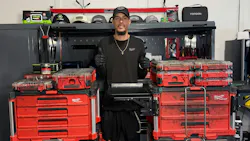
Over the past five years, Tyler Gallardo has made many changes to his business. Initially, he was a mobile technician. Then, he built his own 30’ by 50’ shop, and most recently, he’s made the switch from an LLC to a nonprofit. During this time, you could say that his one constant was change – even with his tool storage set-up. Gallardo uses the Milwaukee Tool PACKOUT System to organize the majority of his tools, and he loves how customizable the system is, allowing him to modify his setup into whatever works best for him in the moment.
Building something bigger
For about the past 10 years, Gallardo has worked as a technician. Like many techs, he was fascinated by cars from a young age, fixing his RC cars when they would work. As he got older and was trying to figure out what he wanted to do with his life, he had to make some tough choices.
“College was very expensive,” Gallardo says. “I didn't have the means to pay for it, and I was into cars at the time. My car was always needing a repair, 'cause it was a sports car, and I was driving it like a sports car. I figured the best thing for me would be to figure out how to learn how to work on cars so that I could fix my car.”
He recalls buying his first car broken and spending a week fixing it because that was the only way he could afford to buy anything. Fast forward to him talking with a mobile technician his parents knew who encouraged Gallardo to start his own business. At first, he thought the idea was crazy, but after a few weeks, things seemed like they could actually work out.
After spending some time as a mobile technician, he realized just how hard the job is on a person – being outside in all types of weather, needing to have all your tools on you otherwise the job won’t get done – and decided it was time to build a physical shop. While this solved some of his problems, it created others; so he thought about his roots as a technician, and how he had to fix his vehicle himself because he couldn’t afford to have it repaired. This led to Gallardo becoming a nonprofit and serving those who can’t afford automotive repairs.
Modular vs. traditional setups
Gallardo’s main set-up consists of two three-drawer PACKOUT systems, one two-drawer, and the Milwaukee Master Mechanics Tool Set, all loaded onto two PACKOUT Dollies. He has modified and customized this setup to his taste.
“Simple stuff like Milwaukee's battery holders are on the sides,” he explains. “I have cup holders on the side. I have shelf systems that are basically workspaces on the sides.”
For Gallardo, a modular setup like this is exactly what he wants for his tool storage.
“I personally would never ever use a traditional mechanics tool cart,” he says. “The reason being is they're often very big, often very bulky. They're heavy to move around the shop.”
The dolly system keeps everything lightweight and compact, so it can easily be moved around the shop. Additionally, the wheels can be locked in place to prevent any movement from the setup. Gallardo also appreciates how modular everything is.
“Say if you have to go do a mobile job for whatever reason, or you're going on a trip, you can just unclip your PACKOUT and just put it in the back of your car,” he says. “As opposed to unloading your tool cart, taking everything you need, putting it in a bag, trying to keep it neat and organized, and then on your way back from your long trip, unpacking it and putting it back into the toolbox.”
In addition to the PACKOUT setup, he does have a Harbor Freight U.S. General Series 3 72” toolbox. However, this is mainly to store specialty tools, among others that are not everyday-use tools.
Understand your tools' worth
When Gallardo was first starting out as a mobile tech, he used totes from Walmart to store his tools. He had a mixture of Harbor Freight hand tools and Milwaukee Tool electric impact wrenches. To grow his tool arsenal, he was using Home Depot’s interest-free financing. All of this to say, he understands how expensive it is just starting out as a technician, so start small and go from there.
He recommends setting a budget and looking for tools with good warranties. “Understand that if you take care of your tools, your tools will last a lifetime,” Gallardo says.
What’s next?
Milwaukee Tool is constantly coming out with new PACKOUT products, so Gallardo plans to keep an eye out for when those are released. That way, he can continue shaping his setup into exactly what he needs as his business grows, too. With this switch from an LLC to a nonprofit, he’s looking to bring on one more technician to work with him and expand the number of people he can help.
“Put people first, and you'll always have work,” he says. “Too many times people want to take advantage of people, [but] when you do right by people, you'll never have a shortage of clients.”
About the Author
 Emily Markham
Emily Markham
Editor | PTEN and Professional Distributor
Emily Markham is the editor of Professional Tool & Equipment News (PTEN) and Professional Distributor magazines. She has been writing about the automotive aftermarket since 2019, after graduating from UW-La Crosse with a bachelor's degree in English. During her first three years with EndeavorB2B's Vehicle Service & Repair Group, Markham also wrote for Fleet Maintenance magazine.
Don't miss Markham's next article. Sign up for PTEN or Professional Distributor's weekly newsletter.