Modern battery diagnostics require modern tools
There are more tools available today for battery and charging system diagnostics than ever before. From battery conductance testers and current clamps to thermal imagers and battery support units, each tool has a place in the diagnostic process. Understanding what these tools do, where they excel, and where they fall short is critical to making accurate diagnostic decisions.
Regardless of the level of testing or the inspection process you're performing, testing the battery and charging system on every vehicle should never be overlooked. The battery and charging system are integral to every system on the vehicle. A weak battery, unstable charging system, or voltage-related concern can create symptoms that appear completely unrelated to the actual fault.
Battery testing cannot be overlooked
One of the primary tools used in our shop is a Snap-on EECS800 battery tester (Figure 1). Modern battery testers provide much more information than simply a pass or fail result. They allow technicians to evaluate battery condition, available cranking capacity, charging system performance, and overall battery health. These tools provide a fast and effective starting point for evaluating the electrical system and should be part of every inspection process.
Current measurement is another critical part of battery and charging system diagnostics. The Pico Technology Picoscope 4425 current clamps and PicoScope Diagnostic Suite provide the ability to measure and visualize current flow in ways that conventional test equipment cannot. Whether diagnosing a battery draw concern, evaluating charging system performance, or monitoring current consumption over time, having the ability to see what is happening within the electrical system can significantly reduce diagnostic inspection time (Figure 2).
The value of thermal imaging
We've had a few vehicles come in for battery draw concerns where we were unable to find any instance of the vehicle actually having a measurable draw. The battery would be tested using conventional testing methods, and current draw testing would show no abnormal current consumption. Despite the customers’ concerns and repeated battery failures or dead batteries, with nothing outside the battery appeared to be responsible for the discharge.
The issue was ultimately found to be an internal short between cells in the battery. What made these cases particularly interesting was that the fault was really only noticeable using thermal imaging.
In the picture shown (Figure 3), one of the only indications of the fault was a heat pattern visible across the top of the battery. Without physically cutting the battery open, our suspicion was that there was a short across the internal strapping components connecting the battery cells together. In other instances, we've seen similar failures where the short was only noticeable from the side of the battery when viewed with a thermal imager.
Although these instances are very rare, they demonstrate why thermal imaging can be an extremely helpful tool to have available. Thermal imaging is not limited to battery diagnostics. It can be useful for identifying high-resistance connections, charging system concerns, overheated electrical components, poor connections, and a variety of other electrical and mechanical issues.
The image shown was captured using a FLIR ONE cellphone adapter. Tools like this have made thermal imaging much more accessible than it was just a few years ago. Being able to quickly connect a thermal camera to a cellphone allows technicians to investigate electrical concerns quickly without investing in a large dedicated thermal imaging platform.
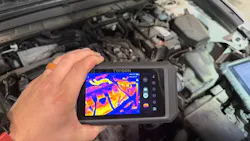
That being said, our thermal imager of choice is the TOPDON TC003 (Figure 4). One of the reasons we prefer this unit is that it houses the entire processing unit and camera in a single Android-based tool. Having everything integrated into one device makes it convenient to use in a shop environment, and because it is a dedicated unit, it is always available when needed.
Maintaining these tools
No matter what testing equipment you choose to use, it is important to understand that the tools themselves require maintenance and periodic evaluation. Battery testers, current clamps, charging system analyzers, thermal imagers, and support equipment are among the most heavily used tools in most repair facilities. They are also some of the first tools to begin producing inaccurate results due to mishandling, misuse, misunderstanding, or normal wear and tear (Figure 5).
Damaged cables, worn clamps, contaminated terminals, loose connectors, and deteriorated test leads can all affect the accuracy of the information being gathered. As technicians, we often focus on the condition of the vehicle while overlooking the condition of the tools we use to evaluate it.
Reference the service information
At this point, it should be noted that we're still only talking about conventional 12V batteries installed in vehicles today. We haven't even touched on testing secondary batteries found in start-stop vehicles, lithium battery systems that are becoming increasingly common, or the other battery variants currently on the market.
Many of the newer lithium battery systems are housed in cases that look very similar to traditional flooded lead-acid batteries. Without consulting service information, it can be difficult to determine exactly what type of battery is installed in the vehicle. Because testing methods, charging procedures, and specifications vary between battery types, keeping track of the systems you're working on is vitally important.
That is why factory service information should always be referenced for testing methods, specifications, and expected test results. No matter how good the testing equipment is, applying the wrong testing procedure can still lead to an incorrect diagnosis.
Utilizing the proper support tools
Even beyond testing these systems, one of the most important parts of the repair process is maintaining stable battery voltage. Whether you're performing a programming event, advanced diagnostics, module configuration, or even something as simple as a brake service, stable battery voltage is critical.
Battery support tools are no longer optional equipment in a modern repair facility. They have become a necessity.
In our shop, we utilize several different battery support options depending on the application. One of those options is a Prologix PL6100 Clore Automotive battery support unit, which provides a stable voltage source during service procedures. We also utilize the PowerMax PMBC Series units as our primary battery support equipment (Figure 6).
The PowerMax PMBC series is capable of functioning as a two-stage or three-stage charger, supports lithium battery applications, and includes a dedicated power supply mode for programming events and any other situation where maintaining stable battery voltage is important.
Modern vehicles place greater demands on battery support equipment than ever before. Cooling fans, electric pumps, module wake-up events, network communication, and other electrical loads can create substantial changes in current demand during service procedures. A quality battery support unit must be capable of maintaining voltage stability throughout those changes.
Conclusion
As vehicle technology continues to evolve, the tools available for battery and charging system diagnostics continue to evolve as well. Battery testers, current clamps, thermal imagers, battery support units, and service information all play an important role in the diagnostic process. No single tool provides every answer. Instead, each tool contributes a piece of the overall picture.
The examples discussed here serve as a reminder that sometimes the answer is not found by using a different diagnostic process, but by looking at the problem with a different tool (Figure 7). Whether it is a battery tester, a current clamp, a thermal imager, or a battery support unit, understanding the capabilities of the tools available to you is just as important as understanding the vehicle you're working on.
Tools mentioned:
- TOPDON TC003
- FLIR ONE Cellphone-based Thermal Imaging Adapter
- PowerMax PMBC Series chargers and power supplies
- Snap-on 6V, 8V, 12V Advanced Battery System Tester with Printer, No. EECS800
- Clore Automotive PRO-LOGIX 12 Volt 100A Flashing Power Supply and 60/40/10A Battery Charger, No. PL6100
- Pico Technology PicoScope 4425 Current Clamps
- Pico Technology PicoScope Diagnostic Suite
About the Author

Keith Perkins
Keith Perkins has been in the industry for over 19 years, serving in various capacities, including engine machinist and assembler, dyno tuner, diagnostic technician, instructor, technical information specialist, repair technician, and many more roles through the years.
Currently, Perkins co-owns and operates the L1 Automotive Group with his wife. The L1 Automotive Group is comprised of three companies: L1 Automotive Diagnostics and Programming, Level 1 Automotive, and L1 Automotive Training.
Perkins currently holds the title of ASE Master Certified L1 Technician and ASE certifications A1-A9, L1, L4, X1, P2, xEV Level 2, and various other industry certifications. He also serves as a Subject Matter Expert for the ASE A1, A2, A7, A8, L1, and L4 tests.
Perkins has served on the Board of Directors for NASTF since 2023. He enjoys spending time with his wife of 18 years, Liz, and his two daughters, Rylynn and Bailey, in his off time. His favorite non-automotive activity is skydiving!