Understanding your hand and specialty tool needs
Key Highlights
- Hand tools such as ratchets are fundamental for everyday automotive repairs, with features like low back drag and different head styles enhancing accessibility.
- Selecting the appropriate socket length and broaching inside the socket are crucial for proper fastener engagement and avoiding damage during repairs.
- Specialty tools like oil filter wrenches, seal installers, and harmonic balancer pullers are designed for specific tasks, improving efficiency and preventing damage during complex repairs.
- Having personal, dedicated specialty tools can save time and increase productivity, especially in flat-rate repair environments.
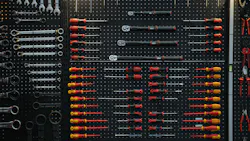
While hand tools are nothing new to technicians at any level, they are still essential to everyday jobs in the shop. On the other hand, specialty tools may be new to some technicians, but having the right tool for the job is crucial, especially when working on newer vehicles.
The everyday tool – hand tools
Hand tools cover a wide range of repair solutions, including ratchets, sockets, wrenches, and screwdrivers. As the name suggests, any tool that is operated by hand is considered a hand tool. I’ll be focusing on a few hand tools that technicians regularly use throughout their workday, and the different features available for those tools that may be needed to get a job done.
The ratchet
One of the most frequently used hand tools is a ratchet. My personal ratchet of choice is the Ko-ken USA Z Series, which is offered in 1/4", 3/8", and 1/2" drive sizes. Choosing a ratchet may seem like an easy task, but there are quite a few differences among them. One difference is back drag, which refers to how much force is needed to engage the next tooth of the ratchet. Another is swing arc, which is the number of degrees of movement required to engage the next tooth. Ratchets with exceptionally low back drag and minimal swing arc make an excellent choice for tight-access areas, which are becoming increasingly common on newer vehicles.
Another ratchet feature to consider is whether you prefer a fixed head, flex head, or locking flex head. For example, Ko-ken’s Z Series is available in flex-head or fixed-head versions, as well as with either a push-button style anvil or a detent-ball style. Ultimately, it comes down to personal preference. However, having a durable and high-quality ratchet with a lifetime warranty is a must-have for today’s automotive industry.
The socket
Another high-use hand tool is the socket. Just like ratchets, sockets come in many different variations. Having the right socket for a job can make or break the repair. They come in four main lengths: shallow, semi-deep, deep, and extra deep. The length of the socket can play a significant role in the job you are performing. In my career, I have found the semi-deep length to be the best of both worlds. It allows you to access nuts that sit lower on studs while remaining slim enough to avoid contact with surrounding components. The same applies to the extra-deep variant, which allows you to reach fasteners positioned far down a stud, such as a turbo band clamp. When tightened, the clamp exposes many threads, and an extra-deep socket provides enough internal clearance for the longer stud.
Another important feature is the broaching inside the socket. Broaching refers to how far down the chamfer extends inside the socket. This can be very beneficial in everyday work. For example, if you have a bolt without a shoulder or washer and you use a socket with deep broaching, the fastener can fall too far inside the socket. As a result, there may not be enough thread protruding to start the fastener properly. In my opinion, shallow broaching is ideal. This feature is found on a variety of different brands, such as Snap-on, Ko-ken, Cornwell Quality Tools, and Mac Tools.
Specific fixes call for specialty tools
While hand tools cover a wide range of items in your toolbox, specialty tools may not have as large a presence. Before we look at some examples, let’s discuss what makes a specialty tool special. A specialty tool is something designed for a specific use or job and is often provided by the dealership or shop where you work. As you progress in your career, you will most likely acquire your own specialty tools. For me, I needed specialty tools for a flat-rate job and often found that someone else was using them or had misplaced them. For a flat-rate technician, time spent looking for the right tool costs money, which is why I prefer having my own tools, so I have them when I need them.
The oil filter wrench
The first tool I will mention is the Blue Point OFTOY468 Oil Filter Wrench. Toyota uses a canister-style oil filter that requires a special wrench to remove the canister without damaging it. This applies to four-cylinder, six-cylinder, and eight-cylinder engines, and this tool works on all three sizes. It is also an approved special service tool in Toyota’s catalog. This is a tool you will likely use throughout your career, from lube technician to master technician, since oil changes are part of many repairs and maintenance services. This particular wrench is known for withstanding significant force without slipping, even in cases of overtightened or “frozen” filter cups. I have personally used this tool throughout my career as a Toyota/Lexus technician and have never had an issue with it. It also features a lifetime warranty. Additionally, Blue Point offers additional filter cups in the same style for other manufacturers if you work on multiple makes and models.
The seal installer
Another specialty tool I recommend is a seal installer. This can be a broad term because engines, differentials, and transmissions use many different seal sizes. That is why I suggest this as a shop purchase, since it can become expensive to buy every size individually. If you work at a dealership, there is a good chance a master set is provided. The purpose of a seal installer is to drive a replacement seal in straight and to the correct depth.
One example is the Toyota front differential seal installer from East Coast Gear Supply (ECGS). A common issue on Tacomas and 4Runners is front needle-bearing failure, which can cause vibration while driving that disappears in four-wheel drive. The repair involves replacing the needle bearing with a solid bushing, and ECGS offers a kit that includes the bushing, removal tool, installer, and seal driver. Beyond that repair, axle seal replacement is also common. Whenever a CV axle is removed, replacing the seal is recommended. If you do not have access to a dealership master set, the ECGS installer is an affordable option. Although it is marketed for Toyota axles, it fits a range of other axle seals as well. If you need a complete set of sizes, the ICON set from Harbor Freight is another good option. It includes twelve size adapters for seals and bearing races, a comfort-grip striking handle, and an air-hammer attachment for driving races in and out.
The harmonic balancer
The last specialty tool I would like to highlight is the Schley Products 64300 harmonic balancer/crankshaft pulley holding tool. This tool is designed for Toyota/Lexus V6 and V8 engines, though similar tools are available for other makes and models. Its purpose is to hold the crankshaft pulley while removing or torquing the bolt to factory specifications. The tool features two cutouts for bolts that thread into the pulley and a 1/2" square drive on the end for attaching a breaker bar. This allows you to counterhold the pulley and prevent crankshaft rotation. If a crank bolt has not been removed in many years, it can be very difficult to break free due to high torque specifications. Proper installation and torquing are equally important, as this bolt is critical to engine operation. Incorrect or excessive torque can lead to future issues.
While each technician will have different needs for specific hand and specialty tools, at the end of the day, each tool plays a significant role in our everyday lives as technicians. Having the right tool for the job helps repairs go smoothly and efficiently. They allow us to complete jobs correctly, prevent comebacks, and ensure quality repairs.
Tools mentioned
- Ko-ken USA Z Series Ratchets
- Sockets
- Blue Point OFTOY468 Oil Filter Wrench
- East Coast Gear Supply Seal Installer
- Harbor Freight ICON Seal Installer Set
- Schley Products Harmonic Balancer/Crankshaft Pulley Holding Tool, No. 64300
About the Author
 Chris Biediger
Chris Biediger
Chris Biediger is an ASE Master Technician and a Toyota/Lexus specialist. He spent almost 10 years at a Toyota dealership before venturing off with his old foreman to become his new foreman to run an independent Toyota shop, Hill Country Yota Works in New Braunfels, Texas. Biediger has been a technician for 12 years now, and aside from the shop, he also runs TxToolGuy on social media, showcasing tools, shop life, and diagnostic videos.