Key Highlights
- Proper shop lighting enhances safety, creates a welcoming environment, and helps technicians perform precise work more effectively.
- Technicians benefit from portable, hands-free lighting options like headlamps and flexible inspection lights, improving visibility in tight spaces.
- LED technology has become the industry standard due to its energy efficiency, durability, and versatility in design.
- Emerging lighting trends include flexible, under-lift, and wheel well lights, providing innovative solutions for complex repair tasks.
Let's face it, lighting is an oft-forgotten but critical part of everything we do. Almost all of us, especially those of us with older, tired eyes, have encountered a time when we needed more light for something we were working on. Even for those with excellent eyesight, you won’t find a technician anywhere in the world who doesn't value a good service light or have a trusted, favorite flashlight/headlamp.
Much like the automobile, technician and shop lighting technology has transformed significantly over the last 100+ years, including some meaningful advancements in the past 25 years. Since the early 1900s, incandescent lights were the only option better than a simple kerosene lantern. While it pales in comparison to current technology, incandescent lights were leaps and bounds ahead of kerosene lanterns. The 1930s saw the adoption of battery-operated, hand-held work lights; though these could be described as dim on their best day, they were better than nothing.
It has been an incredible advancement in lighting technology over the past 100 years, and LED lighting is the best technology currently available.
Shop facility lighting
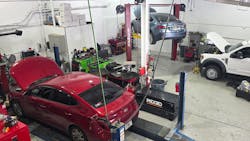
In the 1950s and 60s, many shops began moving from incandescent bulbs towards either fluorescent-type bulbs or high-intensity discharge (HID) bulbs, often referred to as high bay lamps. By the late 1970s, most auto repair shops were using one or the other. Lighting was decent with either, though both had issues with cold temperatures, and HID in particular required a good amount of warming up before they produced a usable light to work with. Fluorescent lights were typically used with inside ceiling heights under 10', and the HID lights tended to work best when ceilings were 12'-15' high, or more (Figure 1).
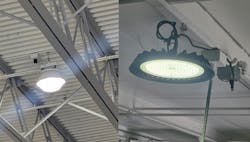
In the early 2000s, we began seeing light-emitting diode (LED) technology that at the time looked promising, but was very expensive. Boasting significant reductions in electricity consumption and huge boosts in lighting output (lumens), LEDs slowly started to find their place. As their popularity grew, the cost to implement LED lighting dropped significantly. By 2020, LED technology had firmly taken its place as the best lighting technology for indoor and outdoor spaces. Offering a huge range of designs, LEDs have become the "Swiss Army Knife" of lighting. You can basically find a design that fits any need for any building, inside or outside. They are brighter, can be fully weatherproof, have better energy efficiency, and can be had for pennies compared to incandescent, fluorescent, or HID lighting.
A few years back, I completed my shop. A 2,400 sq. ft. building, and I didn’t hesitate to outfit it with 20, 8' long LED light packs, purchased on Amazon for about $20 each. They boast a 15k lumen rating, and, when installed in my 20' high ceiling workshop, emit so much light that I tend not to look up! There really is no other, more viable lighting option for a shop than an LED bulb.
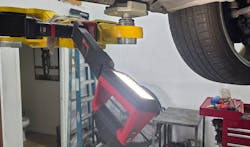
Specific workspace lighting is also important. Aside from updating to LEDs on the ceiling of workshops, progressive-thinking shops are adding light attachments that push light up from the floor or attach to a vehicle lift arm, giving the technician even more options to have handsfree lighting on whatever they are working on (Figure 2).
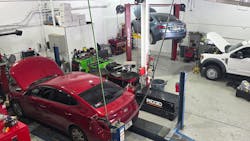
Lighting doesn’t just have value for the technician. Bright exterior lighting makes any business look safer and more inviting to prospective clients. The same can be said for well-lit waiting areas. Having a dingy, dark office may scare off prospective clients and certainly could lead them to prejudge a business’s competence before they get a chance to see how great the staff really are. Smart shop owners know this and invest in bright, clean light, inside and outside their facilities (Figure 3).
Technician lighting
Good shop lighting is important, but even good shop lighting leaves a lot to be desired for the typical technician who has to work under or inside a car. For a long time, technicians relied on a drop light that was attached to a cord and pulled down from a retractable reel from the ceiling. These worked because we didn’t know any better. Corded droplights had a lot of drawbacks, not the least of which was that they were restricted by how long the electrical cord was.
Other drawbacks included incandescent bulbs that generated a lot of heat, which could inadvertently melt things on a car’s interior. Plus, incandescent bulbs are really fragile. Even with a metal cage around them, most bulbs wouldn’t survive a drop from 30" off the ground. Not to mention, dropping an incandescent bulb around an open fuel source, like when replacing a fuel filter, could result in a devastating fire. Corded fluorescent and then LED droplights solved some of the most dangerous drawbacks to having droplights, but generally speaking, there are much better, non-corded solutions for today’s technician.
Flashlights
I cut my teeth as a dealership technician in the early 1990s, and back then, there was one name that technicians recognized as better than all others: Maglight. Maglight flashlights were a staple in every technician’s toolbox from the 1970s up through the 1990s. Ranging in sizes, probably the most popular were the aluminum-bodied models that took the “C” size batteries.
Back in my early days, the rechargeable Maglight with a halogen bulb was the holy grail. They were expensive, but any technician who had one was known to take their job seriously, and I had two.
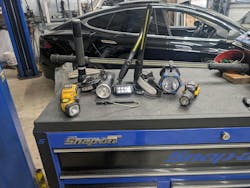
Moving forward to today, we’ve seen the flashlight market become extremely competitive, especially with the adoption of super-bright, energy-efficient LED bulbs. Flashlights come in all shapes and sizes to fit the needs of any technician. It may even make sense for a technician to own multiple flashlights. (Figure 4).
Headlamps
Headlamps started to gain popularity in the early 2000s, but were large, clunky, and didn’t have very good battery life. In the past 15 years, we’ve seen these shrink, get lighter, brighter, and, with LED technology, we’ve seen headlamps that can last 6+ hours. This type of light is useful because it frees up both of the technician’s hands, and it's easy to point where you need the light because it’s attached to your head. You can find comfortable, lightweight headlamps for well under $100 nowadays. There are so many options available that you’ll have to try a few to see what suits you best.
Inspection lights
Inspection lights are lights with flexible ends that allow you to manipulate them into tighter spaces, sometimes utilizing a fiber optic tube to help with this. I like using inspection lights for peeking inside a wheel to see how much brake life is left. Inspection lights don’t shine as bright as a flashlight, but you can put light on exactly what you need, and for cases like checking brake life, an inspection light works best.
Ultraviolet lights are another type of inspection light. They are really useful when chasing fluid leaks. You can add fluorescent dye to just about any fluid, and a UV light helps make the dye really pop at the leak source.
Lighting trends
I’m starting to see a trend in new ideas for lighting popping up throughout the trade. Lights that are flexible enough to fasten around a wheel well, lighting up the entire well area and all the suspension and brake components. This shows innovation that will be useful for many technicians. Under-lift lighting options are also starting to gain popularity. These are lights that clip onto a loft arm and can be manipulated under the vehicle to shine up at the work area.
It is hard to write about lighting for the auto repair industry and not think about how lucky we are to even have the ability to create our own light. It was only in 1879 that Edison invented the first viable incandescent light bulb. To think, before that, all workshops were lit by gas and kerosene lanterns. I couldn’t imagine working in those conditions. It is amazing to see how far we have come in workshop lighting, and I’m looking forward to seeing what the innovators of the lighting field will come up with next.
About the Author
 Pete Rudloff
Pete Rudloff
Owner, Pete's Garage, Inc.
Pete Rudloff is a nationally awarded technician, national automotive instructor/consultant, technical writer, software developer, automotive trade advocate, and owner of Pete’s Garage Inc. in Newark, Del. Rudloff has a national reputation as friend to the general auto repair shop and is known for fixing difficult to fix cars and facing challenging trade issues head-on. In 2016, Rudloff created FlexCheck Auto DVI in order to help independent auto repair shops nationwide increase their revenue.