Building your diagnostic tool arsenal
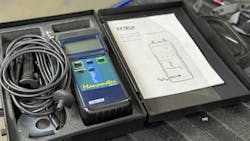
Today, a technician can be presented with challenges that may require a wide range of tooling, but it’s knowing which tools and techniques that makes the modern diagnostic technician an asset. Knowledge and skills must come first because you can have the best tools available, but without the knowledge of when and how to effectively apply that tool, you won't get anywhere. Knowledge is king!
In this article, I’ll break down many of the tools I have first-hand experience with and others some of my colleagues have found to be successful across the following categories:
- Low voltage
- High voltage
- Driveability, ignition, fuel, and emissions
- General servicing
Low-voltage electrical tools
Low-voltage electrical systems can produce all sorts of faults across almost every vehicle system. With some of today’s vehicles hosting hundreds of modules, a sound electrical system is a top priority, and that starts at the battery.
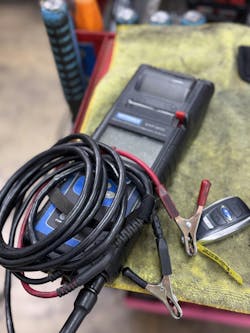
Battery starting and charging system testing tools should include a trusty DVOM, a variety of test leads, connections, and a battery charger and test device. When I started in this industry, it was common to see a volt amp tester (VAT) in the workshop. The tool contained a voltmeter, an ammeter, and a carbon pile. Eventually, the carbon pile took a back seat as a small hand-held battery tester entered the market (Figure 1).
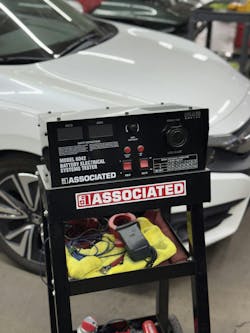
The advantage here was that battery assessment could be performed on a battery that was not fully charged. While this test is accurate to a degree, it can still provide ambiguity. Having a secondary way to assess a battery through a tried-and-true load test is one method we use in my shop. Additionally, the carbon pile is used to apply a load to a charging system, so one could quickly observe an alternator’s ability to perform, and moreover, if you find yourself wanting to test the DCDC converter performance on a Hybrid or BEV, the carbon pile can be of great assistance (Figure 2).
Parasitic load testing is another test that is always performed in my shop for every battery service to ensure that the battery has every opportunity to live a long life.
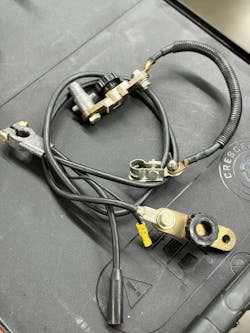
Performing this test has had its pain points, especially if you’re going to conduct the test properly. What I mean by this is that unless you have a fully accurate low-amp current probe, you will need to get in between the negative battery post and cable to measure with your DVOM’s ammeter. Doing this without losing vehicle power is generally where the challenge lies. Over the years, we have adopted special cabling adapters that we would be able to connect between the negative post and the cable so we would be able to start and shut down and exit the vehicle, and then move on to inserting our ammeter without losing vehicle power (Figure 3).
Fast forward to today, and we’re now using a new tool called the PPDraw from Power Probe. This is a tool I saw demonstrated during industry week in Las Vegas, and since that time, one of my apprentices purchased one. This tool is amazing, and it has completely simplified our test routine and, more importantly, cut down the test time tremendously
(Figure 4).
They also have a few complimentary tools that are used to help one identify the parasitic load source as well, and I highly recommend anyone tasked with performing these routines to investigate what these tools can do.
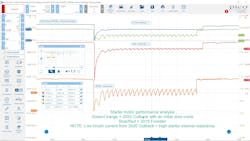
Additionally, I am seeing the lab scope come in handy today when addressing cranking abnormalities. Whenever I hear a vehicle with an initial slow cranking event, I will usually set up a multi-channel scope to have a look at the starter circuit’s internal resistance by monitoring the initial stall current. Lower stall current with nominal source voltage indicates unwanted circuit resistance. With proper termination verified, the starter motor’s internal resistance can be seen. The orange current trace shows lower than normal in-rush current as compared to a normally performing vehicle (Figure 5).
High-voltage electrical tools
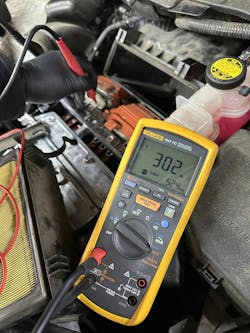
Anyone working on hybrid or BEVs should already possess basic safety skills and understand how to address the high-voltage (HV) system when problems arise. Two essential tools needed for HV side testing are a capable DVOM with the appropriate level of insulation testing ability and a milliohmeter. The two devices I have in my shop are the Fluke 1587 and the Pico Technology MT03a Milliohmeter and Motor Tester. When you’re faced with an isolation fault, OE test routines will likely have you performing insulation tests on HV circuit devices after the battery pack has been isolated from the rest of the vehicle (Figure 6).
Anyone working on hybrid or BEVs should already possess basic safety skills and understand how to address the high-voltage (HV) system when problems arise. Two essential tools needed for HV side testing are a capable DVOM with the appropriate level of insulation testing ability and a milliohmeter. The two devices I have in my shop are the Fluke 1587 and the Pico Technology MT03a Milliohmeter and Motor Tester. When you’re faced with an isolation fault, OE test routines will likely have you performing insulation tests on HV circuit devices after the battery pack has been isolated from the rest of the vehicle (Figure 6).
The milliohm meter will typically be used to assess motor stator windings to verify ohmic specification and balance. Keep in mind, today we’re seeing more vehicles equipped with brushless DC motors driving everything from blower motors to fuel pumps, so the Milliohmeter will come in handy when performing tests on these devices.
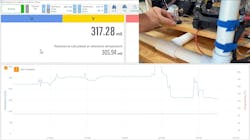
Not only that, but the device also comes in handy when addressing suspected unwanted resistance (especially intermittent) in network communication wiring (Figure 7). I produced a video highlighting the power of the milliohm meter for reference.
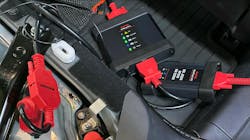
Additionally, one should possess the appropriate scan tools for addressing EVs. The Autel lineup has an outstanding set of tools that can be leveraged for diagnosis. Additionally, they have a very capable tool that can be deployed to interrogate the BMS of most EVs. This can come in handy when assessing used batteries before they are installed in the vehicle (Figure 8).
Driveability, ignition, fuel, and emissions tools
The scan tool is my primary go-to device when addressing most driveability complaints. And like any diagnostic tool, the best tool for the job is the one that can deliver the appropriate information needed in a timely manner. So, depending on the vehicle, symptoms, and conditions, I may choose any of the following tools, and some of course would be used together.
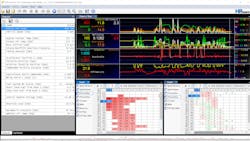
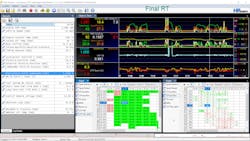
VCM scanner - HPTuners - In most driveability situations, I like to use this tool on road tests since it’s always recording, and playback/review is great. The tool allows one to configure, save, and recall display panels to their liking, and since it’s PC-based, it allows me to screenshot and mark up views, streamlining my documentation process (Figures 9 & 10).
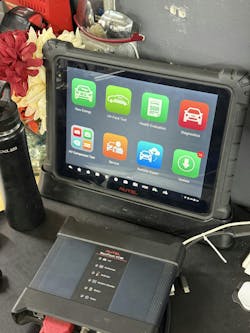
Autel Maxisys - This tool is like the Swiss Army knife, meaning that it is quite versatile for many operations (Figure 11).
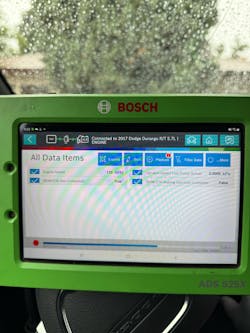
Bosch ADS 525x - Our SMS will allow this device to report directly into an open work order streamlining workflow during routine inspections (Figure 12).
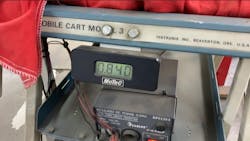
Standalone wideband meter - Motec PLM - This device is coupled with a tailpipe adapter, allowing us to compare values with the vehicle’s air fuel ratio sensor. Here’s a real-world example:
Scan tool data shows a commanded EQ value of 0.993 and a reported lambda value of 0.989 (Figure 13).
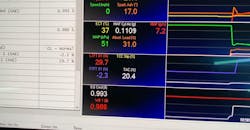
If compared to the tailpipe stand-alone lambda meter, you would see that the actual value is 0.840. This vehicle has a brand new wide-band sensor that was damaged because the PCM’s control over the heater circuit was shorted (Figure 14).
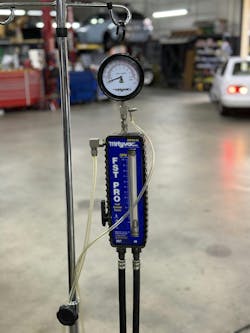
Fuel pressure - Mityvac FST Pro, No. MV5545 - This tool gets less use these days since most vehicles today provide a fuel pressure PID within the scan tool. For the times when you need to measure pressure and volume, even on a return-less system, this tool gets the job done (Figure 15).
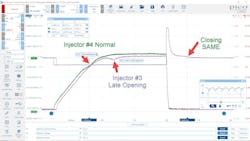
Picoscope 4425A - This is a 4-channel scope that comes with all appropriate probes, including voltage, ignition, current, pressure sensors, and more. Like most advanced tools, this tool will take you as far as your knowledge allows. From basic battery starting and charging system tests, as mentioned earlier, relative compression, in-cylinder waveform collection, and multi-cam CMP/CKP relationship testing to network signal analysis and more. In the following example, I am comparing one suspect injector with another and was able to see that the suspect injector was physically opening later than normal (Figure 16).
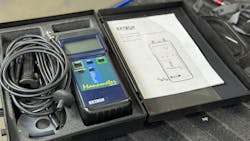
Manometer - This is a tool that is primarily used on vehicles that need to have the crankcase ventilation system verified. Many cars today have sophisticated PCV systems (especially on boosted applications), and when they fail, they can be the source of a variety of engine performance faults (Figure 17).
General Servicing
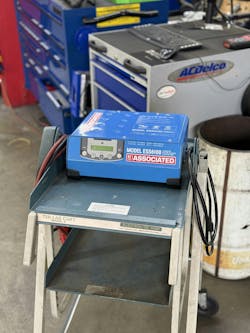
If you’re doing any level of diagnostics, it is imperative to maintain sufficient vehicle power during testing, analysis, and, more importantly, programming and calibration. Our shop has several maintainers (Figure 18).
Inspection camera - Vivida VA-450 - Another great tool for general service and maintenance is the inspection camera. We use the Vivida VA -450. Back in the day, a mirror and a light were sufficient; today, we have access to digital inspection tools, which come in handy often (Figure 19).
And finally, general electrical system checks of load devices at a power distribution center can be quickly performed by one of the go-to devices I’ve been using for more than a couple of decades.
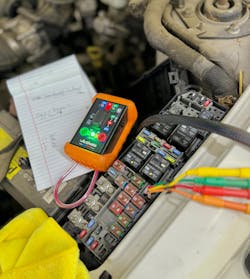
The uActivate from AESwave.com makes for quick work (Figure 20).
For example, you have a vehicle that was towed in, and you want to check the fuel pump circuit. Simply, unplug the relay and insert the tool. Now you have access to timely information and actions you can perform to help you move through your diagnostic processes.
In conclusion, the modern diagnostic technician's value lies in their knowledge and skills, which enable them to effectively utilize a wide range of tools and techniques. By continuously updating their tool arsenal and honing their diagnostic skills, technicians can stay ahead in the ever-evolving automotive service industry.
About the Author
 Scott Brown
Scott Brown
Founder - Diagnostic Network
Scott is an ASE Master Certified Automobile Technician with L1, L3, & L4 credentials and has over 39 years of professional service industry experience. As an independent shop owner in Southern California and with his engagement at various levels of within our industry, he continuously strives to move the industry forward through networking, education, communications, and training. Scott is a founder of the Diagnostic Network (https://diag.net/) which was born in 2018 after he retired after 22 years at iATN, where he served as company president.
Brown is also the host of Professional Tool and Equipment News (PTEN) and VehicleServicePros.com podcast, Torque Factor. The podcast addresses the latest automotive service technologies while focusing on expanding knowledge and awareness around tools, equipment, education, and industry trends.