Worldpac's Dominic Garcia: Productivity, Not Headcount, Will Define the Aftermarket's Next Chapter
Key Highlights
- Shops that post real-time productivity data on screens at every service bay have seen performance rise across the whole team, Garcia says.
- Worldpac's drone delivery program is helping solve a bay-capacity problem, getting small parts to shops in under 20 minutes.
- An industry-wide $30 billion backlog of delayed maintenance is pushing Worldpac to expand its exclusive-brand parts strategy alongside OEM offerings.
- Garcia expects the technology gap between well-invested shops and smaller, under-resourced ones to keep widening as consolidation continues.
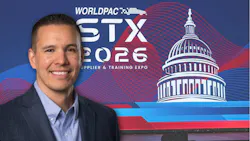
The average vehicle in operation on American roads is inching closer to 13 years old—a car parq record —and Worldpac Chief Commercial Officer Dominic Garcia says it presents an opportunity and a warning for independent auto repair shops. In his opening general session address to shop owners and technicians at Worldpac STX on Thursday, August 20, 2026, Garcia pointed to a $30 billion backlog of delayed maintenance industry-wide, warning that hiring new technicians alone won't solve shops' capacity problems—productivity will.
In this exclusive Motor Age Q&A, Garcia discusses what that means for auto repair shop owners, factors holding shops back, how service advisors play a key role in recovering that deferred-maintenance revenue, and why he believes the technology gap between prepared and unprepared shops is only going to widen.
In your opening general session talk, you mentioned that hiring alone won't solve the capacity problem shops are facing—it's more of a productivity gap. What are some ways shops can improve productivity beyond adding car count?
Dominic Garcia: Technician productivity is extremely important. I've visited shops here that have screens at every service bay showing each technician how productive they are throughout the day—tracking parts orders, tracking hours billed versus hours worked. It's not quite a wall of shame, but it works a bit like ranking a sales team: If you're at the bottom, you think, “OK, I better do a little better here.” Every time I've seen a shop do this, it raises the bar across the entire shop. There's always going to be somebody at the bottom, but everyone's trying to perform better.
So, it's not just tracking performance in that one bay—it's a leaderboard for the whole shop?
Garcia: That's right. You can see how efficient people are, how fast they're producing the work—it's basically a scoreboard. It also tells them if they're waiting on parts; some shops will run two bays if they have the space. And that's actually where drone delivery solves a bay-capacity problem. I've seen it happen: A shop is doing a great job, then something happens—you break a stud or a lug nut—and it's a small part, but what do you do? Now we can drone it to you. It flies as the crow flies, bypasses all the traffic, and you can have it in less than 20 minutes.
Regardless of the time of day?
Garcia: Right. And I'll tell you—when John first said, two years ago, that we were going to offer drone delivery, I thought, Yeah, OK. Then I saw it in action and was totally blown away. We're expanding it. You also mentioned there's $30 billion in delayed maintenance across the industry right now, often because customers can't afford the repair. How should service advisors be coached to get some of that work approved, instead of letting the customer walk out with nothing done?
Garcia: A couple of things. One, service advisors can attend a class through WTI—that's a good way to build the skill. Having an experienced service advisor really matters; I've seen advisors who can navigate that conversation well. Many shops also offer financing options to customers.
You also have to think about where a vehicle is in its lifecycle. What we used to call the “sweet spot”—four to 10 or 11 years old—is now four to 15 years and growing, so we've had to expand our own parts assortment to match. A vehicle used to become more of a DIY, second-vehicle situation with fewer miles driven once it hit that 15-year range—that's less and less the case now.
That's part of why we've expanded into an exclusive-brand model alongside our OEM and national brands. The strategy is meant to follow the customer through the vehicle's lifecycle: Early on, they want an OE product; as the vehicle ages, quality matters less to them than hitting a price point that gets them to the next stop. So, a service advisor may need to help a customer figure out where quality matters and where they can make concessions. And our exclusive brands—private-label parts—go through the exact same rigorous warranty scrutiny as our OEM brands. Some of them actually outperform the branded parts on warranty rates, which is pretty astounding.
Given that the average vehicle on the road is 13 or 14 years old, how do advisors convince someone that a $1,000 repair is worth the investment?
Garcia: There's the straightforward case: This is broken, and your car isn't going anywhere without it. But the deferred-maintenance piece is going to be a continuing challenge. The affordability gap on new vehicles isn't going away—I've seen the average American's affordability somewhere around $45,000, while the average new vehicle costs $50,000, and if it's an EV, it's $80,000. So, consumers really can't afford a new car, and they're keeping their vehicles longer. Because of that, they have to maintain them, even though I think people are getting a little less disciplined about it. It's a challenge the whole industry is going to have to work through.
You also talked about vehicle complexity—it’s not just an EV issue anymore, but ADAS and other technical demands are at play. For a shop owner deciding what to invest in next, where should they start?
Garcia: We have a whole tool and equipment division that a lot of people don't even realize exists until they come to an event like this—we set up here specifically to transact, with terminals ready and financing available if a shop needs to finance equipment. So, one place to start is with our tool and equipment team, who can help guide that decision. Two, within our WTI classes, a lot of the tools shops need are being demoed live. Every time we hold a class, people want the exact tool the instructor is using—sometimes that's just an instructor's personal preference, but other times it really is a necessity if you want to fix a vehicle like a BMW correctly.
Some manufacturers are pushing real innovation here. Tesla, for example, has a diagnostic tablet with about a 12-inch screen—one of the few that's Windows-based. A technician can pull up speed dial, diagnose the vehicle, and order the part right from the tablet without walking up to the counter.
Do you think the technology gap is going to widen for older or smaller shops?
Garcia: I do. We're seeing a lot of consolidation in the market—private equity buying up independent repair shops. That said, there are a lot of kids coming out of high school now who want to work on cars. It's becoming a cool thing again, which is exciting. I've been in this industry 30 years, and we've been pretty bad at publicizing the career paths that exist in it. We've gotten better, but we're still not great at it. Now kids are realizing they get to use a cool scan tool, they get to work on computers—it's not just wrenching anymore.
You're almost a computer programmer to some extent.
Garcia: Yes. In fact, one of the things I mentioned yesterday is that roughly 50% of vehicles now require some kind of reprogramming. Replace a mechanical part, and you may have to reprogram something else. That's becoming more and more common—which is why I think the EV conversation isn't really just about EVs. It's about mechanical parts increasingly working together with electrical ones. That's part of what's driving the average vehicle cost up to $50,000.
What are you seeing these components do to average repair orders?
Garcia: The average repair order is going up, but car counts are actually down—we've seen that here in 2026 versus 2025. I believe that's tied to the deferred-maintenance gap, and it's going to be tough to solve.
And when you factor in that nearly every vehicle now requires some kind of calibration, that adds another cost. It's kind of a perfect storm for car owners.
Garcia: Right. And then you've got fuel prices adding to it, too. With fuel prices, I'll say we've lived through this before, and typically it just kicks the can down the road. But eventually those vehicles have to be fixed and maintained, and they will be.
“Shops that aren’t doing that are going to fall behind. You’re absolutely going to fall behind.”
— Dominic Garcia, Chief Commercial Officer, Worldpac
With the aftermarket projected to grow steadily through 2029, what should shop owners be doing right now to capture that growth?
Garcia: Education, really. The classes we offer here cover business, marketing, sales, technical skills—all of it. Shops that aren't investing in that are going to fall behind, especially as vehicles keep getting more complex. I'd put education at No. 1.
We talk a lot about the importance of an educated workforce at the four-year level, but we don't always bring that conversation to this level, the trades. It's just as important here.
Garcia: It's incredible how many people are eager to learn—and then how many of those who become experts are eager to teach. We get shop owners all the time asking if they can teach for WTI. Most of our instructors are actually current or former customers of ours.
About the Author
 Chris Jones
Chris Jones
Editorial Director
Chris Jones is group editorial director for the Vehicle Service & Repair Group at EndeavorB2B.
A multiple-award-winning editor and journalist, and a certified project manager, he provides editorial leadership for the auto care industry's most trusted automotive repair publications—Ratchet+Wrench, Modern Tire Dealer, National Oil & Lube News, FenderBender, ABRN, Professional Distributor, PTEN, Motor Age, and Aftermarket Business World.
Subscribe to receive news and updates from any of these industry-leading brands.