Boxed In: The Culture of the $100,000 Toolbox
Key Highlights
- Toolboxes are often mistaken for investments, but they are depreciating assets that do not generate income.
- High-end tool setups can cost up to $80,000, while comparable quality tools and storage can be acquired for around $4,500.
- Many affordable, professional-grade tools and storage options are available from brands like Harbor Freight, Tekton, and used marketplaces, often at a fraction of the truck prices.
- Industry culture and convenience lead technicians to overspend, driven by the desire to impress or avoid hassle, despite the financial benefits of smarter choices.
- Techs can significantly reduce costs by buying quality used tools, exploring alternative brands, and resisting the pressure to finance expensive toolboxes.
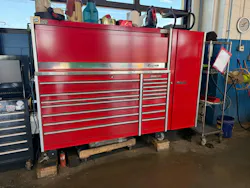
Walk through almost any shop, and the most expensive thing in the building isn't sitting on a lift. It's lined up against the wall: rows of chrome toolboxes, most of them still being paid off, week by week, with interest. We tell each other that a good box is an investment. In reality, it's the most expensive thing most techs will ever own that earns them nothing at all.
The industry pushes you to own far more tools than your work requires, and the tool truck model exists to keep it that way. Here's what that actually costs you, and what you could do instead.
The Box Has Never Made You a Dime
Your toolbox has never turned a bolt. It's never closed a ticket or diagnosed a no-start. You did that. The tech makes the money—not the tool, not the box, not the name stamped on the side.
We call the box an investment anyway. Tell ourselves "Buy once, cry once" or "It holds its value." But neither is true. An investment earns or holds value; a toolbox is a cost center we've all agreed to treat as a 401(k) with drawers. Finance it, and it's a cost center with interest. Don't confuse your tools with your value. You're the one closing tickets and earning the paycheck, yet we treat a depreciating piece of furniture like it's the most important investment in the shop.
So before you sign anything, ask the only question that matters: How much box do you actually need to make a living? The answer is a lot less than the truck wants to sell you.
The $4,000 Setup That Does More Than a $16,000 Box
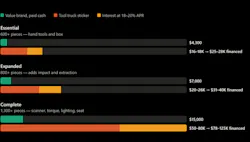
GearWrench's MEGAMOD614 is a 614-piece master technician set including drive tools, chrome and bit sockets, ratcheting wrenches (including flex-head and reversible), a full run of pliers, and screwdrivers, all laid out in pre-cut foam and dropped into a 42-inch, 11-drawer mobile workstation with a built-in charging station and a five-year warranty on the box itself. Lifetime warranty on the hand tools. With a price tag around $4,000 for tools and storage, it's hard to argue with.
Now go build that same coverage off a tool truck: comparable sockets, comparable wrenches, an equivalent box. By the time the box and the tools are paid for, you're looking at roughly $16,000 to $18,000. Four times the price for the identical ability to turn a fastener. That spread is well over $10,000—a used car, paid in cash—and not one bit of extra capability.
One honest caveat: the 614 doesn't include impact sockets, so budget another $150 or so for an impact set. So, $4,000 plus a cheap add-on, and you're working for a quarter of what the truck wanted.
And these kits aren't one-offs. The line scales from a $1,000 starter kit—enough to earn a check on day one—through a $7,000 mid-tier, up to a $15,000 flagship with the wide box, scanner, torque wrench, and lights: a genuinely comprehensive master setup. Tekton, Icon, and Husky build comparable coverage at similar money. Price that flagship tier off a tool truck and you're staring at $50,000 to $80,000 and climbing.
The Option Nobody Uses
There are alternatives. Nobody hid them from you. They're sitting in plain sight, well-priced, easy to buy, and capable of the same work. You've just been trained to walk past them. And every dollar of truck markup you've ever paid was optional.
Value-brand master kits. The complete setups described above, professional-grade, lifetime-warrantied, a third of truck pricing, also come in smaller individual kits, and almost nobody on the floor runs them. Quality isn't keeping techs off these kits. Culture is.
The truck's own budget lines. Snap-on sells Blue-Point. Matco sells Silver Eagle. Cornwell sells bluePOWER. Same truck, same driver, same weekly stop, and the warranty is usually the same as their flagship lines, at a fraction of the price. Most tool trucks carry a solid selection of these, and almost nobody buys them. The trucks themselves are saying the flagship is optional; the floor just refuses to hear it.
Harbor Freight. The Icon hand-tool line performs within a few percent of the truck brands in independent head-to-head testing, close enough that techs who watch the comparisons start rethinking every purchase they've made. An Icon screwdriver set runs about $55 against roughly $220 for the truck-brand equivalent. A US General rolling cabinet starts at a few hundred dollars.
Used tools. Marketplace, estate sales, auctions, and the back wall of every shop are full of premium tools at 30 cents to 50 cents on the dollar, because every time a tech retires, gets hurt, or leaves the trade, a fortune in tools hits the secondhand market at once. Premium tools were built to last decades, and a 20-year-old wrench can work as well as a new one.
And ask your driver. Trucks take trade-ins when techs upgrade, and repossessed boxes come back to the route. A trade-in flagship box off the truck itself can run a fraction of new—same box, same brand, but somebody else's depreciation.
Pawn shops. This is where financed boxes go to die. Somebody bought it new at 20%, couldn't keep up, and pawned it for pennies. A six-month-old $15,000 box gets pawned for $1,200.
And most lifetime hand-tool warranties are honored as a simple walk-in swap. Bring the broken tool, leave with a new one, no receipt, no questions. So, buying these tools used is nowhere near the gamble the showroom mythology makes it out to be.
Why Does Nobody Do It?
Because the box was never really about the tools. Two things keep the truck rolling.
First, shop culture. Nobody wants to be the guy with the "cheap" tools. The first-year apprentice looks at the master tech's stacked, lit-up, six-figure setup and reads it as the standard. That's the benchmark that determines if they belong. The box is a flex before it's ever a tool, and a kid will finance his way into the costume rather than be frugal.
Second, convenience. The value kit means an order, a wait, a delivery. The truck comes to you every week, parked in the bay, financing built in, high limits and rates for anyone who hasn't applied for a credit account before. Or an informal "truck account" you settle with the driver on a handshake, no bank, no credit pull. It's the path of least resistance, and it's designed that way. But convenience is never free. You pay for it once in the markup and again in the interest. Box financing often runs 18% to 20%, enough to push the final tab toward double the sticker. The truck's entire business model depends on making the most expensive choice feel like the easiest one.
Own Your Craft, Not Your Debt
None of this is anti-tool, or even anti-tool truck. Buy good tools. Take pride in a box that works. Just be honest about what you're holding: a depreciating asset you may still owe money on.
You can build a complete working setup for around $4,500, and far less if you shop value brands, buy used, and walk past the truck. What you'd save against a financed six-figure box setup is a down payment on a house, or years of an apprentice's debt erased. Keep it, and the truck stops being something you dread. Your paycheck stays yours, every week.
About the Author

Noah Nelson
Technical Editor | Motor Age
Noah Nelson is the Technical Editor for Motor Age Magazine. As an ASE Master Certified Automotive Technician (A1–A9) with 25 years of hands-on industry experience, Noah specializes in advanced electrical systems, vehicle communication networks, and physics-based diagnostic workflows. He is currently documenting his pursuit of the prestigious ASE/AutoCare Association World Class Technician registry.