Making New Technicians Ready for the Workforce
Key Highlights
- Employers now compete for entry-level technicians, highlighting the industry’s urgent need for skilled, ready-to-work graduates.
- UTI emphasizes electrical diagnostics and foundational skills, reflecting industry trends toward complex electrical systems and onboard diagnostics.
- Soft skills such as professionalism, punctuality, and communication are integrated into the curriculum to enhance employability and career longevity.
- The school promotes long-term career development through mentorship, clear pathways, and visibility, encouraging students to view their roles as part of a broader growth plan.
- Specialized training, including NASCAR-endorsed programs, prepares students for high-performance and motorsports careers, exemplifying the industry’s diverse opportunities.
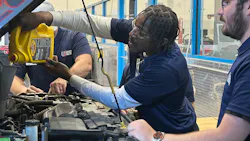
At the Universal Technical Institute campus in Mooresville, North Carolina, 35 dealerships, trucking companies, and recruiters lined the parking lot with pop-up tents under blue skies at the bi-annual career fair. In an unusual twist, the students have the upper hand. Although they're searching for employment, their demand in the industry gives them an advantage. Instead of trying to convince a prospective employer to choose them, the employers are actually the ones competing for the best talent.
Across the country, dealerships and independent repair shops are all chasing the same thing: entry-level technicians who can contribute quickly. UTI graduates have that competitive edge based on their experience.
As Robert Kessler, campus director, puts it, "These employers, usually they come in and tell us, 'I don't need one. I need, like, three or four guys. Can you help us?'"
That demand shapes everything happening inside UTI's classrooms and labs. The goal isn't simply graduation—it's producing technicians who are ready for the realities of today's shop environment.
John Dodson, vice president of business alliances, says the pressure is constant. "There are three available for every student," he notes.
For shop owners and working technicians, the bigger question isn't whether students are interested in the field—it's whether those students are actually prepared to hit the ground running in the shop.
Diagnostics Over Basic Maintenance
While oil changes may still be viewed as the entry point for many new technicians, the skill shops want most today is electrical diagnostics, says Bobby Leatherman, education manager at UTI-Mooresville.
"Right now, the more electrical, the better," he asserts. "If a student comes in and takes electrical classes and does well in them, they can pretty much get a job anywhere." Although today's technicians are expected to navigate increasingly complex electrical systems, onboard computers, and advanced diagnostics, there's still something to be said for basic diagnostic skills.
Why Oil Changes Still Matter
Even with diagnostics taking center stage, UTI has intentionally gone back to basics. Tony Frassetto, director of business alliances, says employer and advisory board feedback encouraged the school to refocus on foundational work.
"They've asked for us to sort of go back to the basics, back to oil changes," he notes. It may sound simple, but it reflects how most careers in the shop actually begin.
"They're not going to leave here at 20 years old and be turned loose in a garage," Dodson points out. "They'll either go on to BMW or Mercedes, or they'll go to a garage, and they'll start out in the quick lane, and they'll move their way up."
For employers, that matters. Shops don't need entry-level technicians pretending to be master techs—they need new hires who understand the fundamentals, perform them correctly, and earn the next opportunity.
Soft Skills Still Decide Hiring
Technical skills may get a student noticed, but professionalism often determines whether they get hired—and whether they stay.
Dodson says UTI places heavy emphasis on workplace expectations.
"Are you on time? Are you a professional? Do you have your work shoes, your safety glasses, your name tags?" he asks as part of the typical checklist for students.
Those details matter because employers are evaluating more than wrench skills. Attendance, attitude, and communication often decide who gets promoted from quick lane to diagnostic work.
Kessler says career preparation is built into the curriculum from day one.
"We do mock interviews with them, we do resume prep," he explains. "Everything we do, in addition to the curriculum, is all aimed at getting them into a job."
For technicians already in the field, this may sound basic—but for the next generation entering the industry, these expectations are often new. And while some technicians have a natural talent when it comes to being conversational, not all are blessed with the gift of gab.
Shops Must Sell a Career, Not Just a Job
Hiring young technicians today requires more than posting an opening and waiting. Frassetto says the best employers build a long-term plan.
"Bring them in with a plan for growth, you know, put them under a master technician or someone who's sort of like their mentor," he encourages shop owners and leaders. That mentorship piece is critical, especially for independent shops and quick lube operators competing against dealerships with large incentive packages.
Margie Decker, director of student and career services, says visibility matters. "I think showing a pathway so that they have a clear understanding is important," she says. "Most of our students are taking those jobs as part-time jobs right now while they're in school—they're not thinking of them as long-term careers. And when you have an organization that can build and incentivize those individuals to stay, whether they become an owner of a franchise or what they do with it, that's the ticket."
The Next Generation
Student Isaac Hales may be the best example of what employers hope to find. He drives two hours each way to campus every day, chasing a future in high-performance and motorsports work. UTI-Mooresville is the only campus that also offers NASCAR-endorsed mechanical training.
When asked what he's taking with him after graduation, his answer was immediate: "Precision under pressure is the biggest thing that I'm taking away," he asserts.
He's already thinking beyond the first job.
"I'm looking for something that gives me the opportunity to work on high-performance vehicles or things that have character to me," he explains.
That mindset is exactly what shops need: technicians who understand that the first job is only the beginning.
The technician shortage won't be solved by simply graduating more students. It'll be solved by producing entry-level technicians who can walk into a shop, learn quickly, and grow.
That's the real challenge for the industry—and the one schools like UTI are trying to address.
At a Glance
The Universal Technical Institute-Mooresville offers six core programs, including Automotive & EV Technology, Welding Technology, HVACR Technician, Electrical & Industrial Maintenance Technology, Electrical, Electronics & Industrial Technology, Electrical, and Robotics & Automation Technology. Plus, Mooresville offers NASCAR-endorsed training and manufacturer-specific advanced training options for automotive graduates, including Ford FACT and Mopar TEC.
The team manages 90-plus brand relationships across UTI campuses nationwide, including brands like Pennzoil, Harley-Davidson, Peterbilt, Kawasaki, Ford, Honda, Jeep, GMC, Mercedes, and Suzuki. The focus is on helping companies engage, recruit, and/or support the next generation of aspiring technicians through product and training-aid inclusion, digital promotion (UTI Go), campus presence and branding, and on-campus engagement.
UTI operates 16 campuses across 10 states with additional new campuses planned, such as UTI–Salt Lake City in West Jordan, Utah, which is slated for opening in 2027.
Source: John Dodson, vice president of business alliances, UTI-Mooresville
About the Author
 Christine Schaffran
Christine Schaffran
Christine Schaffran is the editor-in-chief for Ratchet+Wrench magazine at Endeavor B2B. She is an award-winning journalist, having covered both commercial and industry magazines and newspapers during her career. She previously served as editor-in-chief for another publisher for 17 years prior to joining Endeavor. When she's not spending time with her husband and son, you'll find her in the kitchen experimenting with new recipes and delicious dishes to try.