Business in the Front, Party in the Rear

When the average person envisions the operation of an automotive repair shop, they're likely thinking about the technicians. Of course, a shop can't exist without the service-technical staff, but it also can't survive without the rest of the team—ideally, like a well-oiled machine.
This includes leadership; a foreman, if you will. Although this role is defined differently from shop to shop, foremen generally play a role in distributing work, continuing education for the rest of the technicians, and are the last line of defense for problem-child vehicles, avoiding negative shop experiences like misdiagnosis and “comebacks.” More often than not, this same person becomes the liaison between the rest of the techs and the service advisors—and even the customers in some circumstances—often handling bottlenecks as they surface.
Having someone in that role is a prudent way to structure how a shop operates because of the built-in fail-safes mentioned above. However, I feel many techs and advisors (and other customer-facing team members) rely too heavily on this structure, and as a result, the foreman is stretched too thin and all of the situations requiring his or her input are delayed. Believe it or not, I feel there's a bigger underlying issue. This structure tends to make techs lazy, and that's bad for business; lost revenue is just the beginning.
Communication Is Key
What I'm describing above isn't a comment that has been shot from the hip. I've witnessed this happen in shops all across the country. And here's where the main issue lies, in my opinion.
Technicians fall prey to the flat-rate pay structure and tend to cut corners. No, I'm not only speaking about taking shortcuts in the repair process, necessarily, but I am speaking about how the repair orders are documented. Let's face it: the less time spent putting pen to paper (or populating a digitized document), the more effective time can be spent making money on other jobs. (Yes, this also occurs in shops without the flat-rate pay scale.)
But here's what many techs and other team members don't take the time to consider:
- For every moment a service advisor must trudge back into the shop to get more information from a technician, that's less effectively applied time the service advisor is producing revenue (answering the phone, scheduling appointments, and selling work).
- This same transaction costs the technician effectively applied time as well, for obvious reasons. They must stop working to answer pertinent questions.
- The missing information from the repair order costs the technician (and the shop) money, as many times certain labor operations have been inadvertently omitted. The work has been completed, but neither the technician nor the shop has collected for these operations (such as programming and configuring an ECU after replacement).
- Consider when an undocumented underlying or additional issue exists on the vehicle. The customer returns for a subsequent visit under the impression that the issue will be rectified free of charge (often already frustrated with the shop). From the shop's perspective, you don't have a leg to stand on. Had the repair order been documented properly—noting the vehicle's existing status or area of concern—at worst, you could've said: “I told you so.” At best, you could've further solidified your rapport with the customer as an honest and thorough facility, looking out for their best interests.
- Repair orders become legal documents in situations when we find ourselves in a court of law. Needless to say, if the document won't hold water, we may be responsible, and the cost may be a lot more than just money.
- And last, but certainly not least: justifying additional diagnostic time. It's hard enough for some shops to get paid for any type of diagnostics (that's a problem they need to focus on, but it's outside the scope of this article). But asking for more money after quoting perhaps one hour of initial diagnostic charge can be like pulling teeth, especially if the advisor doesn't understand the specific reason.
- I’m sure you get my point by now. We need to be doing a better job at documenting. That goes for what the technician documents on the repair order, but also what the service advisor includes on the documentation issued back to the customer for their records. More importantly, we need to be doing a better job at communication in general. This goes well above and beyond the traditional “3 Cs”—complaint, cause, and correction.
A Ticking Time Bomb
A 2010 Cadillac Escalade was towed to the shop with the complaint that the transmission wasn't performing correctly:
- The customer experiences a harsh shift into gear.
- The shift indicator (the PRNDL) was inoperative.
- The engine RPMs were elevated before the vehicle would move, and was slow to accelerate.
- The MIL was also illuminated.
The customer was quoted an initial one hour of diagnostic time to evaluate the concern. The customer agreed to the charge, and analysis proceeded. A scan for DTCs was performed, and among other issues, no communication with the vehicle's transmission control module could be established.
An initial preliminary inspection revealed an open fuse No.19, located in the under-hood fuse block. The technician attempted to replace the overloaded fuse, but the fuse would open subsequently. At this point, he reached out to me for assistance.
Approaching the situation with not only an urge to provide a diagnosis, but also as an educational opportunity, I began discussing with the technician what the indication of the blown fuse signifies. We discussed the circuit's current flow exceeding the fuse rating. And, if this fuse was the correctly rated fuse for the suspect circuit, the circuit was overloaded.
We pursued the conversation further: there potentially existed one of two faults, and it's our responsibility to determine which:
- 1st scenario: Circuit No. 2139 (from the under-hood fuse box to the transmission assembly) was shorted to ground. If this were the case, my suggestion was to think about potential causes (such as harness damage)—potentially a wire that was pinched by a collision/impact, or perhaps an incorrectly routed wire harness from a previous repair.
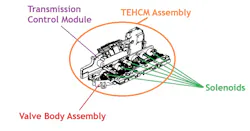
- 2nd scenario: A short was present internal to the transmission assembly. This could be within the transmission control unit itself, or a shorted solenoid within the valve body. (For this vehicle's transmission, the components are integral to one another—the Transmission Electro-Hydraulic Control Module, or T.E.H.C.M.)
We then discussed potential approaches to easily determine which fault existed. A reminder: a solenoid isn't typically energized under all operating conditions. If a solenoid were the source of the short circuit, the fuse should blow only when that solenoid is energized. If the fuse opened under any operating condition, the fault was either harness-related or the TCM itself.
The Initial Approach
Analysis began by first substituting the fuse for a device that accomplishes two goals for us as diagnosticians. It must first offer circuit protection so we can continue troubleshooting without causing further damage to the associated circuitry. It must also indicate whether or not the fault is present. A simple incandescent light bulb would do the trick.
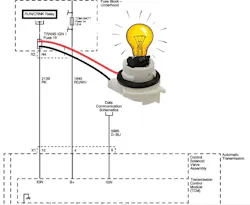
If no fault was present, the bulb might not energize/illuminate at all. Or the bulb may energize but not illuminate brilliantly. In that scenario, the bulb would behave as just described because a path to ground would be present (but through the intended loads, not a direct short to ground).
The bulb was connected to the circuit in place of the blown fuse. As a result, the lamp illuminated brilliantly, indicating the short to ground was present. This occurred when the ignition key was “on.” This great preliminary information led us to the next logical step: component isolation.
In this vehicle's topology, the harness is most easily isolated from the transmission assembly directly at the transmission's 24-way main connector, X1. After disconnecting the harness from the transmission, the bulb ceased to illuminate.
Although the results of the above test isolated the short to within the transmission itself, we didn't know if the fault was within a solenoid or the TEHCM assembly. Either way, internal components would have to be accessed, meaning disassembly is required to pursue a pinpointed diagnosis further.
Seeking More Diagnostic Time
Frequently, technicians seeking more diagnostic time are viewed as “sour grapes” or greedy. Although many times the tech is undertooled for the diagnosis, lacks the proper service information, and/or the understanding necessary to pursue the fault, and that's the reason they seek more time (as padding).
However, in many cases, this occurs because the tech doesn't typically share the reason for requesting additional time. Again, this all goes back to a lack of communication and documentation.
Consider a system that keeps technicians on the “straight and narrow” for the first diagnostic hour. A system that discourages a technician from disassembly and instead leverages easy-to-perform, surface-level testing that justifies requesting additional diagnostic time. In situations like this, the diagnostic levels could be defined ahead of time and explained to the customer in detail.
I look at it like this: if the customer chose to end the pursuit after a second diagnostic hour was requested, the value for the first diagnostic hour should already have been realized. In this case, the first diagnostic hour should correlate to the promises already made to the customer, and would have paid for:
- Visual preliminary inspection and/or road testing
- Full vehicle DTC scan
- Inspection and discovery of open fuse
At this point, even though the vehicle evaluation thus far took only a few minutes, the knowledge gained from the technician's tenure and experience brought value to what was discovered and how it was discovered. In other words, more diagnostic time to pursue the proven circuit fault is justified. It isn't ideal or prudent to spend the time to access the TEHCM for internal circuit testing/isolation at this point—within the first diagnostic hour.
However, without proper communication with the rest of the team, as the tech requests more diagnostic time, the advisor's perspective (as well as the customer's) shows the tech has another 45 minutes of time to invest prior to seeking more.
A Potential Solution
Want to avoid situations like this one? Try this demonstration of communication on for size:
Level-1 diagnosis = 1 hour (15 minutes invested)
- Customer states “transmission performance degraded.”
- Vehicle cannot be operated safely on motorway.
- Scan for DTCs … “P0XXX” and “UXXXX” stored, unable to establish communication with Transmission Control Module.
- Inspected and found blown fuse #19 (15A) in under-hood fuse block.
- Fuse replaced; opens upon subsequent key-on event.
- Must pursue root cause of circuit #1850 (pink wire) overload prior to further transmission performance evaluation.
- REQUEST ADDITIONAL DIAGNOSTIC TIME FOR CIRCUIT/COMPONENT ISOLATION. CUSTOMER APPROVED ADDITIONAL DIAGNOSTIC HOUR
Level-2 diagnosis = 1 hour (5 more minutes invested)
- Fuse No. 19 substituted with circuit protection; short circuit is present.
- Isolated transmission assembly from wire harness; short circuit eliminated.
- Fault found to be internal to transmission assembly.
- Considering high mileage (200,000-plus miles) and inability to evaluate transmission conditions otherwise, suggestion is to replace transmission assembly and program/configure TEHCM.
Although the circumstances are unfavorable, the technician is demonstrating his concern for the customer's best interest. He's also demonstrated his professionalism in that he has built in the value for both diagnostic hours charged to the customer.
This win/win/win situation allows the service advisor to sell additional diagnostic time (with confidence) to the customer, the technician to be paid properly for the justified diagnostic time required (with productivity topping 600%), and most importantly, the customer to realize the perceived value of diagnostic charges required.
The end result in this scenario: the customer avoided spending money on replacement of a TEHCM for 3.0 hours of R/R, plus the cost of the component and software programming (with the potential to find out only later that the transmission has internal mechanical faults).
The other scenario is to have sold the customer a transmission assembly (without proper diagnosis), only to find out the wire harness was simply shorted externally. The symptom would still have remained, and the customer would have invested potentially thousands of dollars unnecessarily.
We could come up with several scenarios, but there aren't many honest scenarios where everyone wins. Communication between the customer and service advisor, as well as the service advisor and technician (and back again), is crucial to maintain the level of professionalism that ensures customers keep coming back.
Technicians need to be paid fairly to do the job correctly. Advisors can't sell with confidence if technicians ask for more time arbitrarily. And customers won't want to spend their hard-earned money if there is little perceived value.
What's the solution? It's simple: we all need to try a bit harder to work as a team. Start tomorrow and see how fast the numbers will reflect the teamwork. I can promise you that.
About the Author
 Brandon Steckler
Brandon Steckler
Technical Editor | Motor Age
Brandon began his career in Northampton County Community College in Bethlehem, Pennsylvania, where he was a student of GM’s Automotive Service Educational program. In 2001, he graduated top of his class and earned the GM Leadership award for his efforts. He later began working as a technician at a Saturn dealership in Reading, Pennsylvania, where he quickly attained Master Technician status. He later transitioned to working with Hondas, where he aggressively worked to attain another Master Technician status.
Always having a passion for a full understanding of system/component functionality, he rapidly earned a reputation for deciphering strange failures at an efficient pace and became known as an information specialist among the staff and peers at the dealership. In search of new challenges, he transitioned away from the dealership and to the independent world, where he specialized in diagnostics and driveability.
Today, he is an instructor with both Carquest Technical Institute and Worldpac Training Institute. Along with beta testing for Automotive Test Solutions, he develops curriculum/submits case studies for educational purposes. Through Steckler Automotive Technical Services, LLC., Brandon also provides telephone and live technical support, as well as private training, for technicians all across the world.
Brandon holds ASE certifications A1-A9 as well as C1 (Service Consultant). He is certified as an Advanced Level Specialist in L1 (Advanced Engine Performance), L2 (Advanced Diesel Engine Performance), L3 (Hybrid/EV Specialist), L4 (ADAS) and xEV-Level 2 (Technician electrical safety).
He contributes weekly to Facebook automotive chat groups, has authored several books and classes, and truly enjoys traveling across the globe to help other technicians attain a level of understanding that will serve them well throughout their careers.