Modern EGR: A Fully Integrated Strategy
Key Highlights
- EGR systems have evolved from mechanical vacuum valves to electronically controlled valves with feedback sensors for precise emission management.
- Modern strategies include internal EGR via VVT and cam profiles, reducing reliance on external EGR valves and improving engine efficiency.
- Diagnosing EGR issues requires analyzing system inputs, sensor responses, and understanding how engine conditions influence EGR flow and performance.
- Low-pressure EGR systems, especially in diesel engines, offer benefits like cleaner exhaust and better turbo compatibility but introduce complexity and potential restrictions.
- Proper understanding of EGR and related systems is essential for accurate diagnostics, effective repairs, and compliance with emissions regulations.
We know that the internal combustion engine produces many harmful emissions. Hydrocarbons (HC), which are unburned fuel, and carbon monoxide (CO), directly and indirectly act as greenhouse gases and reduce oxygen availability. NOx (NO and NO₂) poses significant human health hazards and is a major factor in photochemical smog and acid rain. The modern three-way catalytic converter (TWC) uses a ceramic substrate coated in a wash coat of platinum (Pt), palladium (Pd), and rhodium (Rh) to help convert these gases from the harmful elements listed above to less harmful elements like N₂, CO₂, and H₂O. But the TWC needs a helping hand. It relies on the engine control module (ECM) to control the air/fuel ratio to keep it as close as possible to the stoichiometric 14.7:1 ratio for optimized catalyst efficiency. The TWC also relies on the ECM to help lower combustion temperatures to keep the amount of NOx leaving the combustion chamber at more manageable levels.
So, what is NOx? Nitrogen oxides are formed when oxygen and nitrogen combine in high-temperature combustion. Our atmosphere, which is made up of approximately 78% nitrogen and 21% oxygen, contains both these elements in abundant amounts. NOx occurs naturally in our atmosphere, and scientists agree that naturally occurring NOx emissions account for roughly one-third of total global NOx emissions. The other two-thirds are man-made. But just because something is naturally occurring doesn't mean it isn't harmful, and scientists began to realize in the mid-20th century that there are things we can do to mitigate some of these harmful pollutants.
EGR Enters the Chat
The first exhaust gas recirculation (EGR) systems came on the scene in the early 1970s. The early EGR systems were very simple. A vacuum-operated valve would open under light load conditions, allowing exhaust gas from the exhaust manifold to enter the intake manifold. The system relied on basic inputs, such as ported vacuum and thermal switches, and diagnostics were largely mechanical. Common failures included carbon clogging in EGR passages, ruptured vacuum diaphragms, and sticking pintle valves. These were straightforward systems with failures that were generally accompanied by obvious symptoms—rough idle, stalling, and poor acceleration. As EGR technology evolved into the 1990s and the industry transitioned into OBD II, we started to see the addition of EGR position sensors, differential pressure feedback (DPFE) sensors, and ECM-controlled EGR solenoids. These additions allowed the ECM to monitor EGR flow more directly and allowed for the setting of diagnostic trouble codes when EGR performance fell outside of expected ranges.
Modern EGR Strategy in Spark-Ignition Engines
In today's gasoline engines, EGR is part of a coordinated airflow and combustion strategy managed by the ECM. That strategy includes electronic EGR valve control, integration with electronic throttle control, interaction with variable valve timing (VVT), and airflow modeling using a multitude of sensor inputs. The system aims to introduce exhaust gases precisely based on real-time engine conditions. Today, it's not only about reducing harmful NOx emissions; through reduced throttle loss and reduced heat rejection, EGR can actually increase efficiency. Throttle loss is simply the energy lost because of the restriction of the throttle plate. By nature, a closed throttle is a restriction, and the engine needs to work harder to draw in air. By filling the cylinder with inert exhaust gas, the throttle blade can be opened further for a given power output, reducing that throttling loss. Reduced heat rejection increases efficiency because lower combustion temperatures also reduce the loss of thermal energy to combustion chamber surfaces, leaving more of that thermal energy for conversion to mechanical work during the power stroke.
Electronic EGR
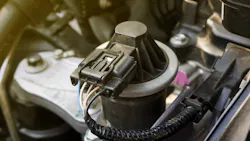
Today, EGR valves are electronically controlled (EEGR) and include position feedback. They no longer rely solely on vacuum; the ECM typically commands the valve directly using duty cycle or stepper motor control. The valve reports its position back to the ECM, allowing for closed-loop control. The ECM will know what it has commanded, and the ECM will know what the valve did. But the ECM needs to determine if the correct amount of exhaust gas actually flowed back into the intake, because most of the time, EGR flow isn't directly measured by the vehicle.
When the EGR valve is commanded open, exhaust gas is going to enter the intake stream, which displaces some of the incoming fresh air. The result is a measurable change in engine operating conditions. Many modern electronic EGR systems use feedback from the manifold absolute pressure (MAP) sensor to monitor EGR flow into the system. Intake manifold pressure is higher when EGR is flowing than when it isn't. Therefore, when exhaust gas is circulated into the intake manifold, MAP sensor readings increase. The detection of EGR flow occurs by monitoring this increase in pressure. If the difference in pressure between EGR command on and off is below a minimum threshold, then a concern with the EGR valve has occurred.
EGR, OBD Readiness, and a Diagnostic Approach
EGR plays a direct role in OBD readiness monitors and emissions testing—particularly the EGR monitor itself. Drive cycles and strategy vary by manufacturer, but in general, to complete the monitor, the ECM must:
- Command EGR operation when conditions are met.
- Observe the expected change in airflow or combustion response.
- Verify that the system reacted, and did so within calibrated limits.
If those markers aren't hit, the monitor won't complete. While the EGR monitor with most manufacturers is fairly straightforward to reset, some manufacturers, such as Toyota, can be finicky and require involved drive cycles to get the I/M monitors to reset.
Think Past Code-based Diagnostics
To effectively diagnose modern EEGR systems, the technician is best to think past code-based diagnostics and focus more on system behavior. Start by confirming not only circuit integrity and that the valve is responding, but that the ECM is commanding EGR under the right conditions. Remember the old saying “garbage in, garbage out.” By reviewing system inputs in service information and then viewing live data—ideally in the conditions where EGR will be commanded—the technician can quickly gain a clear picture of whether the system has based its strategy on accurate information. Next, by understanding how the system monitors flow for that vehicle, the tech can verify things like: When EGR is introduced, how does MAP react? How does the MAF respond? Use bidirectional controls to observe these PIDs, and use your senses to verify that commanding the EGR open at idle produces a rough idle, a stumble, or even a stall. If there's little change with a fully commanded EGR at idle, the system is probably not flowing as expected.
Remember, because EGR monitoring is model-based, anything affecting airflow can influence diagnostics—things like dirty or biased MAF sensors, intake restrictions, vacuum leaks, and exhaust restrictions. A skewed input can lead to a skewed conclusion. Garbage in, garbage out.
EGR Leaves the Chat … Kind Of
Variable valve timing has added another layer to EGR strategy. By adjusting valve overlap, engines can retain a portion of exhaust gases in the cylinder, creating an internal EGR effect. Common engine families, such as later-generation GM LS/LT variants, were able to do away with EGR valves altogether. You've probably noticed the shift in the OBD II non-continuous monitors from simply “EGR” listed to “EGR and/or VVT” listed; that's exactly why.
“Internal EGR,” or using VVT to control NOx emissions in modern engines, allows for faster, more precise, and more efficient control over internal gas retention. Traditional EGR uses external valving and plumbing that can clog and react slowly. VVT manages NOx by optimizing valve overlap to retain exhaust gas.
Even without VVT, some manufacturers circumvented the need for an external EGR system. Starting halfway through the 2004 model year, the 5.9-liter Cummins found in the 2500 and 3500 series Dodge trucks underwent a “refresh” to meet stricter emissions standards. The 2004.5 trucks had several changes, but most notable for this story were the change in cam profile, the addition of a catalytic converter, and injector event timing changes that allowed the truck to be 50-state legal without the use of an external EGR valve on the pickups (many medium-duty trucks retained a traditional external valve). Though the sum of the changes increased the power output of these engines north of 600 lb.-ft. of torque, many owners complained of fuel mileage reduction, a loss of idle quality, and significantly dirtier engine oil.
Turning Down the Pressure
Low-pressure EGR has become an increasingly popular addition to NOx mitigation strategy for some vehicle manufacturers. While traditional “high-pressure” systems pull exhaust gas directly from, or relatively close to, the exhaust manifold to recirculate back into the intake stream, low-pressure systems—which are becoming popular, especially with diesel applications—draw exhaust gas after the aftertreatment system, downstream of the diesel particulate filter, and route it back into the intake.
This approach offers several advantages: cleaner exhaust gas with less soot, improved durability of EGR components, better control under high-load conditions, and enhanced compatibility with turbocharging. But low-pressure EGR isn't without its challenges. The nature of what it is introduces complexity. You have longer routing paths, additional valves and coolers, and lower pressure differentials. All of this makes them more sensitive to restrictions, leaks, and cooler efficiency issues. And these, too, rely on modeled airflow rather than direct measurement.
Speaking of Diesel
EGR has been a hot topic with diesel owners for a couple of decades now. In the early 2000s, truck manufacturers were tasked with hitting more stringent emissions standards. While some NOx mitigation strategies—such as the addition of intercoolers to turbocharged applications—were popular because of their performance enhancements, others, like EGR and EGR coolers, weren't.
Exhaust gas entering a combustion chamber has a couple of effects: it reduces available O₂ in the cylinder, and it reduces combustion temperature. That reduced combustion temperature leads to a lower combustion rate and higher heat capacity. Simply put, EGR makes the diesel burn slower. A diesel combustion event almost always has significantly more oxygen than it needs for combustion, so when the diesel molecules are introduced into the combustion chamber, all that oxygen ensures that combustion happens quickly, and that intense combustion event leads to very high combustion temperatures. So if you introduce inert exhaust gas into the cylinder, you reduce the available oxygen. If you reduce the available oxygen, you reduce the combustion temperature because the diesel burns more slowly, and if you do that, you reduce the creation of NOx emissions. Where some of the unpopularity comes in: lower combustion temperatures also equate to lower power output and lower efficiency.
The Case Some Owners Make to Delete
There are also other arguments that some diesel owners will use to justify deleting EGR valving and coolers, such as that it increases soot production and reduces engine life. And while EGR on a diesel engine will absolutely increase soot production—and when you mix that soot with oily crankcase vapors, it can create an absolutely unholy buildup that can lower performance and damage variable-geometry turbochargers—EGR itself, through numerous studies, hasn't been shown to significantly increase wear in diesel engines under normal driving conditions. While many parts of the country don't actively enforce emissions regulations, tampering with emissions components can land shop owners, management, and technicians in significant trouble. As a technician who worked in the performance industry, I encourage others to research their exposure to liability when performing modifications on behalf of their employer, so at least they're informed of what their potential personal culpability could be before they go and break federal law.
In the End
EGR is no longer just a simple emissions add-on; it's a fully integrated strategy that touches nearly every aspect of modern engine operation. From early vacuum-operated valves to today's electronically controlled and even “internal” EGR through VVT or camshaft profile, the goal remains the same: control combustion temperatures and manage NOx while limiting effects on performance or efficiency as much as possible. For technicians, that evolution means diagnostics must evolve as well. Understanding how the ECM commands, models, and verifies EGR flow, along with how other systems influence it, is critical to making accurate, efficient repairs. Whether it's a traditional valve, a cam-driven internal strategy, or a low-pressure setup, the goal remains the same. And while EGR may look different than it used to, its impact on engine performance, emissions, and diagnostics has never been greater.
About the Author
 Erik Screeden
Erik Screeden
Technical and Multimedia Content Director
Erik Screeden is the Technical and Multimedia Content Director for the Vehicle Service & Repair Group. Erik is an ASE Master Automobile Technician with L1, and L4 credentials, who has been in the industry for over 25 years in various capacities. During that time, Screeden was a technician. He started out at a Ford dealership and continued to several independent repair facilities as well as spent time in the specialty aftermarket at a GM-specific performance shop. After his time as a technician came to an end, Screeden transitioned into a role providing scan diagnostic and J2534 tool support. He was then able to parlay his experience as a technician and a support specialist and use that in several technical sales roles.
Don't miss any of Screeden's video content sign up for Autoplay.