EV Thermal Management: The Hidden System Driving EV Range, Performance, and Comfort
Key Highlights
- Thermal management is vital for EV battery performance, safety, and longevity, especially in extreme climates.
- Liquid cooling systems, while effective, face challenges such as coolant leaks, corrosion, and clogging, requiring regular maintenance and proper coolant selection.
- Advancements like heat pumps, low-E glass, and insulation materials help improve cabin comfort and extend vehicle range in cold weather.
- Proper thermal regulation prevents issues like thermal runaway and ensures safe operation during fast charging and prolonged use.
- Ongoing innovation in cooling and insulation technologies is essential for the widespread adoption and reliability of electric vehicles.
The electric vehicle market has advanced over the last 15-plus years in America, and the older systems have changed. Many more efficient technologies have found their way into newer designs. I live in Central Massachusetts, and it was a very frigid winter. ACDC, our EV technical training center, added a heat pump system to our 4,000-square-foot training lab a few years ago. The heat pump company that installed the system had only worked on homes. The system could not keep up with last winter’s arctic weather. I learned a lot about heat pumps for buildings, and some of that knowledge can transfer to vehicles, so there is more work to do and lessons to learn.
ACDC started teaching heat pump systems in 2013 when Nissan added a heat pump to the Leaf. Since then, that technology for heating the cabin has come a long way. Humans like to warm up on cool days and cool down on hot days. A high-voltage pack is organic. It is a lot like us.
Vehicle performance and range are the main qualities that continue to drive reinvention. Many technologies compete for development dollars, but few components surpass the battery in importance, with cabin heating in the second spot.
Humans like to warm up on cool days and cool down on hot days. A high-voltage pack is organic.
Keeping an EV’s battery cool is necessary for performance and longevity. This technology has continued to evolve alongside the other sophisticated technologies present in modern electric vehicles. We’ll discuss the importance of thermal management in EV batteries, how it's currently designed, the limitations of each method, and solutions being developed.
Why Do Electric Vehicle Batteries Require Thermal Management?
We know that all batteries lose their ability to do work when they are outside in the cold, and electronics don’t like heat. All batteries perform best when they are not subjected to extreme temperatures. The temperature most batteries require for optimal performance is between 65 F and 80 F. It may seem surprising that the optimal temperature for an advanced electric vehicle battery exists within such a narrow range. Considering how temperatures can vary from one season to the next, it’s tempting to question why anyone would use an electric vehicle in all but the most temperate climates. Fortunately, onboard thermal management systems are used to control EV battery temperatures, thus improving performance and lifespan.
Battery Safety and Thermal Runaway
TMS in electric vehicles doesn’t just help lessen the effects of a hot or cold day on the vehicle’s battery; they also play a key role in managing the elevated temperatures generated by the batteries themselves. Lithium-ion cells become unstable and can catch fire when internal cell temperatures exceed 140 F to 190 F Some lithium-ion chemistries can go as high as 194 degrees Fahrenheit. Once ignited, these cells can reach extreme temperatures, often between 2,000 F and 5,000 F Scary stuff.
An EV battery needs to keep cell temperatures below 140 F to 280 F. You have all heard the term “thermal runaway,” a condition in which a battery’s lithium-ion cell enters an uncontrollable self-heating cycle.
Fast Charging Creates Heat
Plugging into a fast-charging station will also heat the battery to a point where the thermal management system will need to intervene. The high current generates a considerable amount of heat that needs to be removed from the battery pack to avoid overheating. Thermal management isn’t just about dissipating heat; depending on the time of year, there may be times when an EV’s battery must be warmed up before it can be charged quickly.
EV Battery Thermal Management Is Evolving
Thermal management processes, like anything else, are not perfect. Like any other system within an electric vehicle, thermal management is not without its challenges.
Coolant Leaks and Aging Components
If the TMS uses liquid cooling to keep the battery at the optimal temperature, there is a chance that the liquid coolant can leak as the connections and battery age. While a small coolant leak sounds like a minor issue, if left unchecked, leaked coolant can degrade the battery to the point where its performance and lifespan are greatly reduced.
Corrosion, Clogging, and Coolant Selection
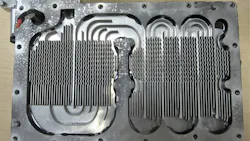
Corrosion and clogging are two more challenges of a liquid-cooled system. Where liquid glycol is present, as it gets older, it can begin to corrode the cold plates, which are responsible for the transfer of heat from the cells to the coolant. Replacing the glycol as part of the regular maintenance of the vehicle will prevent this from happening.
Clogging the many narrow tubes and connections that transport the coolant is another challenge that could reduce the performance of the battery. It’s therefore important to choose the right coolant for the system and to change it regularly.
For example, pure water as a coolant works well because its use minimizes corrosion, and it has a high heat capacity and thermal conductivity. Deionized water, on the other hand, removes harmful minerals and salts that could build up, narrowing the many channels, but has higher resistivity than pure water.
Coolant resistivity measures its ability to resist electrical current, with high resistivity indicating pure, nonconductive coolant that protects against electrolysis and corrosion. As corrosion inhibitors deplete and contaminants increase, resistivity drops, and conductivity rises, indicating the need for replacement, particularly in electric vehicles. The higher the resistivity, the greater the likelihood of corrosion.
Dielectric fluids like perfluorinated carbons—perfluorinated compounds are highly stable, water- and oil-repellent chemicals featuring carbon-fluorine bonds—and polyalphaolefin, a synthetic hydrocarbon base oil, can also be used to cool an EV’s battery, both of which offer several benefits over the other coolant types. Use OEM coolants when servicing EVs.
Climate Challenges and Battery Self-Regulation
The climate surrounding the vehicle is another obvious challenge that must be mitigated by the vehicle’s TMS. Depending on where the operator lives, the vehicle may be exposed to extreme heat or cold when it is not running. In these conditions, keeping the vehicle plugged into the grid is the best path to follow.
When that cannot be done, the HV pack will consume its own energy to self-regulate cell temperature. Tesla will send a text message to alert you to plug in your car if the pack is getting low in cold climates.
Aging Batteries Generate More Heat
Lastly, the age of the battery itself is a challenge to the thermal management system. The older the battery, the more energy is lost as heat. The system must be able to deal with this excess heat as the battery nears the end of its life.
Keeping EV Batteries Cool
So, how are EV batteries kept cool? We briefly referenced a liquid-cooled system above, but liquid is by no means the only—or even the best—method to keep an EV’s battery within the acceptable temperature range. Some of these methods are discussed below.
Air Cooling Systems
First, there are air-cooling systems, like the early hybrids. Air cooling worked OK, but Ford went with a sealed pack that was air-conditioned in model year 2005. Later on, Ford used cabin air.
Depending on whether the battery needs to be warmed or cooled, warm or cool air is passed through the battery. In some air-cooled systems, cabin air is circulated from the vehicle’s interior to the battery pack, warming or cooling the battery as necessary.
While this does sound like a novel and straightforward way to keep the battery’s temperature within an optimal range, it isn’t the most efficient option.
Liquid Cooling Systems
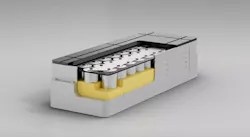
Liquid cooling systems rely on a series of channels to deliver liquid coolant in and around the battery packs in order to wick excess heat from the system.
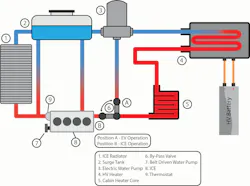
Active liquid cooling uses pumps to circulate the coolant and fans and other devices to extract or redirect the heat. The glycol or water coolant does not come into direct contact with the cells.
It should be noted that while other systems within a vehicle may also require cooling, EV battery packs are cooled separately since the battery’s temperature must be kept much lower relative to the other systems. Keeping the cooling systems separate ensures the coolant responsible for managing the temperature of the EV battery is kept as cool as possible.
Thermal Management Is the Key to EV Adoption
A battery that is too warm or too cold will negatively affect performance. Since EVs are expected to operate in all types of climates, the continued refinement of thermal management processes is vitally important to the growth of the EV market.
If electric vehicles are truly destined to surpass traditional combustion-engine vehicles, all EV technologies—thermal management included—must continue to evolve.
Heating the Cabin
A lot has been written about heat pumps, but less about insulating the cabin. It can keep the inside warmer in winter and improve range. Some DIYers have tried to insulate their EVs.
Low-E Glass and Interior Insulation
Some OEMs have played with removable interior polycarbonate panels. Others opt for low-E (low-emissivity) glass. This is a type of energy-efficient glazing coated with a microscopically thin, transparent metal or metal oxide layer used on windows.
It acts as a thermal filter, reflecting heat back to its source. This keeps interiors cool in summer and warm in winter while allowing natural light to enter. This reduces heat gain and loss by improving thermal insulation.
The transparent coating is 500 times thinner than a human hair, keeping the glass nearly colorless and clear. A “hard coat” is fused to the glass during production. A “soft coat” is applied in a vacuum chamber and is more effective. It is much more effective in double- or triple-pane insulated glass units (IGUs).
Low-E glass is widely used in residential and commercial windows to improve insulation and reduce reliance on heating and cooling systems.
It is possible for Teslas to be retrofitted with this type of glass roof. Using heated seats and steering wheels is more energy-efficient than heating the entire cabin, but you can do more. If you have an EVSE at home or work, you can pre-warm the car’s interior and battery while it is still plugged into the grid.
Why Insulate an EV?
Insulation and in-cabin modifications help retain heat, allowing for comfortable temperatures with less energy consumption.
In Worcester, Massachusetts, my hometown, a company called Talbert Trading, managed by Bob Mantyla, made shoddy. Bob gave me a tour to see how it was made. Two large French-made 60-foot machines started with a hopper. Donated used clothing that did not sell was dropped in the hopper, and out the other end came an under-carpet felt mat commonly referred to as shoddy felt.
It’s used for sound insulation and padding under the car’s carpeting. This was then shipped to the OEMs in Michigan in large rolls, three feet in diameter. That was in the ’80s.
Today, that same concept is making its way into the cabin, but not just under the carpet. Everything that gets cold and is made of metal will be insulated. The firewall, roof, doors, under the rear seat—you name it.
Real-World Testing and Future Implications
A few years ago, at the SAE Congress in Detroit, Michigan, I had a chance to stop at a trade show booth that was offering a dense, shoddy-type material. It was more high-tech and a bit pricey. They had some statistics that made the case to use it.
Once you preheat the cabin while plugged into the grid, you can drive up to 20 miles before you need to turn on the heat. They did their own testing, but the concept is sound.
I have yet to see it in production cars, but every bit of energy used in freezing weather will reduce range.
If they go there, I sure hope they consider us, the repair techs. As the recent war in Iran has taught all of us, EVs make sense in many ways. Gas is expensive, and electricity is not.
Do not pass on the training you may need by staying away from high-voltage systems. It is your present job when the owner writes up an RO on an EV with your name on it.
About the Author
 Craig Van Batenburg
Craig Van Batenburg
Craig Van Batenburg is the CEO of ACDC, a hybrid and plug-in training company based in Worcester, Mass. ACDC has been offering high voltage classes since 2000, when the Honda Insight came to the USA. When EVs were introduced in 2011, ACDC added them to their classes. Reach Craig via email at [email protected] or call him at (508) 826-4546. Find ACDC at www.FIXHYBRID.com.