World Class Wednesday: Marc Wischkaemper: Welding and Fabrication for Fun
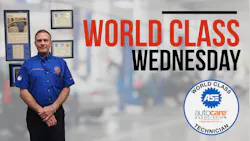
Earning the title of Automotive Service Excellence World Class Technician is no small accomplishment. To be recognized as World Class, these individuals have obtained ASE certification in 22 specialty areas: A1-A8 (automotive), T1-T8 (medium/heavy truck), B2-B5 (collision repair), and L1-L2 (advanced).
Not only is achieving certification in these areas impressive, but becoming World Class is no small feat. As of 2025, only 2,000 technicians have achieved World Class status.
In this Q&A, Motor Age sat down with Marc Wischkaemper— an ASE World Class technician and instructor at South Plains College in Levelland, Texas — to learn more about his journey in the automotive industry and how gaining World Class status has helped advance his career.
Motor Age: Please introduce yourself and tell us about your experience in the automotive industry.
Wischkaemper: I have over 44 years of hands-on experience in the automotive industry. Specializing in European vehicles, my career has spanned an impressive range—from industrial equipment like forklifts to high-end brands such as Maserati.
In 2024, at age 57, I earned the prestigious ASE World Class Technician designation, demonstrating a continued commitment to excellence and lifelong learning in a rapidly evolving field.
Motor Age: What’s the most memorable repair you’ve ever completed?
Wischkaemper: One of the most memorable repairs involved a 2013 Mercedes-Benz E350 Bluetec diesel that had been deemed non-repairable by two separate dealerships. The vehicle suffered from severe electrical communication failures caused by water intrusion due to clogged sunroof drains, which flooded the interior and compromised multiple systems.
After nearly a month of in-depth diagnostics, my engine performance class and I traced the issue to corrosion in a CAN Bus connector. This single point of failure was shutting down the entire network. What had been written off as a total loss was ultimately repaired with a $10.75 connector.
That experience reinforced a critical lesson I emphasize to students: accurate diagnostics—not parts replacement—is what defines a true technician.
Motor Age: Tell us one thing about you that we can't guess from your certifications.
Wischkaemper: In recent years, I’ve returned to a skill I hadn’t used extensively in a long time—welding and fabrication. This has allowed me to build and modify components that are obsolete or difficult to source. Being able to fabricate solutions when parts are no longer available adds another layer of capability, especially when working on older or specialty vehicles.
Motor Age: What automotive technology trend are you most excited about/ most concerned about?
Wischkaemper: I’m most excited about the advancement of diagnostic techniques, particularly the increasing use of oscilloscopes in automotive troubleshooting. The ability to analyze real-time electrical patterns and waveform data provides a level of precision that traditional methods simply can’t match.
At the same time, my biggest concern is that technology is advancing faster than the industry can effectively train technicians. The tools and systems are becoming more complex, but the pipeline for properly trained individuals is struggling to keep pace. Bridging that gap is one of the biggest challenges facing the industry today.
Motor Age: How has ASE certification helped advance your career?
Wischkaemper: ASE certification played a significant role in advancing my career. It not only helped me qualify for my current position, but it also translated directly into academic credit toward my associate degree in the areas where I was certified.
Beyond that, ASE certification represents a standardized benchmark of knowledge and professionalism. It demonstrates both competence and commitment—qualities that are essential in today’s automotive industry.
About the Author
 Emily Kline
Emily Kline
Emily Kline is a Special Projects Editor for FenderBender and ABRN, ABW, Motor Age, and Ratchet+Wrench. She also produces an annual publication for SATA called Painter's Playbook, is a Senior Contributing Editor for NAPA INSIGHT, and oversees Ratchet+Wrench's Shop Goods issues and FenderBender's Ultimate Collision Repair Shop.
She has worked in the Vehicle Service & Repair Group at Endeavor Business Media for over 3 years, learning about vehicle repair and the automotive industry as a whole. She has a bachelor's degree in English from Saint Mary's University of Minnesota in Winona. As a writer, she enjoys her fair share of reading and has no shame in using the long Minnesota winters as an excuse to stay indoors and cozy up with a good book.