World Class Wednesday: Karl Koenigstein: The "Little Things" with OEM Components
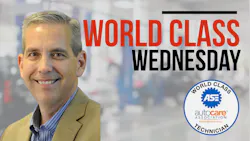
Earning the title of Automotive Service Excellence (ASE) World-Class Technician is no small accomplishment. To be recognized as World-Class, these individuals have obtained ASE certification in 22 specialty areas: A1-A8 (automotive), T1-T8 (medium/heavy truck), B2-B5 (collision repair), and L1-L2 (advanced).
Not only is achieving certification in these areas impressive, becoming World-Class is no small feat. As of 2025, only 2,000 technicians have achieved World Class status.
In this Q&A, Motor Age sat down with Karl Koenigstein — an ASE World Class Technician at K2 Tire & Automotive Analysis LLC in Piedmont, South Carolina — to learn more about his journey in the automotive industry and how gaining World-Class status has helped advance his career.
Motor Age: Please introduce yourself and tell us about your experience in the automotive industry.
Koenigstein: I spent over 32 years in the automotive industry with Michelin Tire, specializing in automotive and light truck tire design and testing. I have worked on everything from passenger cars and pickup trucks to a drag racing test vehicle, to a stint in Formula 1 tire testing. I achieved ASE World Class status at age 57 in February 2024.
Motor Age: What's the most memorable repair you've ever completed?
Koenigstein: I had a very confusing noise crop up on my wife’s Toyota Highlander. We were driving from South Carolina to Florida to visit my family. At a stop for fuel and lunch, I noticed a metallic clanking noise coming from the undercarriage right when the car would come to a complete stop.
After checking the car for any major issues — loose wheel nuts, suspension bolts, steering rack, etc. — I determined it was safe to continue. After returning from the trip, I set about trying to diagnose the noise. It was very tricky. It didn’t make the noise every time. It seemed to matter how hard you stopped, whether the car was level, going uphill, or going downhill when it stopped.
After numerous test drives and inspections, and standing outside the car while others drove it, I became convinced the noise had to be linked to the brake system somehow, but I couldn’t imagine what it could be.
Finally, noticing that the noise always correlated with the front end of the car rising back up after having dived during the stop provided the key clue. Disassembly of the calipers and pads found the smoking gun evidence of witness marks – the backing plate to which the brake pads were bonded had just a little bit — we’re talking a couple of millimeters — of excess clearance compared to the caliper and shims in which the pads were installed.
During the stop, the torque of the rotors pushed the pads all the way to one side of the caliper, taking up all the clearance in that direction. Sometimes, when the car rocked back at the conclusion of the stop, the rotors “pulled” the pads back the other direction and caused them to clank in the caliper.
These were not cheap pads; they were a very well-known brand name whose products I’ve used with good success on several other cars. However, this set was a little undersized. A set of pads from the Toyota dealer fit like an absolute glove and highlighted to me how sometimes, the extra engineering found in true OEM components can provide a superior experience, even if other components are perfectly functional.
Motor Age: Tell us one thing about you that we can't guess from your certifications.
Koenigstein: I have a bachelor’s degree in mechanical engineering, and I really enjoy understanding both the theory of how mechanical systems are designed to work and seeing firsthand how they actually work and how they fail, and thinking about how they can be improved.
Motor Age: What automotive technology trend are you most excited about/ most concerned about?
Koenigstein: I am simultaneously excited and concerned about the exact same trend: the tendency of automobiles to become more rolling networks of computers. On the upside, this brings us features and comforts that would have been unimaginable just a generation ago, as well as the possibility to “fix the hardware with the software” in the diagnostics and repair area.
On the downside, I worry that the parts-department complexity associated with each car having a multitude of VIN-customized computer modules will become unsustainable, and this could lead to vehicles being condemned relatively early in life. Reversing a multi-decade trend of cars lasting longer and longer. However, it does perhaps raise the opportunity for flexible aftermarket modules that can be configured to work with the OEM networks, as the automotive audiovisual / car stereo area has shown.
Motor Age: How has ASE certification helped advance your career?
Koenigstein: It lends some additional credibility to my own consulting business, and to me personally, when I work with technicians on the shop floor or in the classroom.
About the Author
 Emily Kline
Emily Kline
Emily Kline is a Special Projects Editor for FenderBender and ABRN, ABW, Motor Age, and Ratchet+Wrench. She also produces an annual publication for SATA called Painter's Playbook, is a Senior Contributing Editor for NAPA INSIGHT, and oversees Ratchet+Wrench's Shop Goods issues and FenderBender's Ultimate Collision Repair Shop.
She has worked in the Vehicle Service & Repair Group at Endeavor Business Media for over 3 years, learning about vehicle repair and the automotive industry as a whole. She has a bachelor's degree in English from Saint Mary's University of Minnesota in Winona. As a writer, she enjoys her fair share of reading and has no shame in using the long Minnesota winters as an excuse to stay indoors and cozy up with a good book.