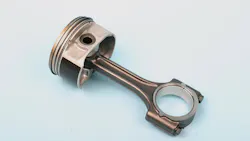
It's commonplace today for OE manufacturers to use connecting rods of the powdered metal type. For example, all of the factory GM LS-platform engines feature PM rods, with the exception of the LS7 and LS9, which feature forged titanium rods.
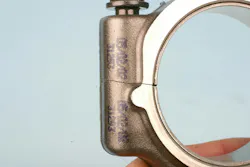
Powder metal rods, also referred to as "fractured cap" or "cracked cap" rods, differ in design and construction compared to cast or forged rods. Powdered metal rods are "pressure cast," with a specially-formulated metal powder that's placed into a mold, then heated to a melting point, and pressurized. Once out of the mold, the small and big ends are honed to size, and rod bolt threads are cut. The rod is then secured in a fixture at the rod’s big end and cap parting line area, and the cap is then snapped off, with no loss of material. The result is a fractured parting line on both the rod and cap. While this process may at first seem a bit crude, it creates a precise mating surface interlock. The cap fits the rod precisely (mirror image surfaces) for perfect cap-to-rod alignment. This mating design means each cap must always remain with its original rod. While a PM rod big-end bore can be slightly oversize, honed, and mated with oversize O.D. bearings, these rods cannot be resized in the traditional manner (where mating surfaces are ground flat to create a smaller, non-round bore, and then honed round again). Care must be taken when handling PM rods so as not to damage the irregular mating surfaces.
Why OEs Prefer Powder Forgings
The OEs are using powder forgings for a number of reasons. Tighter tolerances can be maintained in both dimension and weight, and the use of a powder forging process makes connecting rods, which are easier to machine, require less stock material, and the process eliminates as many as six machining operations. According to MascoTech, a primary manufacturer of these rods for the OEs, the increased machinability of powder forging has reduced tooling per unit cost from about 22 cents to about 4 cents.
Design Advantages of Powder Metal Forging
- Even distribution of stress over the entire side of the I-beam area
- Increased I-beam rigidity (100% increase in stiffness over conventional forged)
- Improved noise/vibration/harshness level, which improves piston and ring action
- No bore offset between rod and cap
- Increased bore stiffness and geometry
- Increased bearing reliability
- Reduced weight
- Crankshaft mass reduction
- Single weight grade (±2 g on 400g rod)
- Reduced mass variation for improved balance
- Full density across the entire rod
- Lower-cost carbon steel
- Proven fracture split method (no crank bore elongation during cracking)
- High machinability
Reconditioning PM Rods
A major concern when trying to recondition cracked cap rods in the traditional manner relates to the irregular mating surfaces of the rod and cap. When these rods are manufactured, they're formed as a single piece. The caps are then separated by fracturing the cap from the rod, which leaves an irregular (and unique) mating surface. This irregular surface provides an accurate location of the cap to the rod, preventing any misalignment of the cap during assembly.
However, if the mating surfaces are machined or ground flat to reduce the rod's large end bore in preparation for re-honing to size, you lose all centering ability. As described earlier, this would destroy the unique cap-to-rod interlock that was created when the cap was broken away from the rest of the rod during manufacturing. Since no interlock mating remains, and since there are no positioning tangs to use, this makes it possible to install the cap slightly off-center, due to the small tolerance range of the bolts to the cap's bolt holes. As a result, the cap might then be installed off-center left-to-right (laterally), or at an angle relative to the axis of the large end bore. If only for this reason, it is not advisable to reface the rod and cap mating surfaces.
The other reason that an attempt to resize these rods can create a problem is due to the relatively thin cap material. Once the mating surfaces are ground flat, the new, smaller and non-round large end bore may require so much enlargement to create a round hole that the cap material may be reduced enough to create a potential weak area. We need to note that in the process of creating flat mating surfaces, it may be necessary to reduce the mating surfaces by as much as .040" or more, which could result in a combined reduction of the hole by as much as .080" or more. Precious little cap material may be left after resizing in this instance.
The Best Approach to Resizing
The best approach, if resizing is necessary, is to avoid disturbing the irregular, cracked mating surfaces altogether. Instead, hone the big end to an oversize that will accommodate the fitting of oversized-O.D. rod bearings. Unfortunately, these oversized bearings are not yet available for all cracked cap applications, so check with your bearing suppliers before committing to this. If available, though, bearings may be obtained that feature a standard size I.D. and a .010" larger O.D.; or an undersized I.D. (to accommodate an undersized ground crank) and an oversized O.D. to accommodate an enlarged connecting rod big end.
About the Author
 Mike Mavrigian
Mike Mavrigian
Motor Age Editor
Mike Mavrigian has written thousands of automotive technical magazine articles involving a variety of specialties, from engine building to wheel alignment, and has authored more than a dozen books that crisscross the automotive spectrum. Mike operates Birchwood Automotive, an Ohio shop that builds custom engines and performs vintage vehicle restorations. The shop also features a professional photo studio to document projects and to create images for articles and books.