The History of Presidential Automobiles
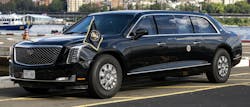
The evolution of the United States presidential vehicle is a narrative that parallels the rise of the American century. What began as a novel experiment with early horseless carriages at the dawn of the 1900s has transformed into a mobile, hermetically sealed fortress. This isn't just a chronicle of automotive advancement; it represents the shifting balance between a leader’s desire for public visibility and the rigorous, modern standards of the U.S. Secret Service.
The Age of the Horseless Carriage (1901-1907)
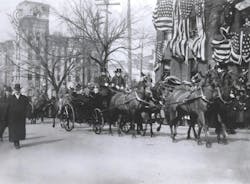
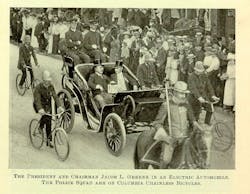
The transition from horse-drawn carriages to motorized transport was fraught with skepticism. At the turn of the 20th century, the automobile was an unreliable "horseless carriage," often viewed as a toy for the wealthy. The honor of the first sitting president to ride in a motor vehicle belongs to William McKinley, who in 1901 accepted a ride in an early motorized carriage. Theodore Roosevelt, who assumed the presidency following McKinley’s assassination, was an equestrian who embodied the "Rough Rider" image, yet he understood the power of modern symbolism. On August 22, 1902, Roosevelt became the first president to participate in an official public procession via automobile, riding in a Columbia Electric Victoria Phaeton. Despite the public pageantry, Roosevelt remained privately skeptical, once describing motor cars as “distinct additions to the discomfort of living.” Nevertheless, by 1907, the Secret Service purchased its first vehicle—a White Motor Company steam car—to follow Roosevelt’s horse-drawn carriage, establishing the precedent for motorized security.
Institutionalizing the Fleet (1909-1921)
The true institutionalization of the automobile occurred under William Howard Taft. Unlike his predecessor, Taft was a dedicated enthusiast. Upon taking office in 1909, he secured a $12,000 appropriation from Congress to purchase the first official fleet of White House motor cars and ordered the immediate conversion of the White House stables into a modern garage. Taft’s initial fleet included a White Motor Company steam car, two Pierce-Arrow limousines, and a Baker Electric. The White Steamer became Taft’s preferred vehicle; he reportedly enjoyed instructing his chauffeur to reach high speeds on Washington’s unpaved streets. In a tactical maneuver that foreshadowed modern security evasion, Taft would occasionally have his chauffeur release a cloud of steam to obscure the vision of persistent reporters.
Woodrow Wilson continued the expansion of the fleet, becoming so vocal a proponent of the industry that he joined the American Automobile Association (AAA), sporting their emblem on his radiator. Wilson was also the first president to own a private automobile that had served in the official fleet, receiving his 1919 Pierce-Arrow as a gift upon leaving office. The 1921 inauguration of Warren G. Harding marked the final transition into the modern era. Harding was the first president to ride to his inauguration in an automobile—a Packard Twin-Six. More importantly, Harding was an avid driver, a skill he frequently utilized during "auto-camping" trips with friends like Henry Ford and Thomas Edison.
The Dawn of Armor and Protection (1933-1950s)
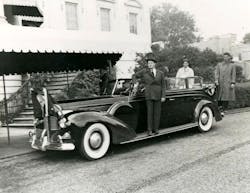
The presidency of Franklin D. Roosevelt redefined the presidential vehicle from a luxury conveyance to a platform for survival. Following an assassination attempt in 1933, the Secret Service moved away from stock models. In 1939, the Lincoln K-Series, famously dubbed the "Sunshine Special," became one of the first state cars built to explicit Secret Service specifications. Originally configured as an open car for parades, it was later returned to the factory during World War II for the addition of armored doors, bullet-resistant tires, and one-inch-thick bulletproof glass. In the immediate aftermath of the attack on Pearl Harbor in December 1941, the Secret Service even utilized a heavily armored 1928 Cadillac that had been seized from the gangster Al Capone as a temporary presidential vehicle while more permanent upgrades were underway.
The Truman and Eisenhower years were characterized by a tension between security and the political necessity of being seen. Dwight D. Eisenhower introduced the "Bubbletop" in 1954—a clear Plexiglas canopy fitted over his Lincoln Cosmopolitan—allowing the public to see him even in rainy weather. While it offered no ballistic protection, it solved the political problem of presidential invisibility. As postwar automotive engineering advanced, presidential limousines increasingly adopted powerful V-8 engines and improved suspensions, reflecting a defensive philosophy in which raw power and speed were seen as tools to outrun an assailant.
The Mobile Fortress and Modern Security (1963-Present)
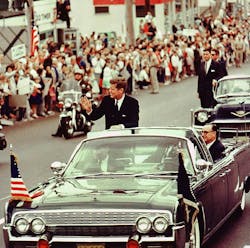
The 1961 Lincoln Continental, designated SS-100-X, remains the most analyzed vehicle in presidential history. The assassination of John F. Kennedy on November 22, 1963, shattered the philosophy of open-air travel. In the aftermath, the car underwent a radical reconstruction known as the "Quick Fix," stripped to its frame and rebuilt with titanium armor and permanent bulletproof glass. This rebuilt car served four more presidents, representing a grim but necessary evolution into the era of the mobile fortress.
The Beast (Today)
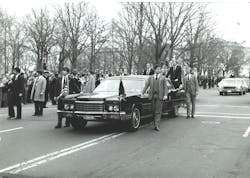
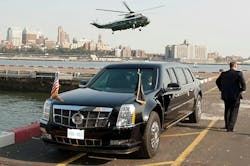
Today’s state car, nicknamed "The Beast," represents the pinnacle of protection engineering. While specific details remain classified, it is known to weigh well over 15,000 pounds. It is a masterpiece of redundancy, carrying its own firefighting equipment, oxygen supply, and a refrigerator containing the president’s blood type. The most significant change in modern motoring is the total prohibition of driving for the president and vice president on public roads. This is a rigid protocol enforced by the Secret Service for security and continuity of government. While presidents like Ronald Reagan and George W. Bush found solace in driving on their private ranches, and Joe Biden famously prizes his 1967 Corvette Stingray, they are rarely allowed behind the wheel on public roads.
About the Author
 Noah Nelson
Noah Nelson
Technical Editor | Motor Age
Noah Nelson is the Technical Editor for Motor Age Magazine. As an ASE Master Certified Automotive Technician (A1–A9) with 25 years of hands-on industry experience, Noah specializes in advanced electrical systems, vehicle communication networks, and physics-based diagnostic workflows. He is currently documenting his pursuit of the prestigious ASE/AutoCare Association World Class Technician registry.